The Reclining Nude

The reclining female nude may strike modern viewers as a cliché, yet in the Western tradition it emerged as one of the Renaissance’s most radical pictorial inventions. In the early sixteenth century it crystallized into a distinct genre in which the female body became the central subject of painting—displayed full‑length, arranged in a state of relaxed repose, and framed so that hands and feet remain elegantly contained within the canvas. Whether meeting the viewer’s gaze or lying in a profound sleep, these figures cultivate an intimacy that borders on voyeurism. The genre’s first fully realized expression appears in the work of Giorgio Barbarelli da Castelfranco (1470–1510), known as Giorgione, whose Sleeping Venus (1510) is widely regarded as the earliest modern painting to present the nude female figure as the sole protagonist of the composition. Although Gardner’s Art Through the Ages, the definitive survey text for art history, acknowledges Giorgione’s Sleeping Venus only briefly—mentioning it as an earlier prototype for Titian’s Venus of Urbino 24 years later it provides no image of Giorgione’s work and instead illustrates the later Titian. This omission obscures the originality and significance of Giorgione’s conception: its serene fusion of idealized beauty, sensual presence, and poetic stillness. In The Sleeping Venus, the reclining nude becomes not merely a motif but a new visual paradigm, one that would shape European art for centuries. The influence of Giorgione’s invention was immediate and far‑reaching.
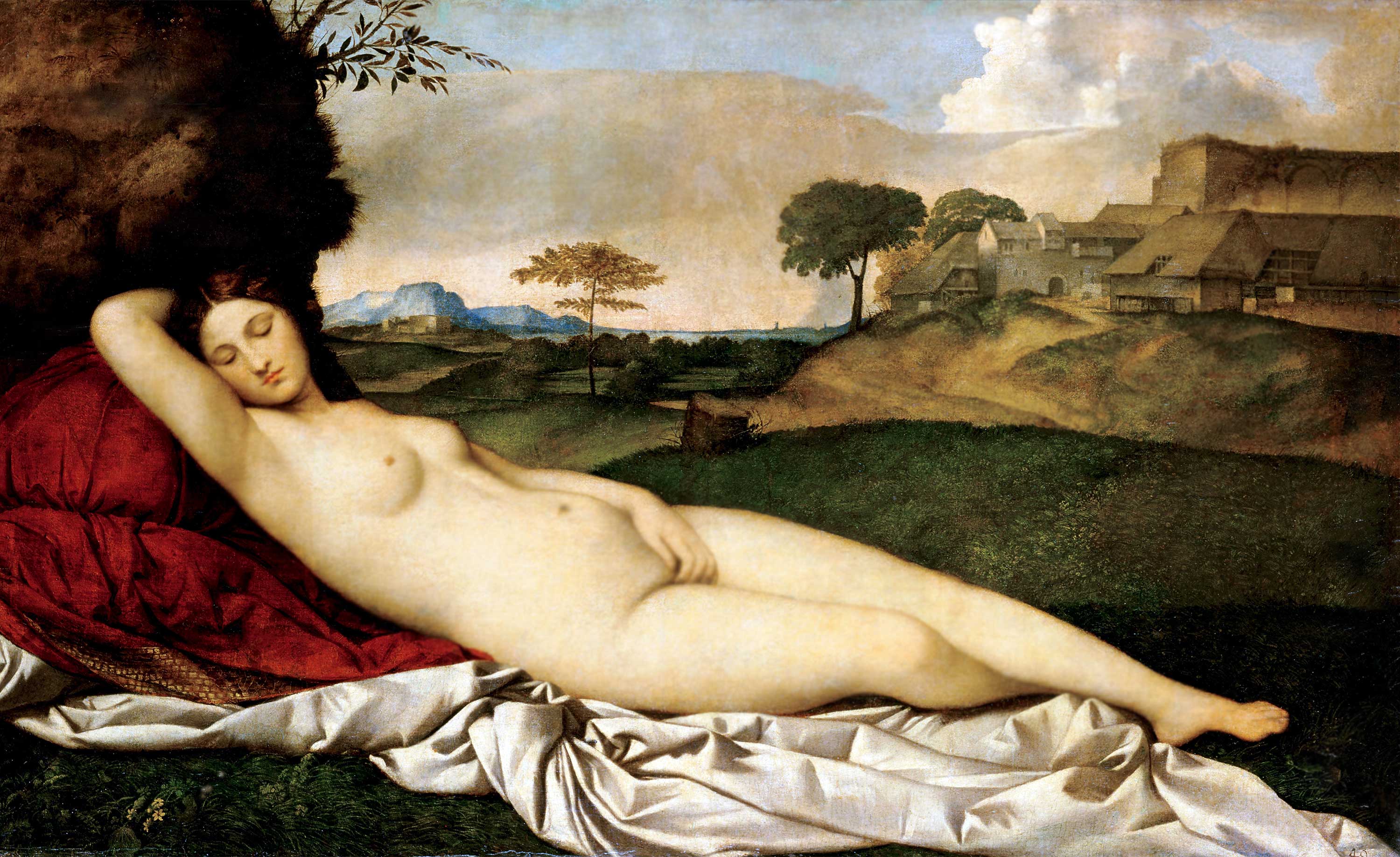
Giorgione, Sleeping Venus, 1510, Oil on canvas, Gemäldegalerie Museum, Dresden Giorgione’s Sleeping Venus (1510) is to the development of the painted nude what Leonardo da Vinci’s Mona Lisa (1505) is to the evolution of the painted portrait: a foundational reimagining of how the human figure could be represented. Just as Leonardo transformed portraiture through his subtle sfumato—those softly blended layers of translucent glazes that animate the corners of the mouth and eyes, creating an unprecedented psychological presence—Giorgione revolutionized the nude by placing a life‑sized female figure in a unified imaginary landscape, her body harmonized with the sky and terrain around her. His contouring line and delicate modeling of flesh suggest true depth and form, yet the figure is not offered as an object of erotic display. Instead, she is a goddess absorbed in sleep, unaware of the viewer who intrudes upon her private world. Giorgione makes us voyeurs, but he also elevates the subject: for the first time, the female nude becomes painted poetry, articulated through a new visual language that would shape European art for centuries. Set within a serene landscape, the goddess lies unaware of the viewer’s presence, her body modeled with a softness and emotional subtlety that mark a decisive shift in the representation of the nude. Giorgione treats the subject not as an erotic display but as an innocent meditation, inaugurating a new visual language that would shape European art for centuries. The landscape—balanced between cultivated architecture on the right and a protective hillside under a gathering storm on the left—creates a unified, enigmatic setting that heightens the figure’s presence. Although Giorgione died before the painting was completed and Titian likely finished certain passages, the work stands as the summit of Giorgione’s brief career and a cornerstone of the Venetian Renaissance.
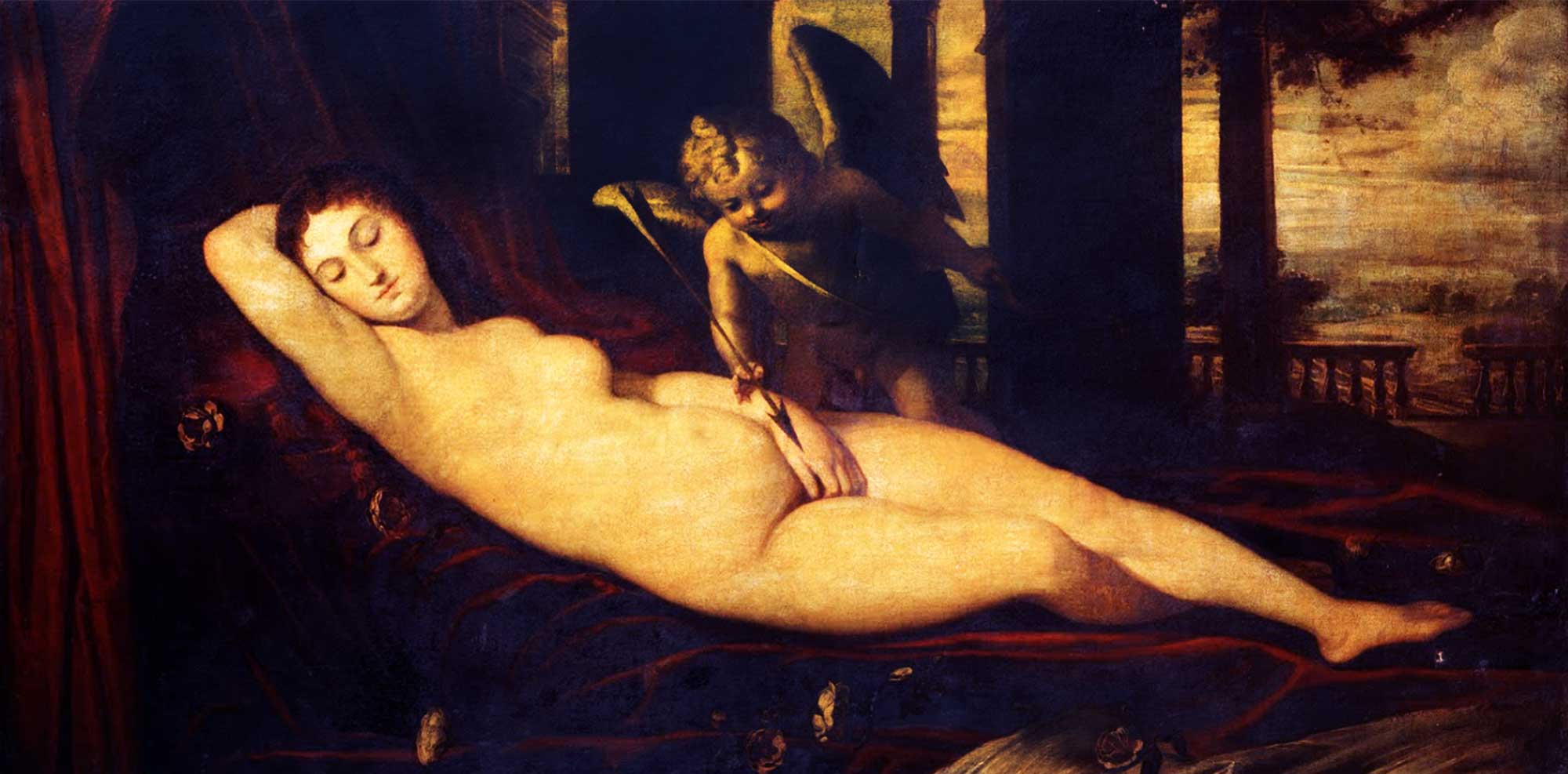
After Titian, Sleeping Venus, 16th-century, Dulwich Picture Gallery, London, UK
After Titian, Sleeping Venus, 16th century; This 16th‑century Dulwich Picture Gallery copy of Giorgione’s Sleeping Venus preserves elements lost in the original, most notably the figure of Cupid, who was painted over in the nineteenth century and is now visible only through X‑ray imaging. In this version, Cupid remains intact, poised beside Venus and holding an arrow that underscores her mythological identity. Unlike Giorgione’s expansive, rolling landscape, the Dulwich painting situates the reclining figure within a veranda that opens onto the distant countryside, creating a more architecturally framed setting. Additional details—such as the red roses scattered around Venus—further distinguish the work and are absent from the original composition. Though technically less refined than Giorgione’s masterpiece, the Dulwich painting is historically significant for preserving the composition’s earlier state, offering insight into how the scene was originally conceived before later interventions altered its appearance.
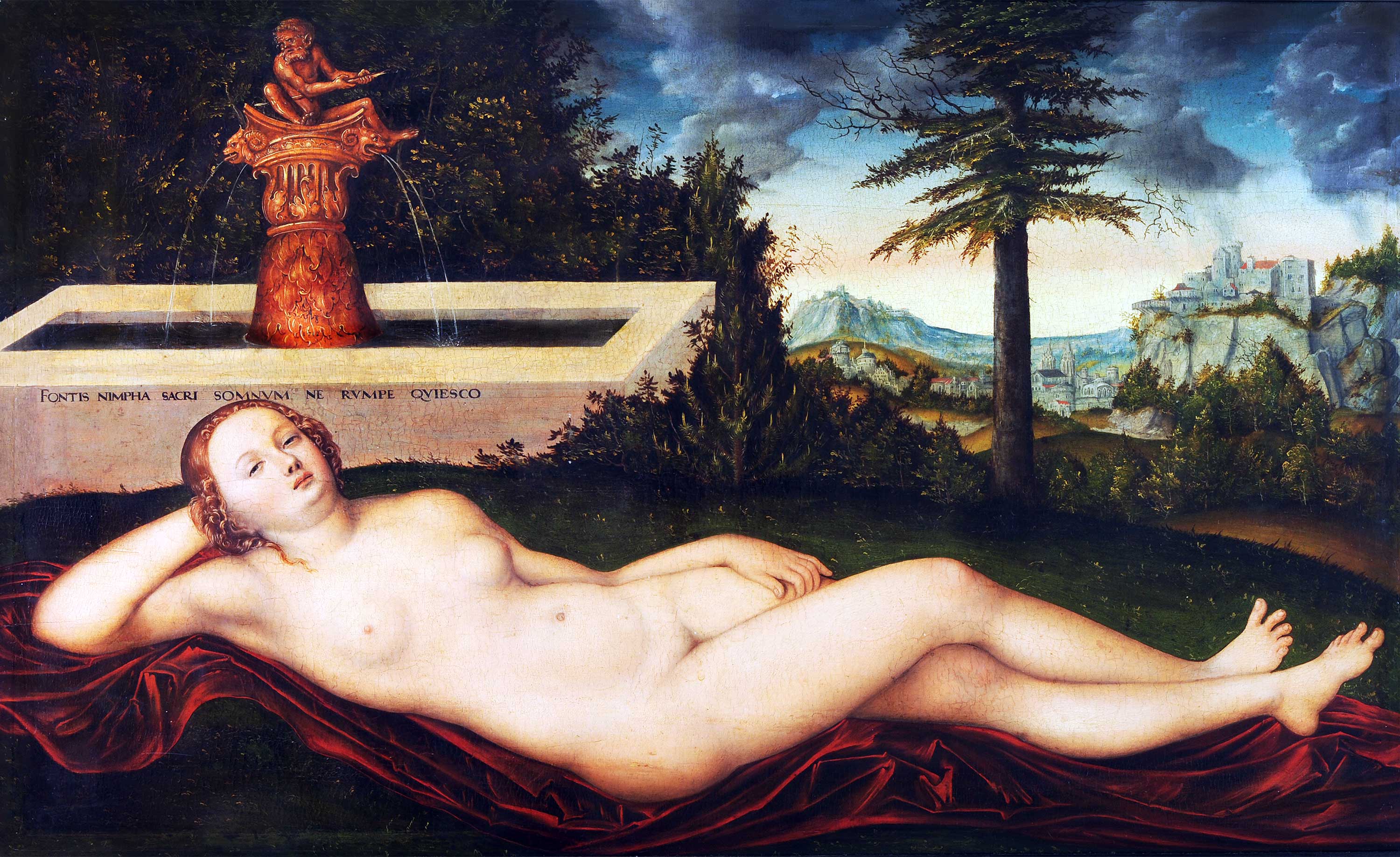
Lucas Cranach the Elder, Reclining River Nymph at the Fountain, 1518, oil on wood panel, Museum der Bildenden Kunste, Leipzig, Germany, 59 x 92 cm, 23 x 36 in
Lucas Cranach the Elder's River Nymph at the Fountain (1518) offers one of the earliest Northern reinterpretations of the reclining nude, blending sensual display with moralizing wit. The nymph lies stretched beside a spring, her pale, elongated body rendered with Cranach’s trademark cool precision, while her coy inscription—inviting the viewer to drink—turns the scene into a playful provocation. Unlike the Venetian ideal, Cranach’s nude is both alluring and slyly self‑aware, her angular elegance set against a crisp, detailed landscape. The work reveals how the reclining female figure, newly energized by Italian models, could be adapted in the German Renaissance into a hybrid of erotic charm, allegory, and courtly sophistication.
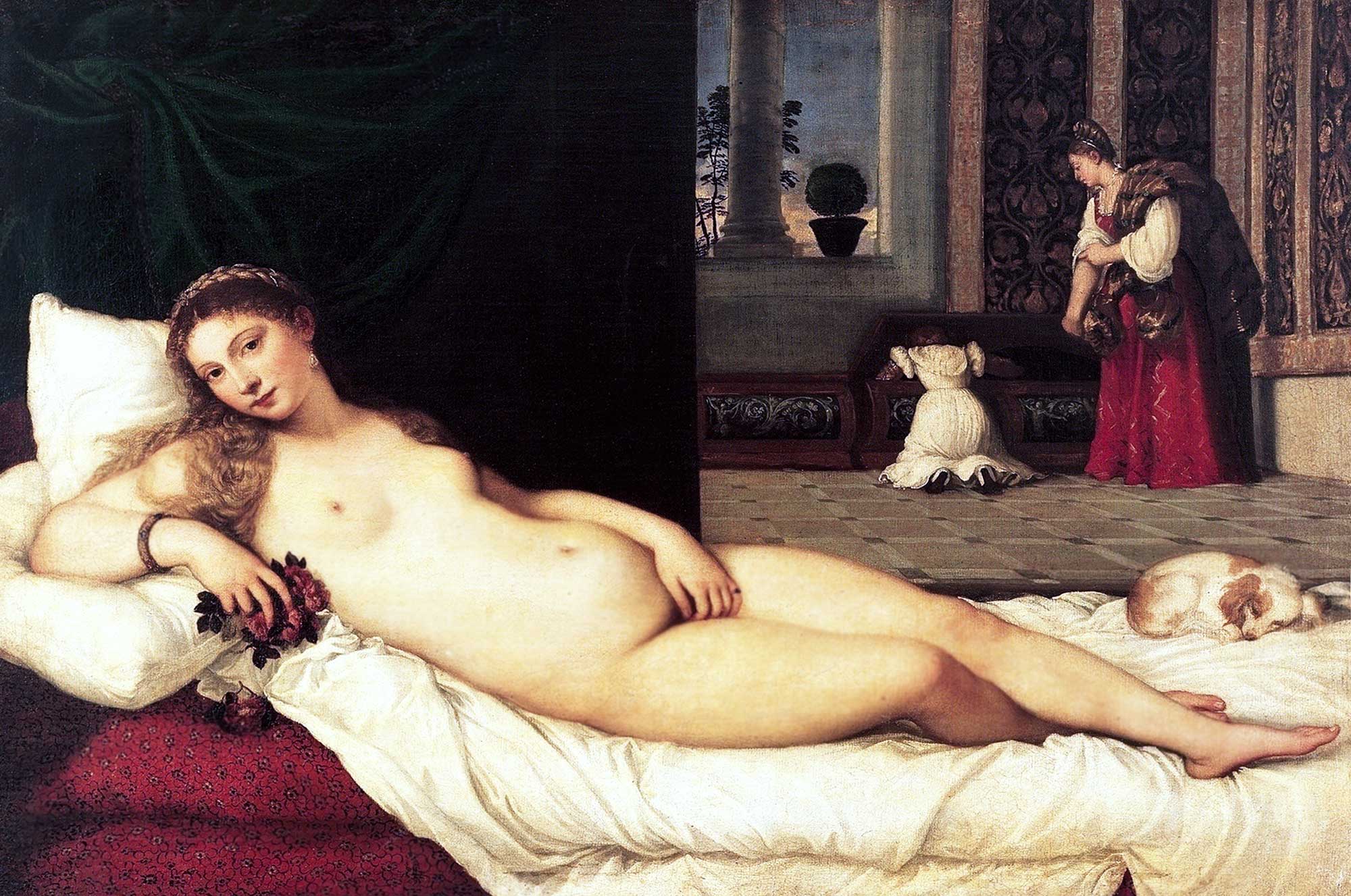
Titian, The Venus of Urbino, 1534, Oil on canvas, 119 cm × 165 cm (47 in × 65 in), Uffizi, Florence
Titian’s Venus of Urbino (1534) transforms the reclining nude into a fully self‑aware, worldly presence. Unlike Giorgione’s dreaming goddess, Titian’s Venus is awake and meets the viewer’s gaze with unmistakable agency. Set within an opulent domestic interior, attended by servants and accompanied by a lapdog symbolizing fidelity, she embodies both sensuality and marital virtue. Her softly modeled body, luminous flesh tones, and the subtle play of diagonals across the canvas establish a new standard for the erotic nude in Venetian painting. Long interpreted as a celebration of conjugal love, the Venus of Urbino became a foundational model for later reclining nudes from Velázquez to Manet.
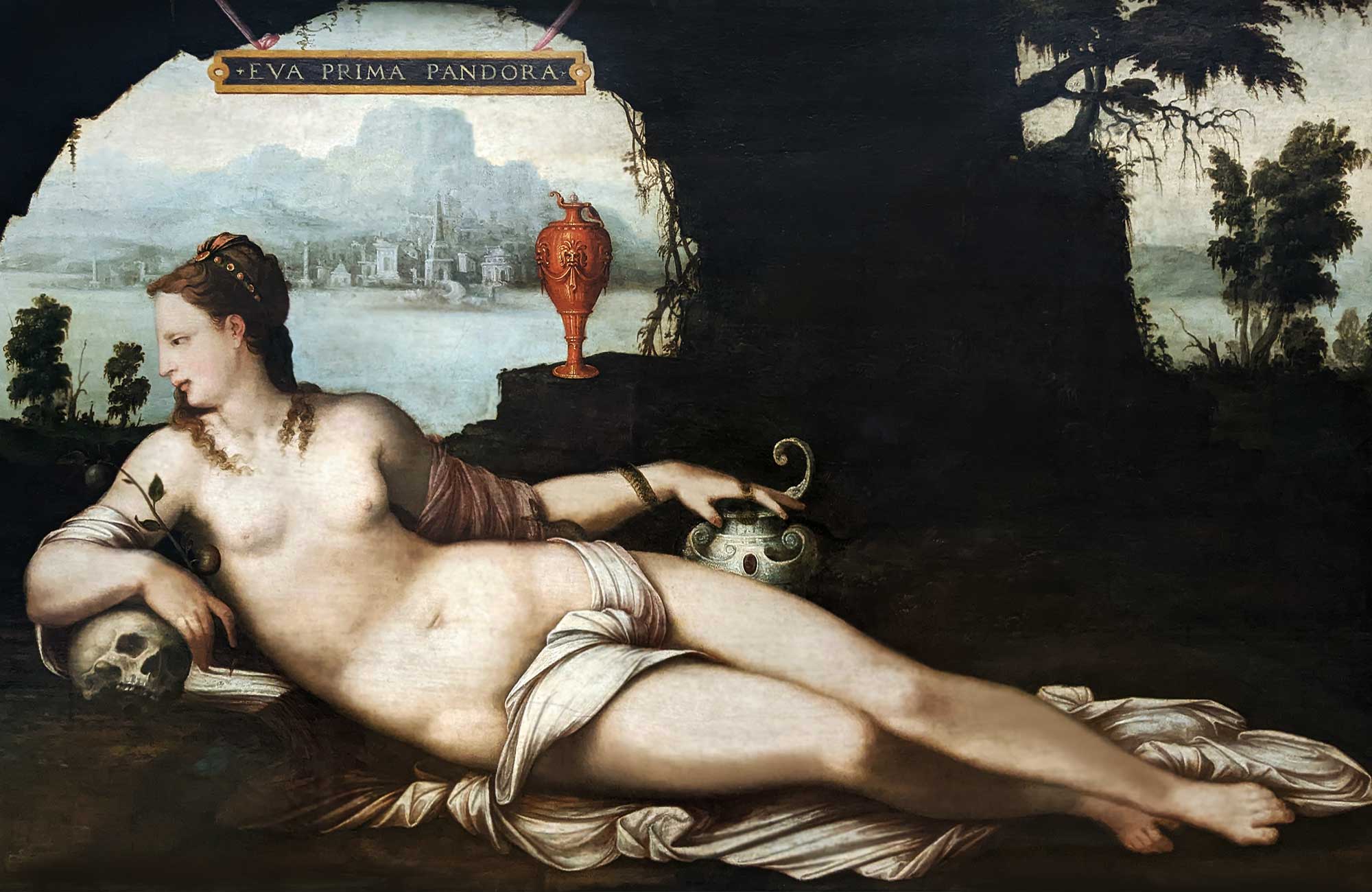
Jean Cousin the Elder, Eva Prima Pandora, 1550, Louvre Museum, Paris
Jean Cousin the Elder’s Eva Prima Pandora (1550) is the most enigmatic reclining nude of the French Renaissance and the only painting securely attributed to Cousin. It fuses a Titian‑derived pose with Northern moralizing symbolism, turning the Venetian nude into an allegory of temptation. The inscription unites Eve and Pandora, reinforced by the skull, serpent, apple branch, and vase — a charged blend of sin, mortality, and origin myth. Set in a shadowed grotto that opens onto a misty landscape, the painting draws on Leonardo and Northern print culture, its atmosphere edging toward French Mannerism. As arguably the first major French painted nude, Eva Prima Pandora stands apart from Fontainebleau’s decorative eroticism, forming a crucial link between Titian’s sensual mythologies and later, more coded French treatments of the nude.
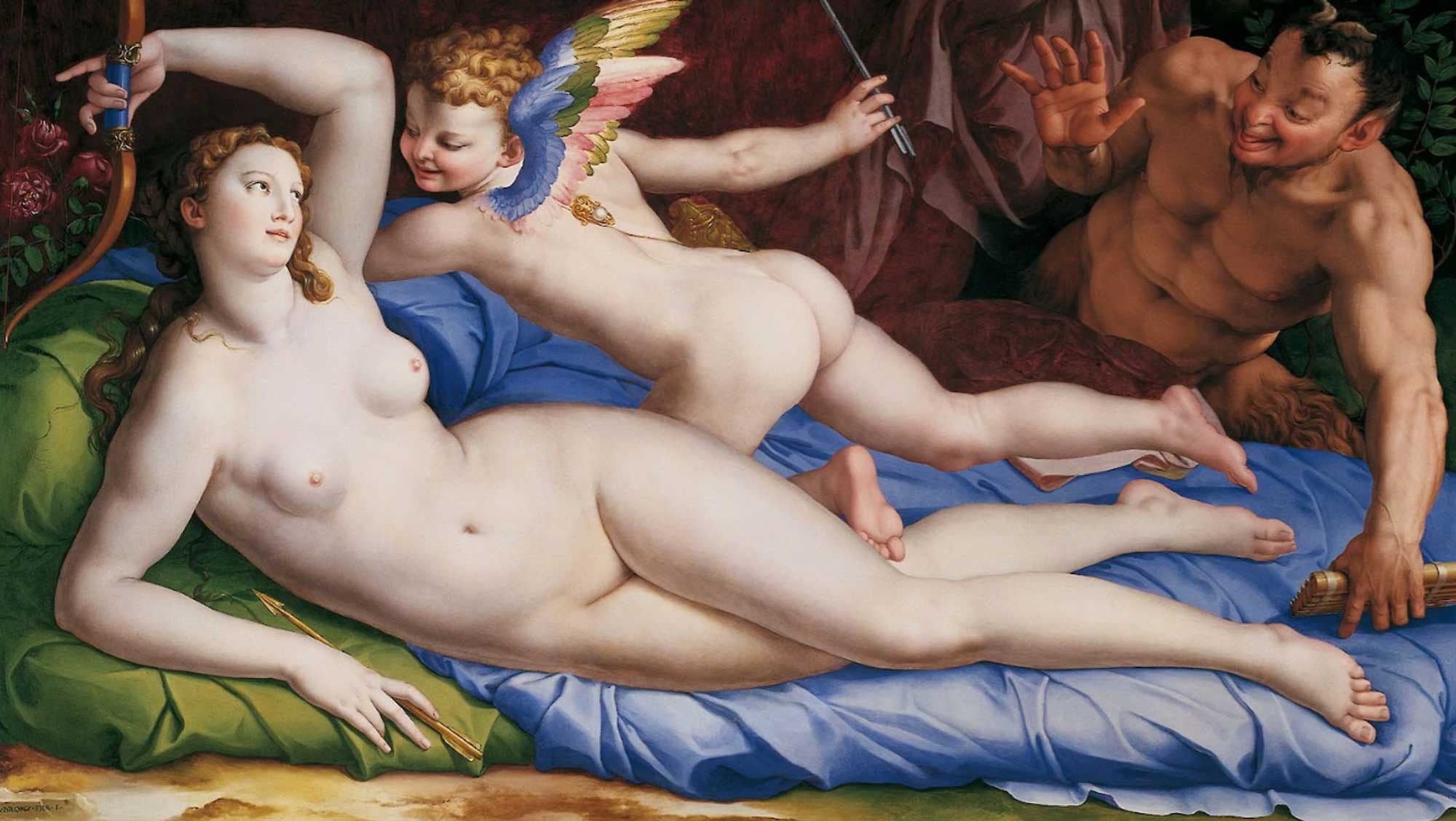
Bronzino, Venus, Cupid, and Satyr, 1554, Palazzo Colonna Museum, Italy
Bronzino’s Venus, Cupid, and Satyr (1554) is a taut, mannerist reinterpretation of the reclining nude, presenting Venus not in languid repose but in a poised, sculptural twist that heightens her elegance and artifice. Flanked by Cupid and spied upon by a lurking satyr, she becomes the axis of a deliberately staged erotic tableau, her alabaster body modeled with Bronzino’s signature enamel‑smooth precision. The cool, polished surfaces, elongated proportions, and intricate interlocking poses transform sensuality into courtly display, revealing how the reclining nude could be adapted to the intellectualized, highly refined aesthetics of mid‑sixteenth‑century Florence.
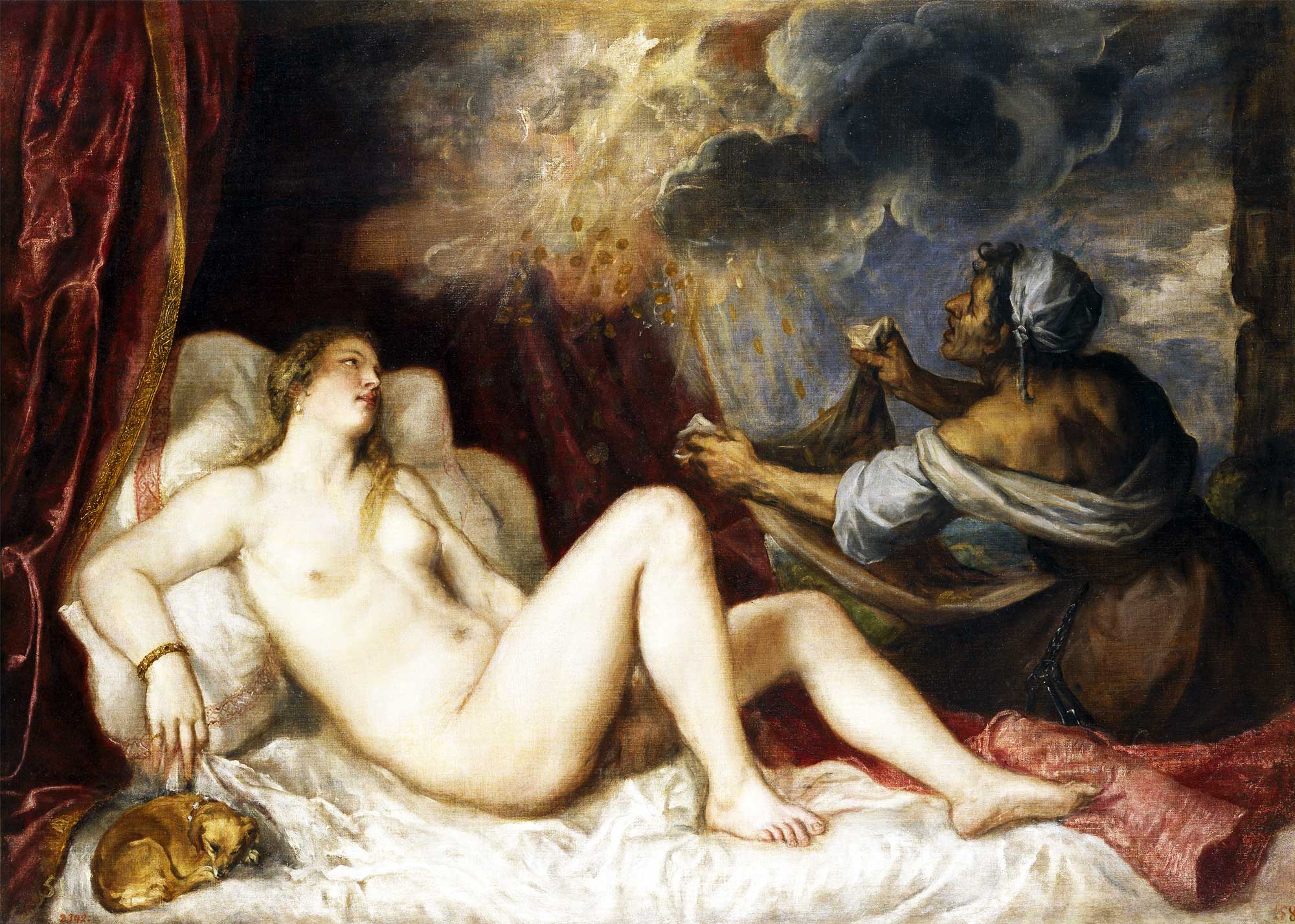
Titian, Danaë, 1540, oil on canvas, Museo del Prado, Spain
Titian’s Danaë (1540)—painted in several versions beginning in the early 1540s—transforms the myth of Zeus visiting Danaë in a shower of gold into one of the most sensual images of the Venetian Renaissance. Where Giorgione’s Sleeping Venus embodies serene idealism, Titian’s Danaë is fully awake to desire: her body illuminated by warm, tactile color, her expression poised between anticipation and surrender. The golden cascade becomes both divine presence and erotic metaphor, and the small lapdog at her side—echoing the Venus of Urbino—reasserts the theme of fidelity within an unmistakably erotic scene. In Titian’s hands, the reclining nude shifts from distant ideal to embodied sensuality, marking a decisive moment when mythological narrative becomes a vehicle for exploring the pleasures, vulnerabilities, and complexities of the human body.
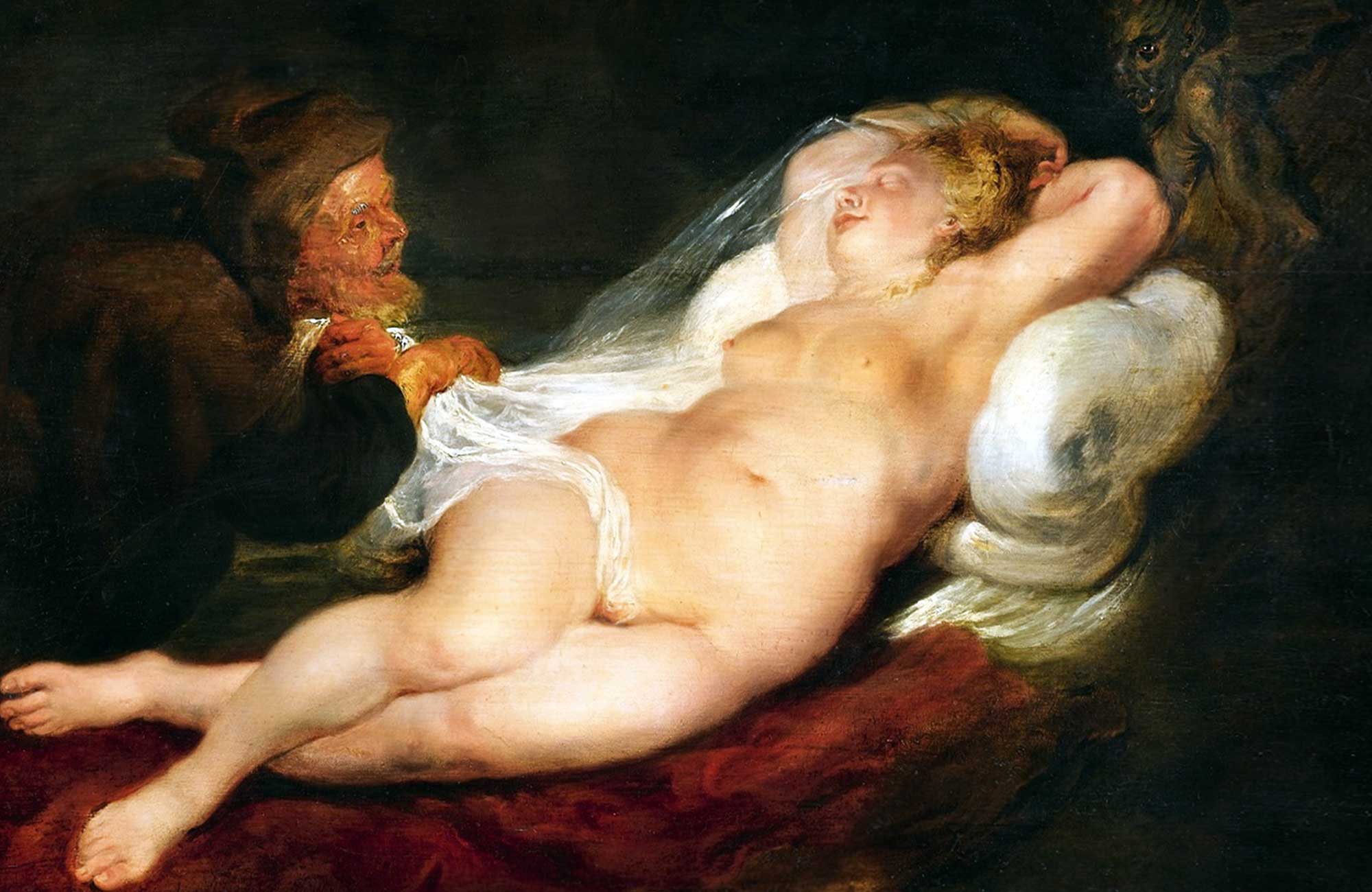
Peter Paul Rubens, Angelica and the Hermit, 1628, oil on canvas, Episode from canto 8 of Ludovico Ariosto's poem Orlando Furioso, Kunsthistorisches Museum, Vienna
Peter Paul Rubens’s Angelica and the Hermit (1628) transforms the reclining nude into a scene of dramatic vulnerability and Baroque sensuality. Drawn from Ariosto’s Orlando Furioso, the painting shows the captive Angelica asleep and exposed, her luminous, voluptuous body rendered with Rubens’s trademark warmth and tactile immediacy. The hermit who discovers her—his face shadowed, his gesture hovering between desire and restraint—introduces a charged psychological tension that complicates the erotic display. The contrast between Angelica’s glowing flesh and the dark, turbulent landscape heightens the sense of peril, making the work a powerful example of how the reclining nude could be recast in the seventeenth century as a narrative of danger, temptation, and moral ambiguity.
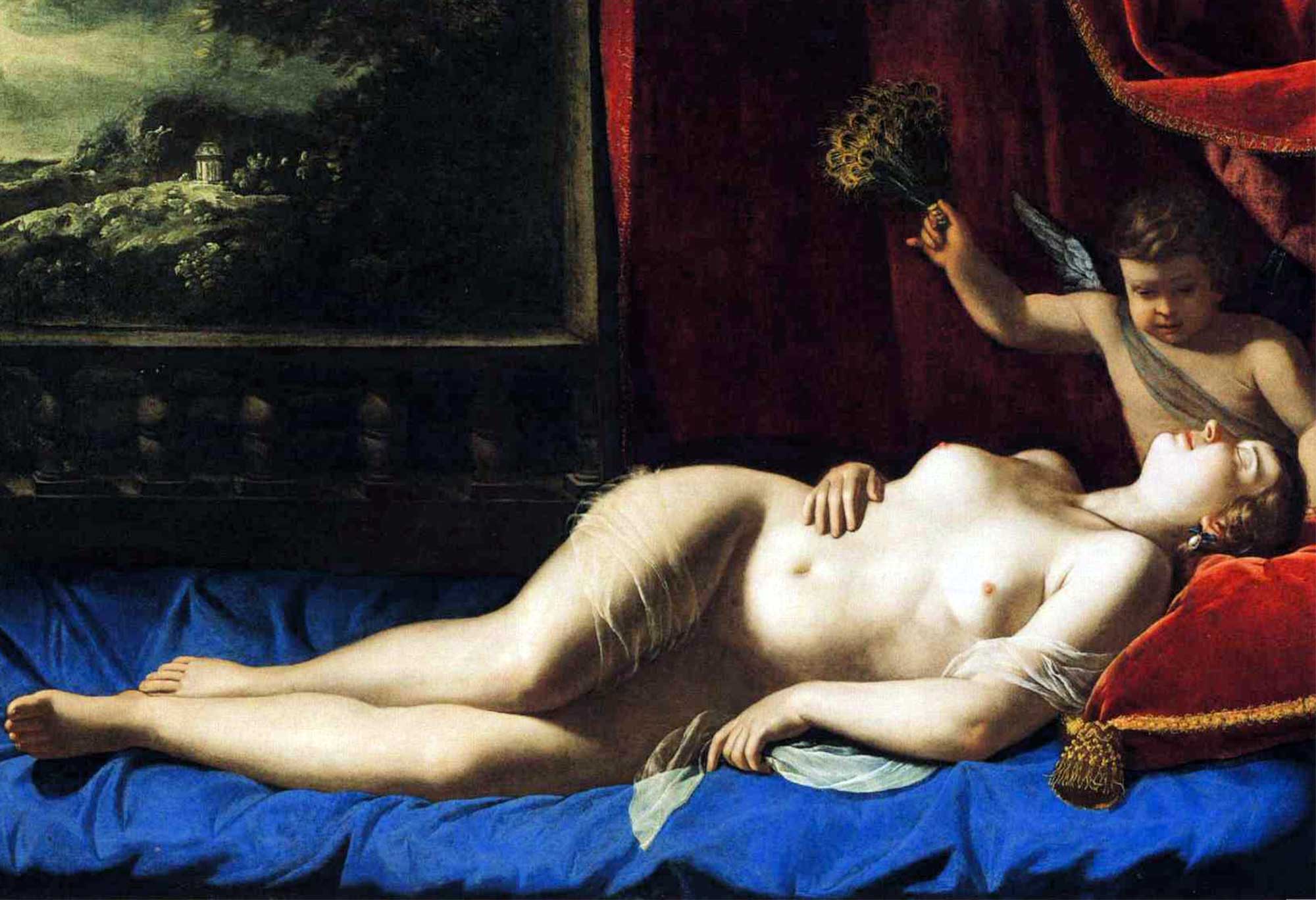
Artemisia Gentileschi, Sleeping Venus, 1630, Virginia Museum of Fine Arts
Artemisia Gentileschi’s Sleeping Venus (1630) reimagines the reclining nude with a warmth and immediacy distinct from her dramatic Caravaggesque scenes. Venus lies asleep in a softly illuminated landscape, her body modeled with a tender naturalism that tempers sensuality with serenity. Unlike the charged narratives of Rubens or the courtly artifice of Bronzino, Artemisia’s Venus feels grounded and human, her repose unthreatened and untheatrical. The gentle fall of light across her flesh and the quiet pastoral setting create a mood of contemplative stillness, revealing how the reclining nude could be recast in the seventeenth century as an image of peaceful, embodied beauty rather than mythic spectacle.
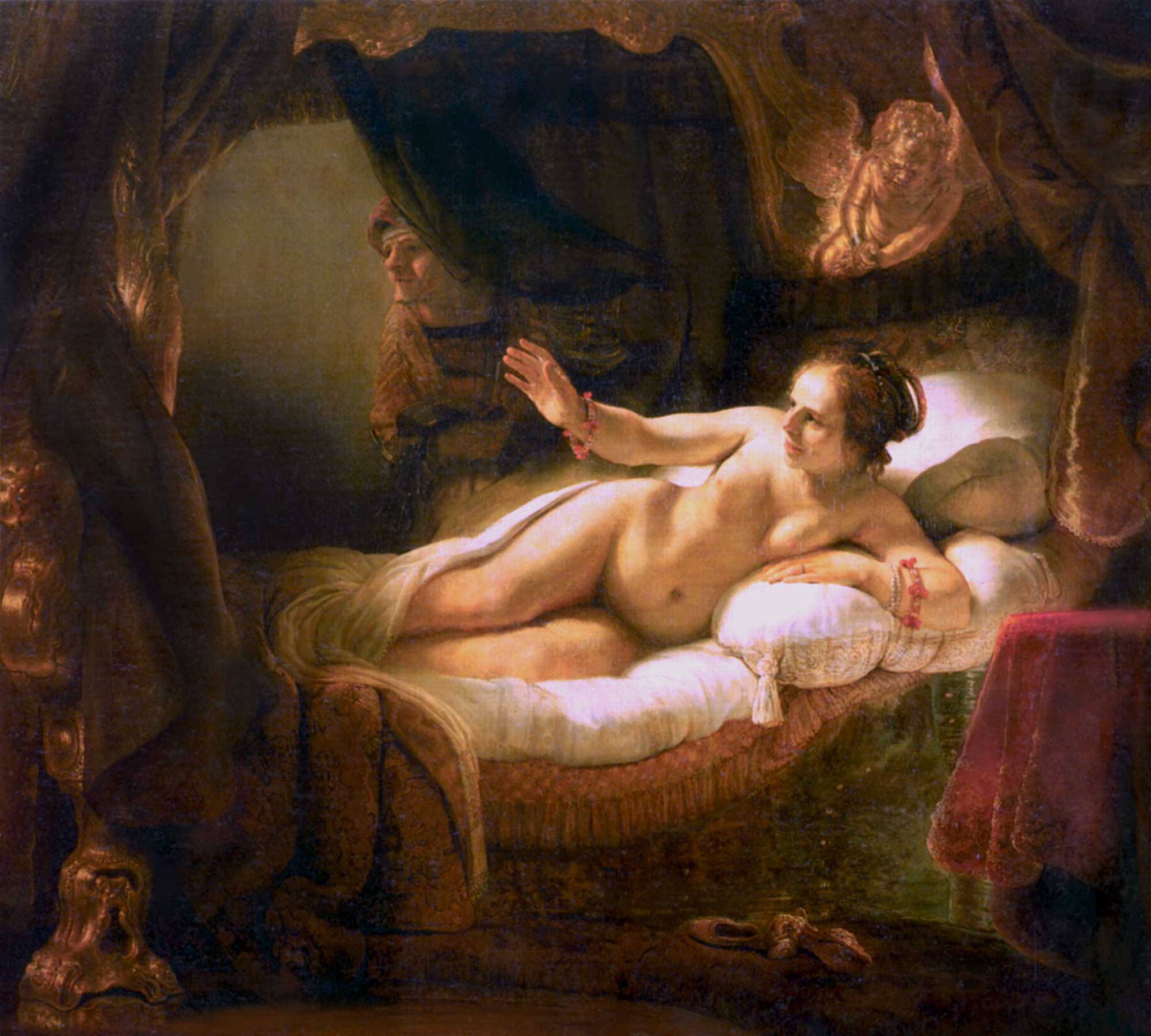
Rembrandt van Rijn, Danaë, 1636, Oil on canvas, 185 cm × 203 cm (73 in × 80 in), Hermitage Museum, St. Petersburg
Rembrandt’s Danaë (begun 1636; reworked in the 1640s) A century after Titian, Rembrandt’s Danaë offers a radically different contribution to the history of the reclining nude. Monumental in scale, it shows the heroine welcoming the divine presence of Zeus, who arrives not as a literal shower of gold but as a radiant flood of light. First modeled on Rembrandt’s wife Saskia and later altered to resemble his companion Geertje Dircx, the painting carries the imprint of the artist’s shifting emotional life, making the figure unusually personal for a mythological subject. Rembrandt transforms the myth into a scene of profound psychological depth. Danaë’s gesture and expression convey tenderness, vulnerability, and luminous anticipation rather than erotic display. His mastery of chiaroscuro turns the divine light into an emotional force, animating her body with warmth and humanity. The result is a deeply intimate vision of divine visitation—one in which sensuality, longing, and spiritual radiance converge.
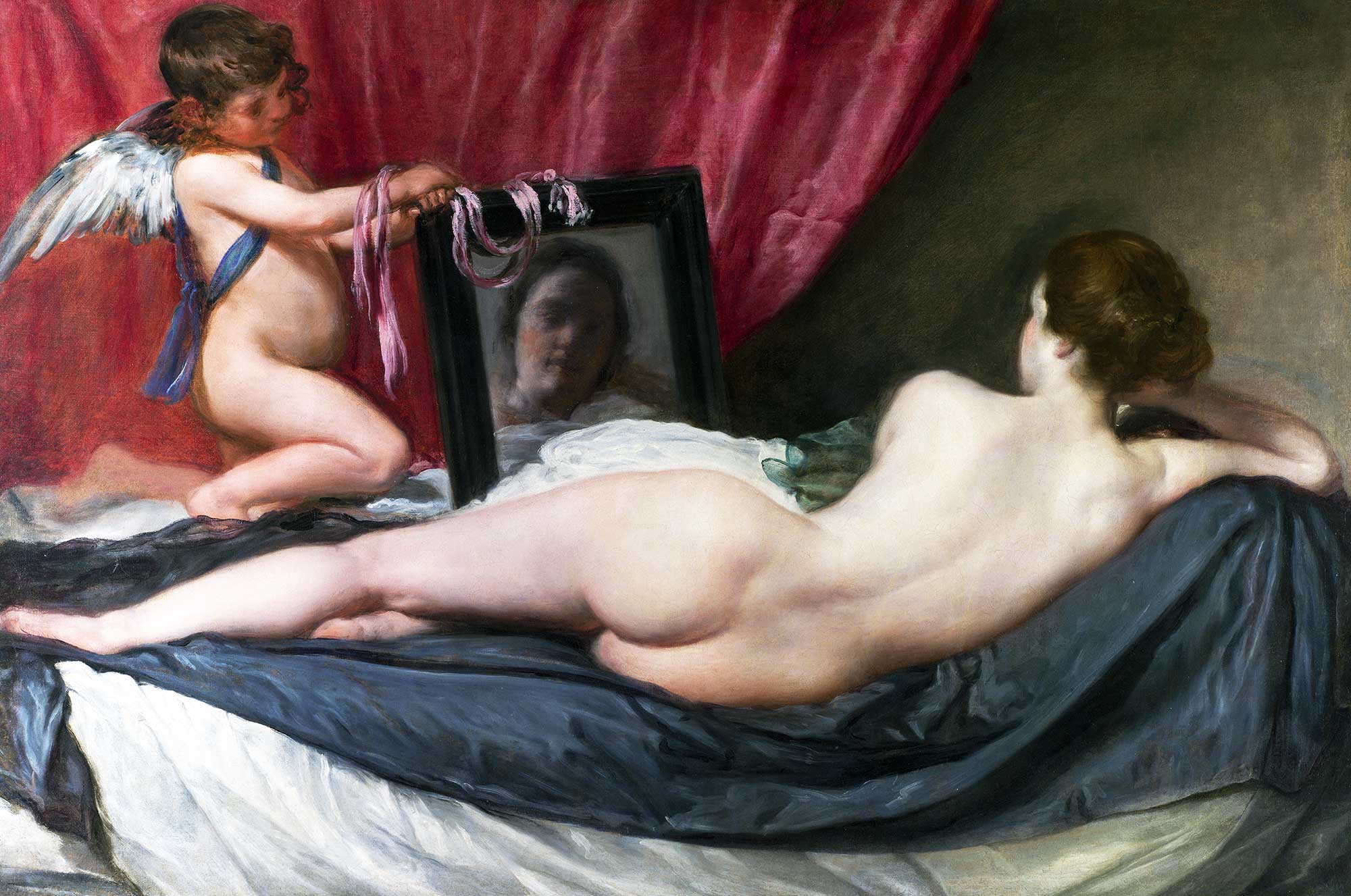
Diego Velázquez, Rokeby Venus or The Toilet of Venus, 1644, National Gallery, London
Diego Velázquez’s Rokeby Venus (1651) painted in Catholic Spain, where nudes were rare and policed—offers one of the most restrained and psychologically nuanced takes on the reclining female form. Turning Venus away from the viewer, he replaces frontal display with a long, quiet sweep of back, hips, and legs, creating a nude that is intimate yet withheld. His handling of flesh is unusually naturalistic: warm, soft, and alive, set against muted drapery that heightens the painting’s atmosphere of private stillness. The blurred reflection in Venus’s mirror, held by Cupid, introduces the work’s central ambiguity. Whether distorted intentionally or reflecting the viewer’s own gaze, it unsettles the traditional dynamics of looking and turns the scene into a meditation on desire and perception. Stripped of Baroque theatrics, the composition feels suspended in time—closer to introspection than myth. Drawing on the Venetian tradition yet transforming it, Velázquez offers a nude defined by distance and ambiguity rather than erotic display. The painting’s modern afterlife adds another layer of tension. In 1914, suffragette Mary Richardson slashed the canvas in protest of Emmeline Pankhurst’s arrest, exposing the charged status of the female nude in public culture. The restored wounds remain part of the work’s aura, marking the Rokeby Venus as both a masterpiece of quiet sensuality and a flashpoint in debates over gender, power, and the politics of looking.
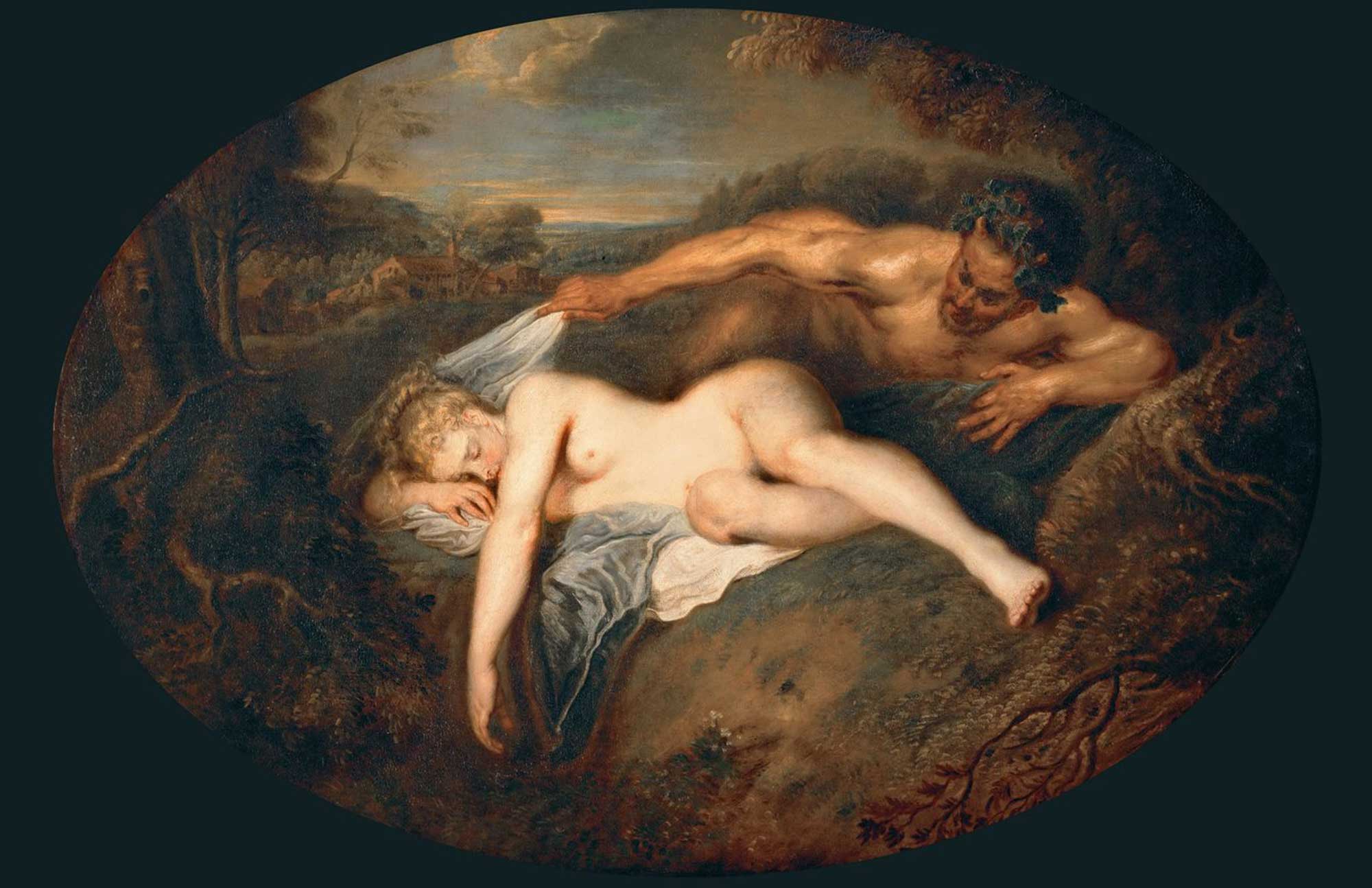
Jean-Antoine Watteau, Nymph and Satyr Jupiter and Antiope, 1710, oil on canvas, 45.2 cm x 37.8 cm (17.7 x 14.8 in), Louvre Museum, Paris
Jean-Antoine Watteau, Nymph and Satyr Jupiter and Antiope, 1710, Watteau reinterprets the reclining nude through the sensuous theatricality of early Rococo. Antiope lies exposed in a soft, luminous repose, her body modeled with a tenderness that anticipates Watteau’s later mastery of atmosphere and mood. The satyr—Jupiter in disguise—emerges from the shadows, introducing a charged tension between innocence and seduction. Rather than the serene idealism of the Venetian tradition, Watteau offers a scene alive with ambiguity, desire, and playful danger. In this early work, the reclining nude becomes a stage for emotional nuance, where myth serves less as moral lesson than as an excuse for exploring the delicate interplay of beauty, vulnerability, and erotic intrigue.
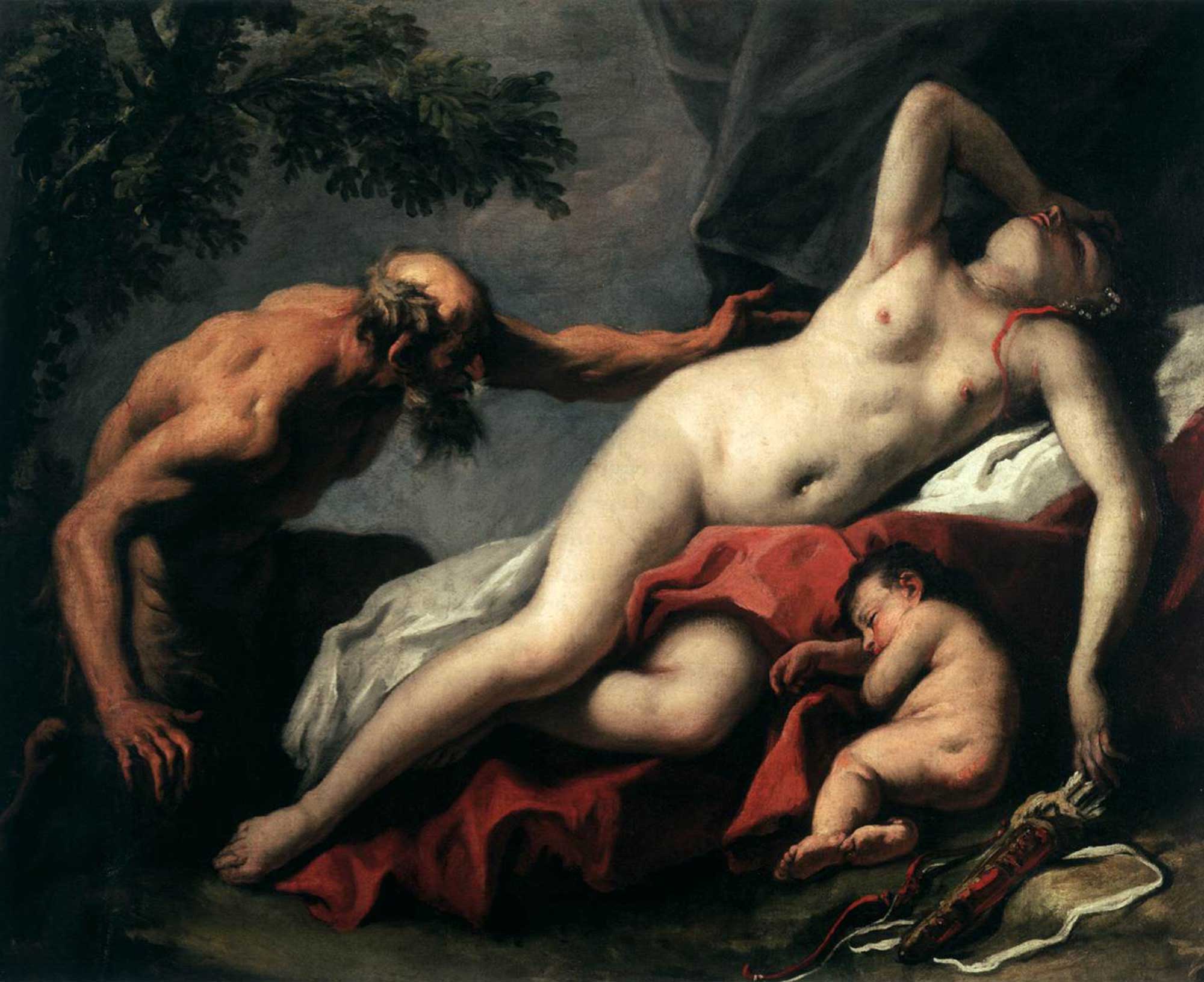
Sebastiano Ricci, Venus and Satyr, 1720, Museum of Fine Arts (Szépművészeti Múzeum), Budapest, Hungary
Sebastiano Ricci’s Venus and Satyr (1720) recasts the reclining nude in the light, playful idiom of the Venetian Rococo. Ricci’s Venus reclines with effortless grace, her luminous, pearly flesh animated by the painter’s fluid brushwork and airy palette. The approaching satyr—more mischievous than menacing—introduces a note of theatrical flirtation rather than moral tension, turning the scene into a spirited exchange between divine beauty and rustic desire. The soft, shimmering atmosphere and dynamic diagonals exemplify Ricci’s ability to blend classical subject matter with a buoyant, decorative sensibility, showing how the reclining nude evolved in the eighteenth century into a vehicle for charm, wit, and sensual ease.
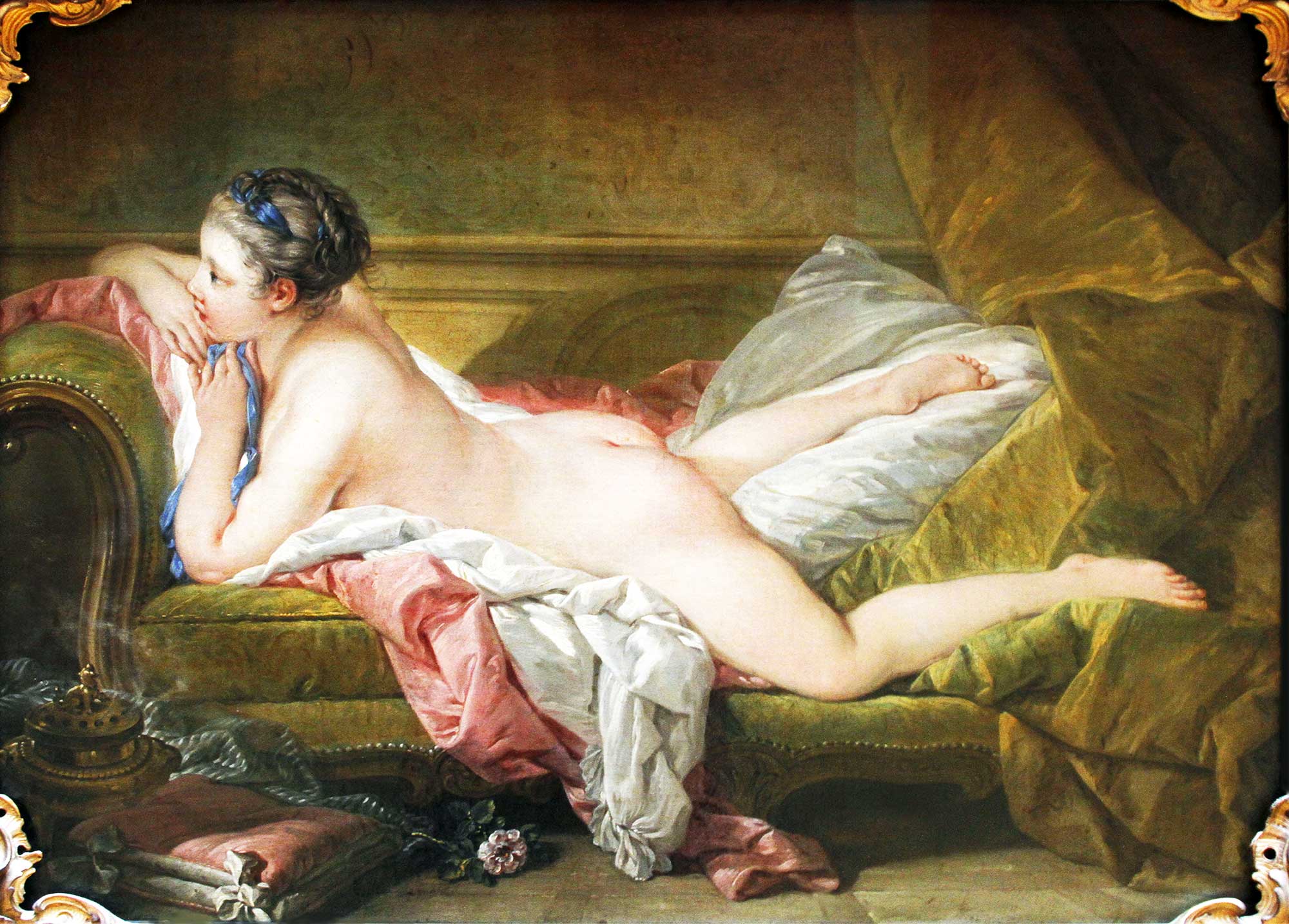
François Boucher, The Blonde Odalisque, 1752, oil on canvas, Alte Pinakothek, Munich
François Boucher’s The Blonde Odalisque (1752), By the mid eighteenth century, François Boucher transformed mythological subjects into playful, rococo fantasies. His portrait of Louis XV’s mistress, Louise O’Murphy (1750), exemplifies this shift toward lightness, charm, and erotic wit. She reclines on a cascade of silks and furs, her body rendered with Boucher’s trademark porcelain softness and luminous, powdered palette. Unlike the mythological pretexts of earlier nudes, this figure is unmistakably contemporary—an idealized Parisian beauty staged as an odalisque, her coy backward glance transforming the pose into a performance of flirtation. The intimate scale, sumptuous textures, and unabashed sensuality reveal how the reclining nude, by mid‑eighteenth‑century France, had become a vehicle for pleasure, artifice, and aristocratic indulgence. Boucher transformed the reclining nude into a playful, rococo fantasy and recasts the mythological Venus as an accessible, contemporary figure. In Boucher’s hands, the nude becomes less a goddess of love than an object of aristocratic desire, a prototype for the eroticized “pin up girl” imagery that circulated among the French elite.
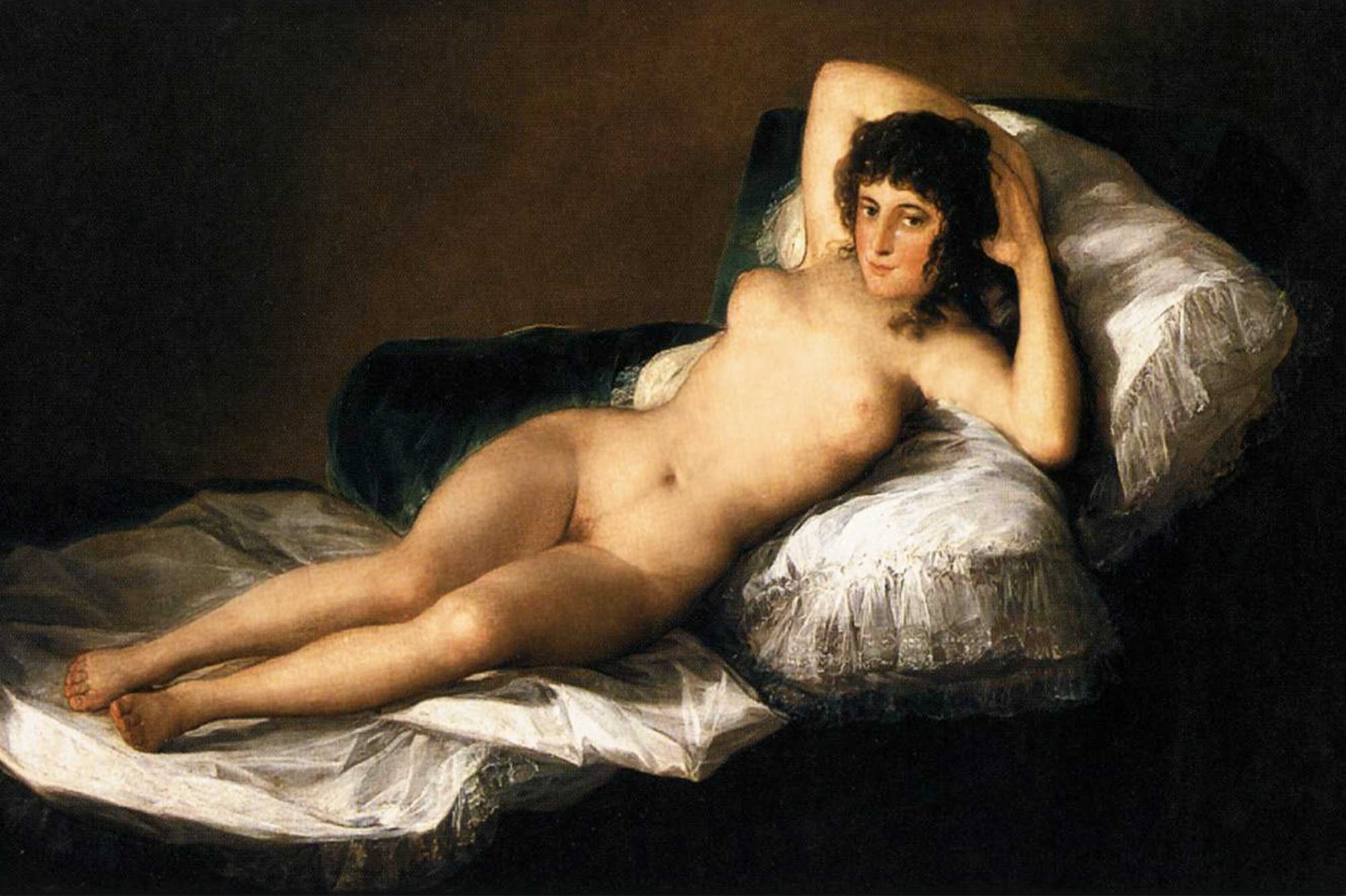
Francisco de Goya, The Naked Maja, oil-on-canvas, 1797, Museo del Prado, Madrid
Francisco de Goya’s The Naked Maja, 1797, became one of the most controversial images in Spanish art. Its frank depiction of a reclining nude—without mythological pretext or allegorical disguise—was unprecedented in Catholic Spain. In 1815, the Spanish Inquisition summoned Goya and seized the painting, accusing it of obscenity. The work’s bold naturalism and unapologetic sensuality challenged the moral and political strictures of its time, making The Naked Maja not only a landmark of modernity but also a flashpoint in the struggle between artistic freedom and institutional control.
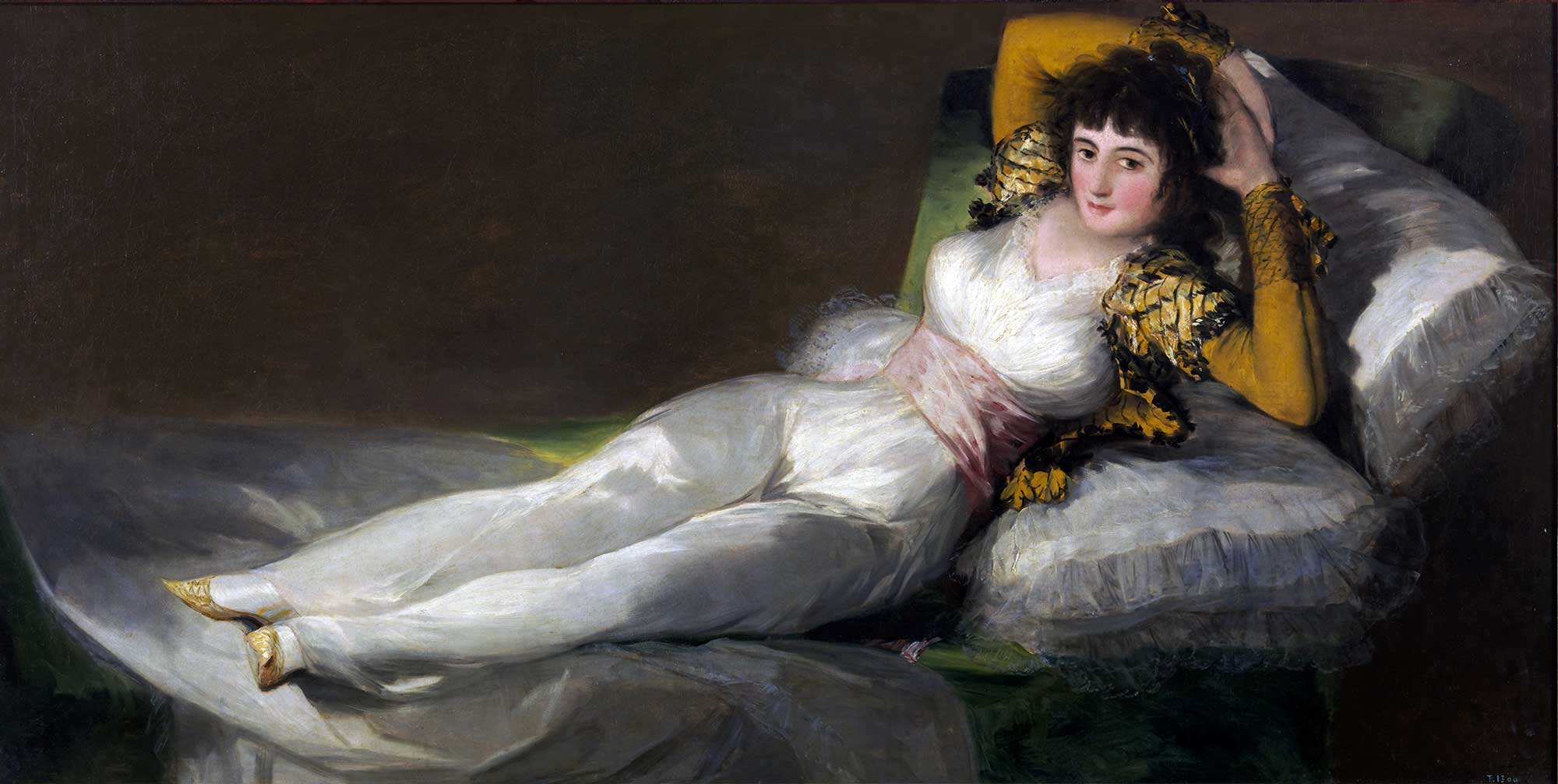
Francisco de Goya, The Clothed Maja, (La maja vestida) oil-on-canvas, 1800, Museo del Prado, Madrid
Francisco de Goya’s Clothed Maja, 1800, forms an extraordinary pair with The Naked Maja, presenting the same reclining woman in an identical pose—first nude, then fully dressed. Unlike traditional “before and after” allegories, the two paintings refuse any moralizing contrast. Instead, Goya treats clothing not as modesty restored but as another form of display, emphasizing the sitter’s confidence, allure, and self‑possession. Her direct gaze, unchanged between the two versions, challenges the viewer with the same bold immediacy. In Catholic Spain, where the nude was tightly policed, the existence of both Majas—one exposed, one elaborately attired—underscored the tension between public decorum and private desire. Together, they mark a pivotal moment in the history of the reclining female figure: a shift from mythological pretext to modern, unapologetic individuality.
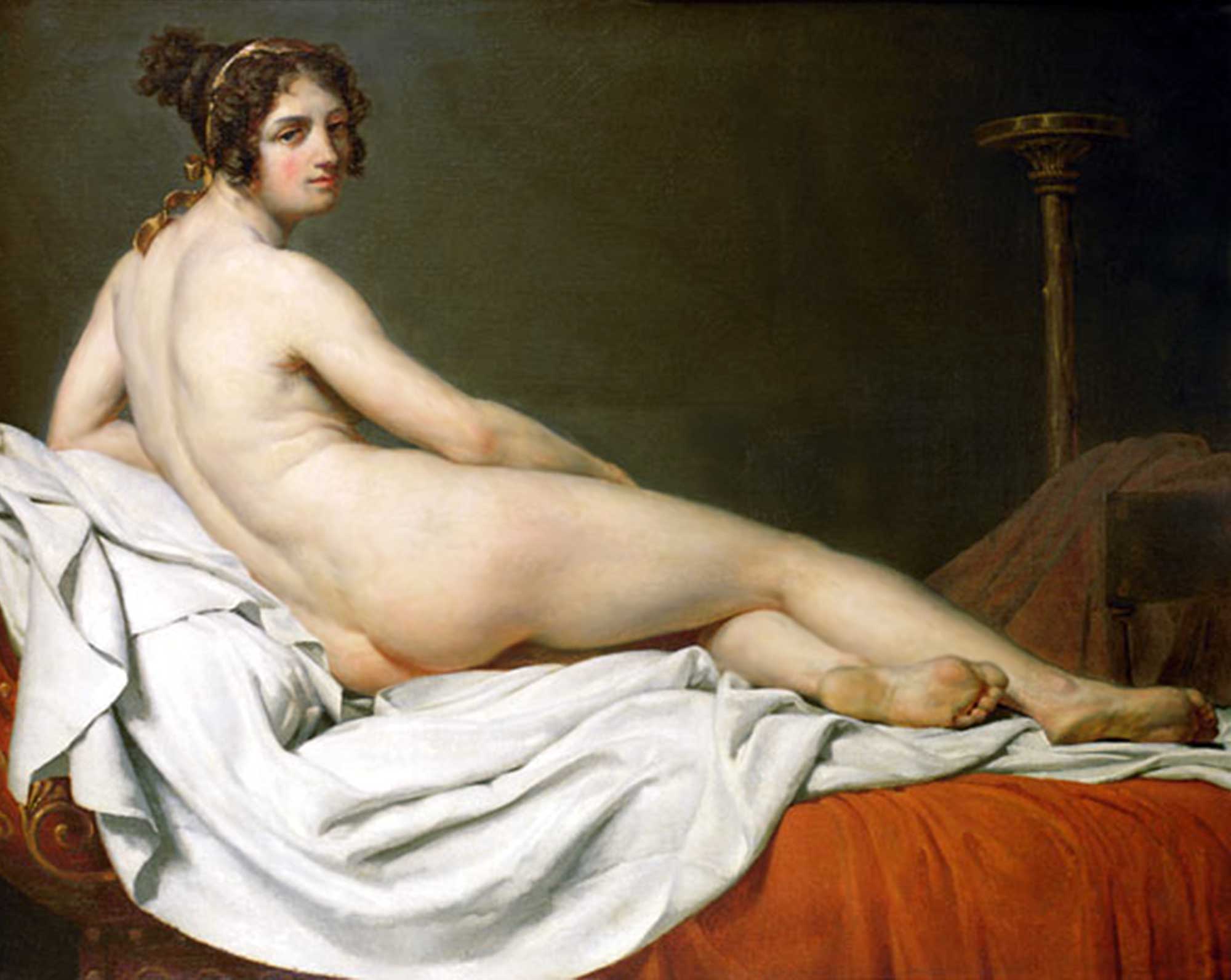
Jacques-Louis David, Reclining Nude also known as "Portrait of a Young Woman in White" 1800, oil-on-canvas, Grand Palais, Paris
Jacques‑Louis David’s Reclining Nude (Portrait of a Young Woman in White) (1800) offers a rare, intimate counterpoint to the austerity of his Neoclassical public works. The young woman reclines on a simple bed, her body arranged in a graceful, unforced curve that softens David’s typically severe linearity. The cool, even light and the restrained palette lend the scene a quiet clarity, while the sitter’s direct, unembarrassed presence distinguishes the image from the mythological nudes of earlier centuries. Neither allegory nor ideal goddess, she embodies a new, modern frankness—an unadorned, humanized approach to the reclining female figure at the turn of the nineteenth century.
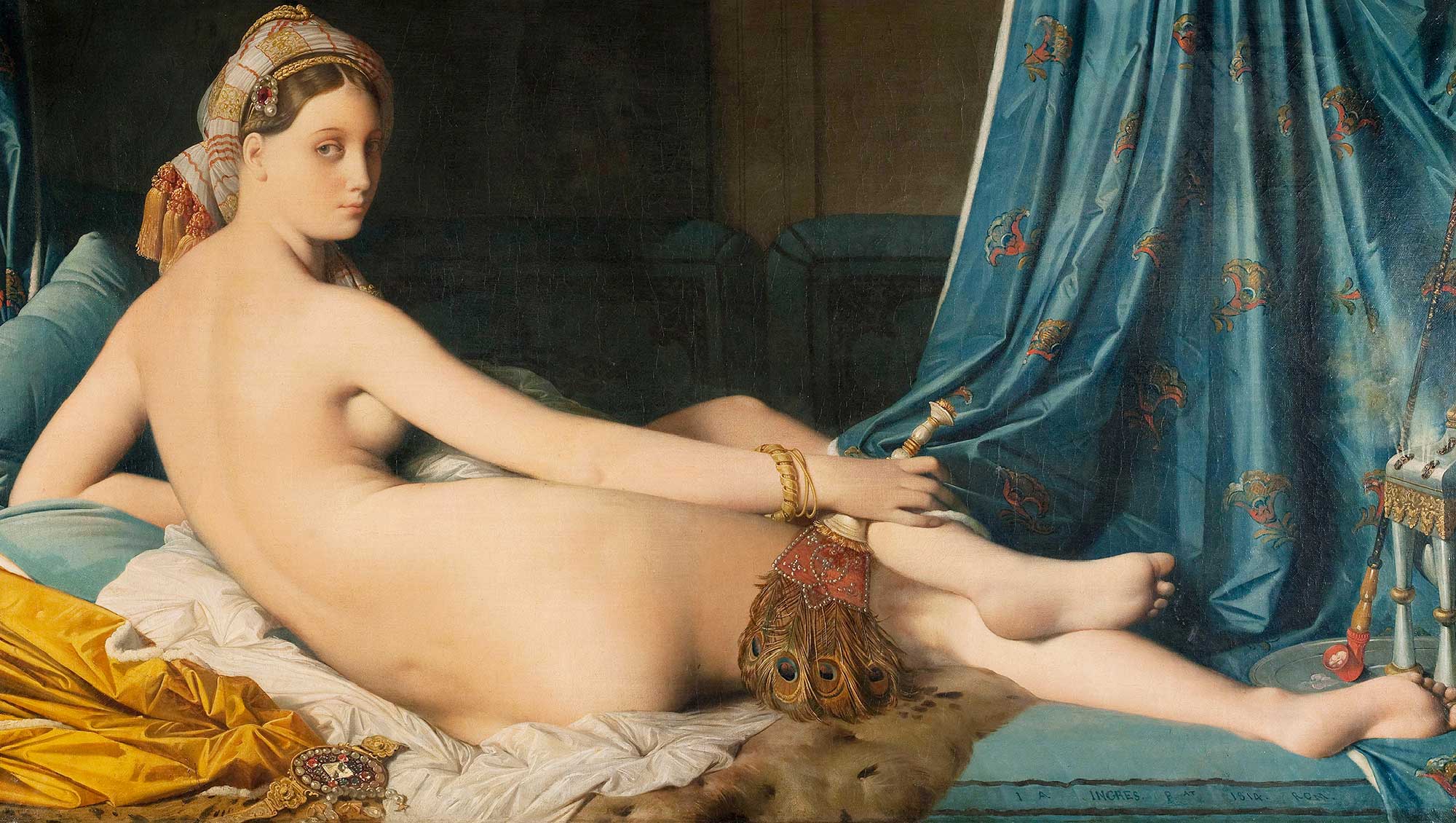
Jean-Auguste-Dominique Ingres, La Grand Odalisque, 1814, Oil on canvas, 88.9 × 162.56 cm (35 × 64 in), Louvre, Paris
Jean‑Auguste‑Dominique Ingres’s La Grande Odalisque (1814) redefines the reclining nude by merging Neoclassical draftsmanship with the exoticism and sensuality of early Romanticism. Commissioned by Caroline Murat, Queen of Naples, the painting presents an odalisque turned toward the viewer with a cool, languid detachment, her elongated spine, attenuated limbs, and small head forming a deliberately distorted anatomy that critics of the 1819 Salon found shocking. These elongations—often described as “two or three vertebrae too many”—were not errors but conscious stylistic choices, drawing on Mannerist precedents such as Parmigianino’s Madonna with the Long Neck to heighten elegance and eroticism. The pose itself echoes Jacques‑Louis David’s Portrait of Madame Récamier, while the luxuriant fabrics, peacock‑feather fan, and blue drapery situate the figure within the Orientalist fantasy that captivated early‑nineteenth‑century France. Ingres’s smooth, even lighting and sinuous contour lines suppress muscular structure in favor of idealized surface, transforming the reclining nude into an object of refined, remote sensuality. The painting marks a pivotal moment when classical form, Romantic exoticism, and the politics of the gaze converge, establishing a template that would shape the odalisque motif for decades.
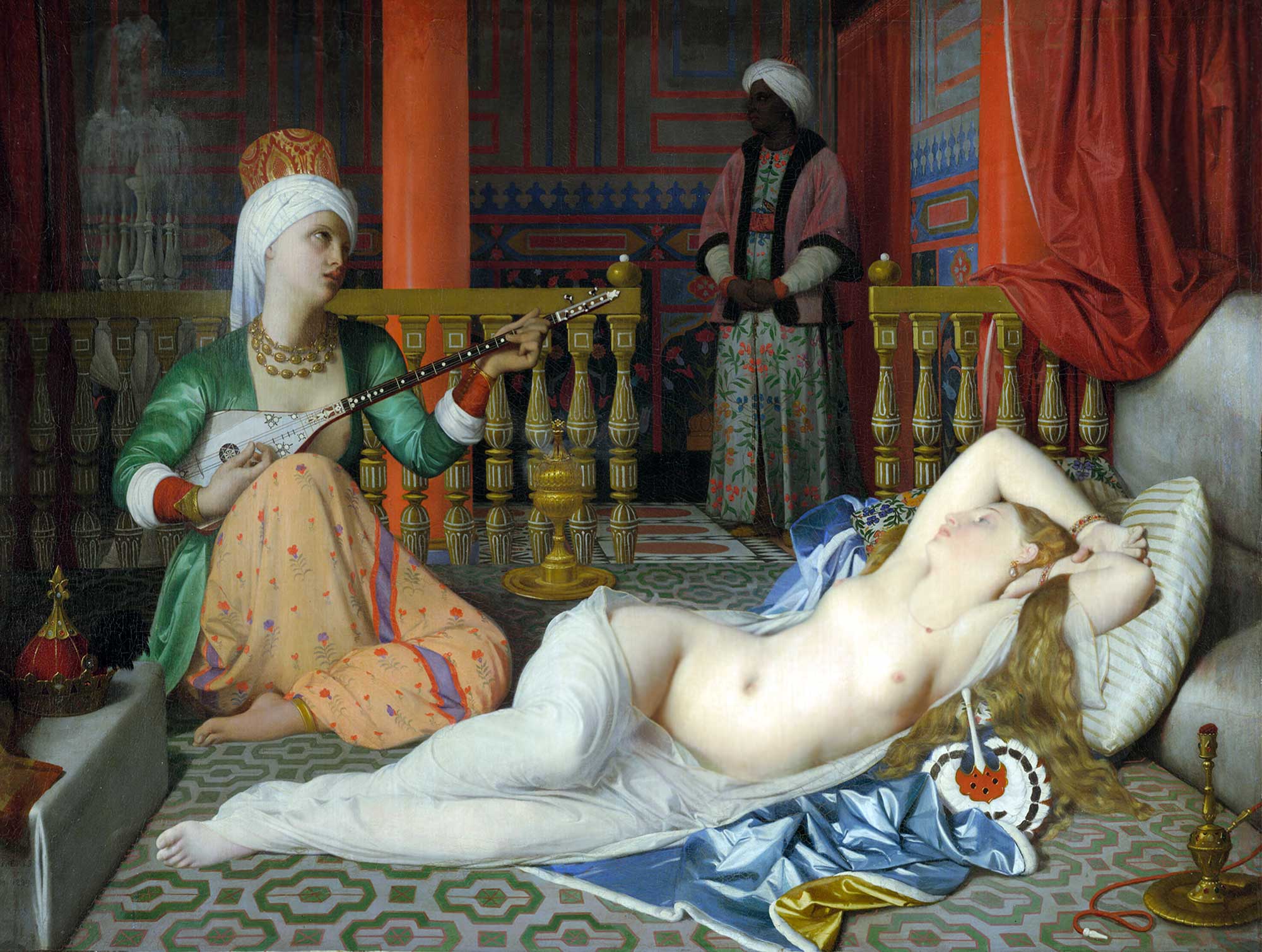
Jean-Auguste-Dominique Ingres, Odalisque with Slave, 1839, oil on canvas, 72.1 cm × 100.3 cm or 28.4 in × 39.5 in, Harvard Art Museums, Fogg Museum, Cambridge, Massachusetts
Jean‑Auguste‑Dominique Ingres’s Odalisque with Slave (1839) expands the odalisque tradition he had shaped with La Grande Odalisque, intensifying its blend of idealized anatomy, Orientalist fantasy, and meticulously controlled surface. The central nude reclines with the same porcelain smoothness and elongated proportions that define Ingres’s vision of feminine beauty, her body offered as a serene, perfected object. Around her, however, the scene becomes more elaborate: a musician plays a tanbour at her side, and a eunuch stands in the background, completing the imagined harem interior. Ingres never traveled to the Near East, and the setting—its mosaics, carpets, instruments, and architectural details—was constructed from engravings, studio props, and his own fantasies, a hallmark of nineteenth‑century Orientalism. The painting’s polished finish and cool, controlled sensuality mask the power dynamics embedded in the scene, where the odalisque’s languid pose and exposed body are framed as a spectacle for a presumed male viewer. In this work, the reclining nude becomes a carefully staged fiction: an idealized body suspended within an exoticized world that reveals as much about Western desire as it does about Ingres’s devotion to line, surface, and classical form.
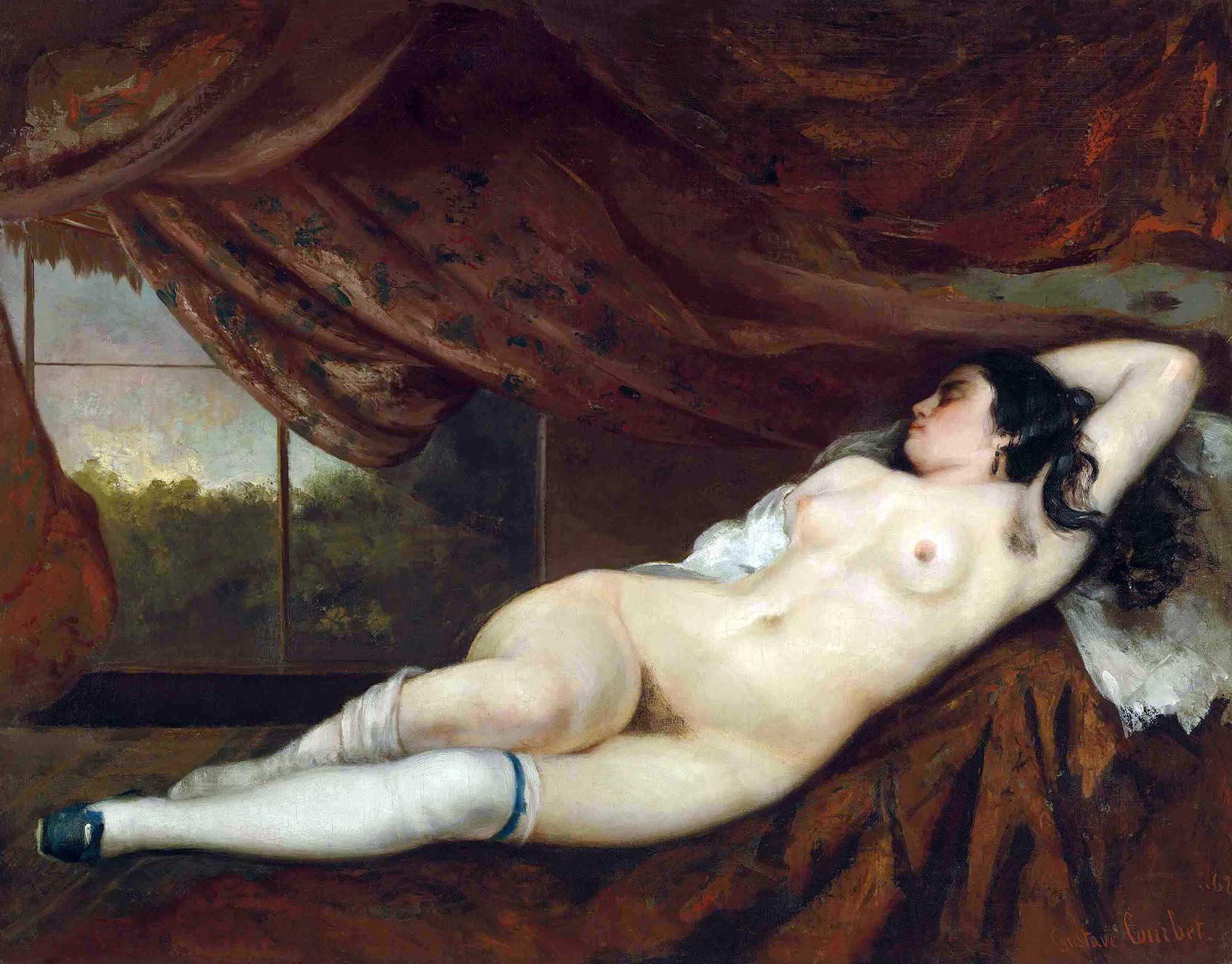
Gustave Courbet, Femme nue couchée, 1862, Oil on canvas, height: 75 cm (29.5 in); width: 97 cm (38.1 in), Private collection
Gustave Courbet’s Femme nue couchée (1862) marks a decisive break from the idealized lineage of the reclining nude. Dispensing with mythological pretext and classical perfection, Courbet presents a woman whose body is rendered with frank, tactile immediacy—flesh that is weighty, lived‑in, and unmistakably real. The pose recalls the long tradition of Venuses, yet Courbet’s naturalism strips away their distance and decorum. His model reclines not as an allegory but as a physical presence, her curves shaped by the artist’s dense, earthy brushwork. In this shift from ideal to real, Courbet challenges the academic canon and asserts a new, modern vision of the nude—one grounded in the body as it exists, not as tradition demands it should be.
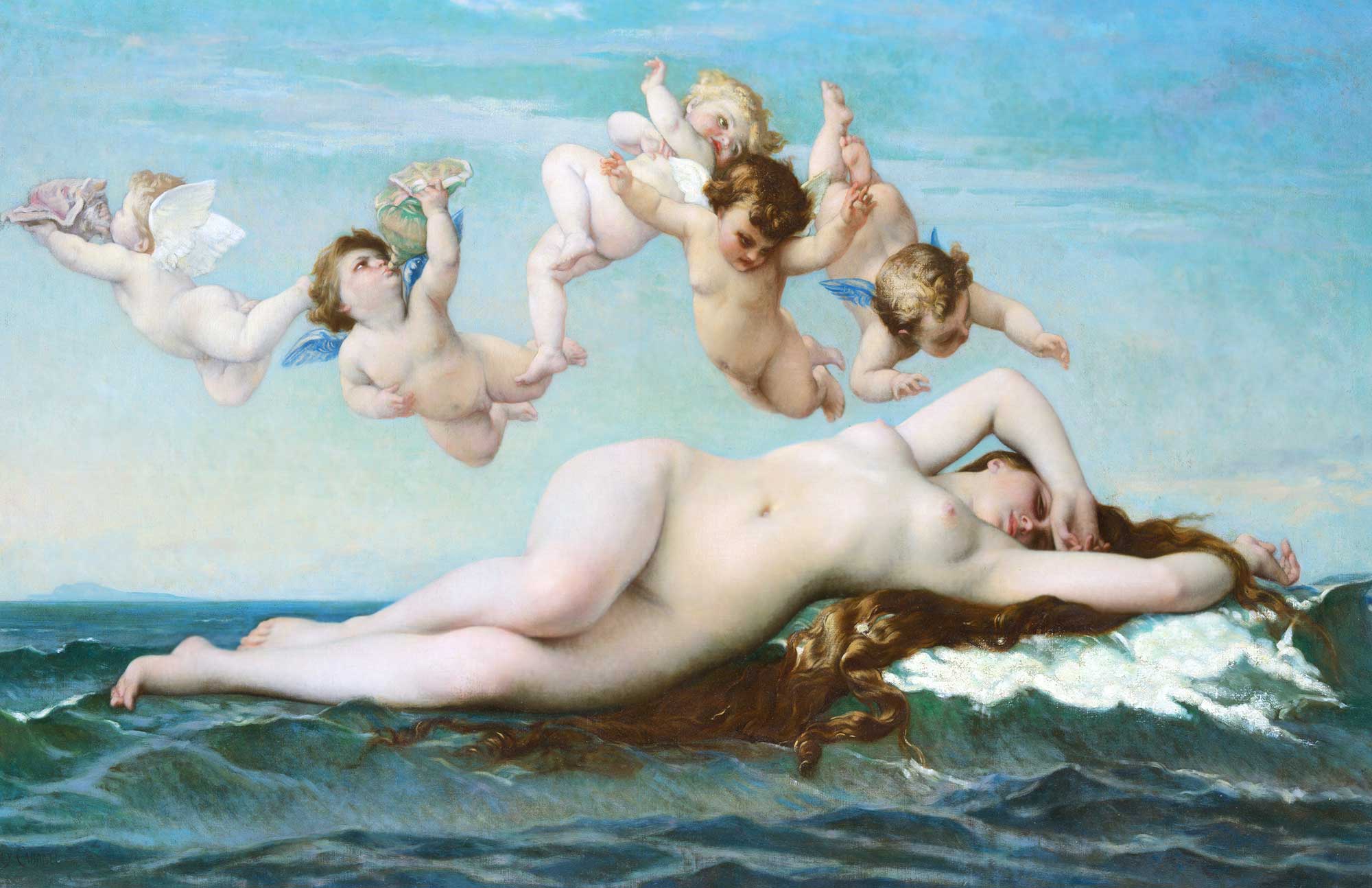
Alexandre Cabanel, Birth of Venus, from the Salon of 1863, oil on canvas, 41 3/4 x 71 7/8 in. (106 x 182.6 cm) The Met, New York City
Alexandre Cabanel’s Birth of Venus (1863) presents the reclining nude at its most opulently idealized, a vision of polished academic perfection unveiled at the Salon the same year Manet scandalized Paris with Olympia. Cabanel’s Venus floats languorously upon a cresting wave, her body rendered in pearly, porcelain tones and softened by a vaporous, almost sugary atmosphere. The coy gesture of her arm, the fluttering putti above, and the seamless finish of the paint surface transform the nude into a confection of divine beauty tailored to Second Empire taste. Celebrated by Napoleon III and embraced as the epitome of academic elegance, the painting reveals how the reclining nude could be recast in the mid‑nineteenth century as a fantasy of immaculate, unthreatening femininity—an image soon to be challenged, and ultimately undone, by the moderns.
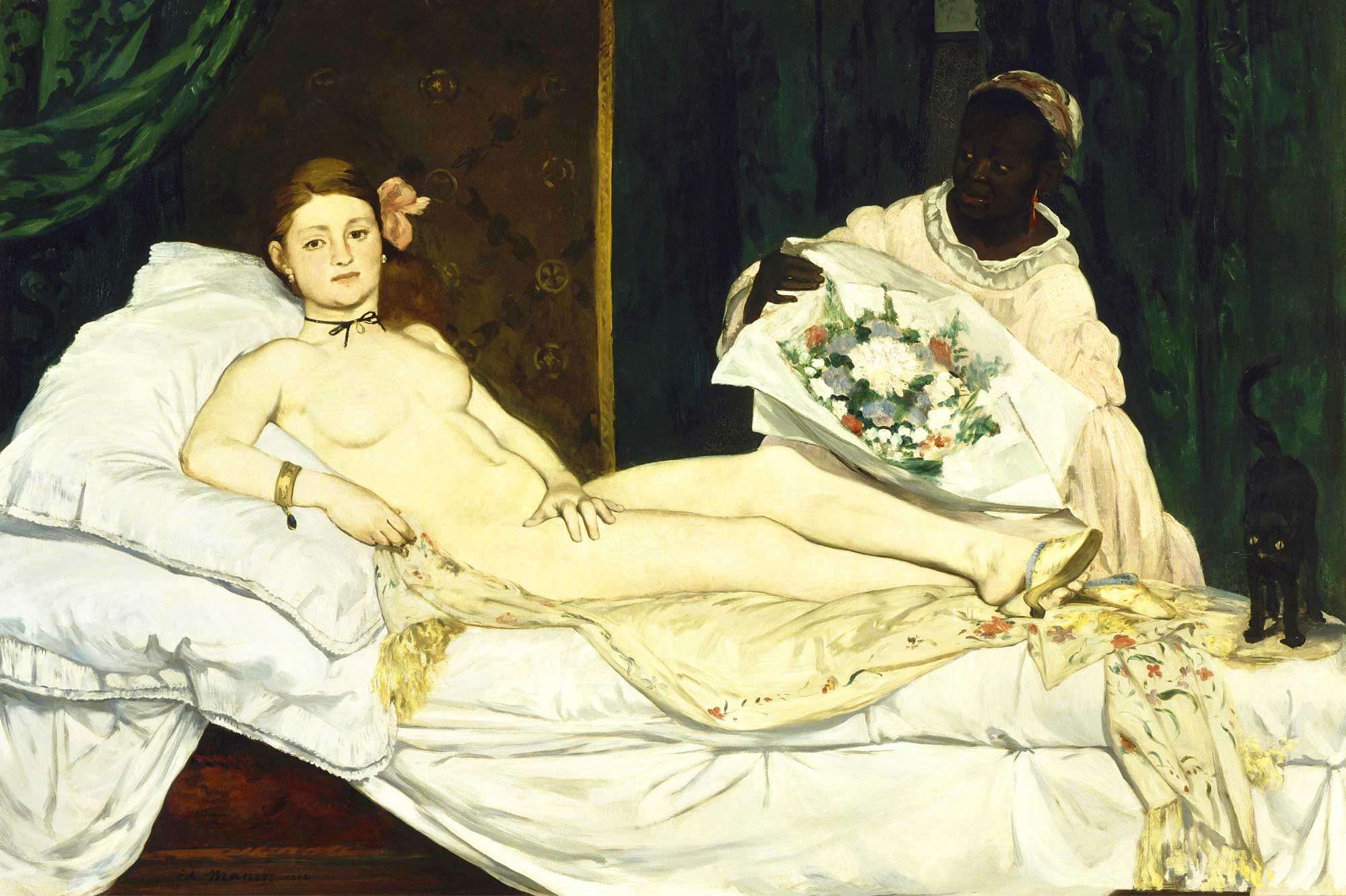
Édouard Manet, Olympia, 1863, Oil on canvas, 130.5 cm × 190 cm (51.4 in × 74.8 in), Musée d'Orsay, Paris
Édouard Manet’s Olympia (1863) dismantled the conventions of the idealized nude with unprecedented clarity. His model is a modern Parisian woman, presented with unflinching directness in a bourgeois interior. The bouquet delivered to her—likely from a clandestine admirer—and the alert black cat at her feet anchor the scene in contemporary social reality. Most radical is Olympia’s gaze: cool, unapologetic, and assessing, it reverses the traditional power dynamic between viewer and subject. A defining shift of modern art is the collapse of the boundary between the “nude” and the “naked.” Goya’s Naked Maja had already presented a specific, contemporary woman rather than a mythological ideal; Manet’s Olympia provoked similar shock nearly seventy years later, not for religious reasons but for its refusal to cloak sexuality in allegory. Instead of a timeless odalisque, Manet offered a woman of his own era, confronting viewers with the realities of their own social and sexual world. What scandalized contemporary audiences was not Olympia’s nudity but her modernity. Her jewelry, orchid, black ribbon, and the black cat replacing Titian’s faithful dog signaled her status as a courtesan. Modeled on the Venus of Urbino, the composition inverts its predecessor’s erotic invitation: Olympia’s hand asserts control rather than offering enticement. Stark lighting, broad brushwork, and her slender, unidealized body further emphasized Manet’s break with academic norms. Critics recoiled at her directness, recognizing in it a decisive rupture with the idealized nude and a cornerstone of modern painting.
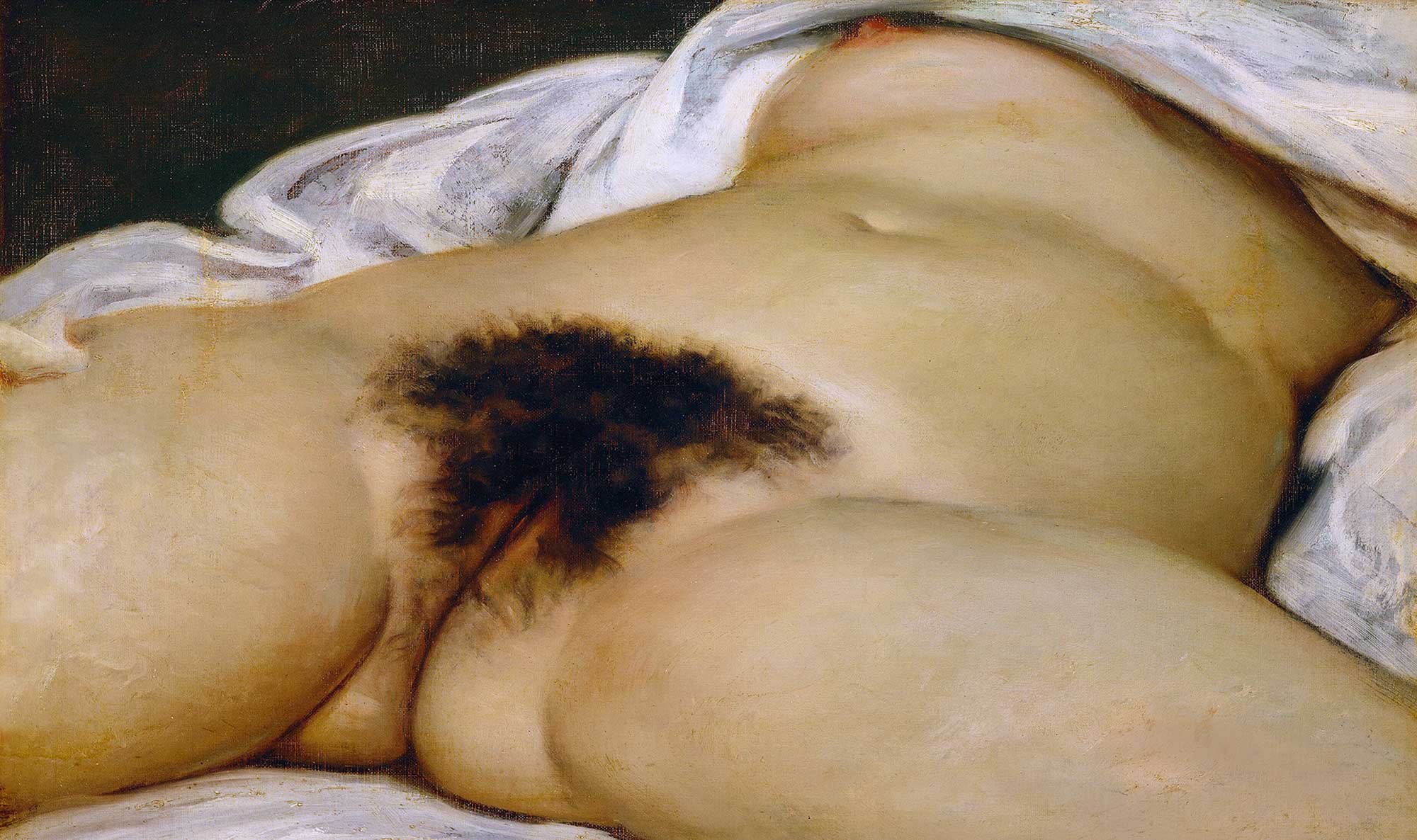
Gustave Courbet, L'Origine du monde, ("The Origin of the World"), 1866, Oil on canvas, 46 cm × 55 cm (18 in × 22 in), Musée d'Orsay, Paris
Gustave Courbet's L'Origine du monde ("The Origin of the World") (1866) is one of the most uncompromising images in the history of the nude, a work that detonates the conventions of the reclining female figure by stripping away every trace of allegory, idealization, or narrative pretext. Commissioned by the Ottoman‑Egyptian diplomat and erotomane Khalil Bey, the painting presents a woman’s torso and genitals in extreme close‑up, cropped so tightly that the body becomes both shockingly direct and insistently real. Courbet’s dense, tactile brushwork—so central to his realism—renders flesh with a frankness that refuses the softening filters of mythology or beauty. In place of Venus, Danaë, or nymph, he gives the viewer an anonymous, unidealized body, transforming the nude from an object of aesthetic contemplation into a confrontation with physical origin itself. Long hidden in private collections and publicly exhibited only in the late twentieth century, L’Origine du monde stands as a radical endpoint in the genealogy of the reclining nude: a moment when the genre collapses into pure corporeality, forcing modern viewers to reckon with the boundary between art, desire, and the politics of looking.
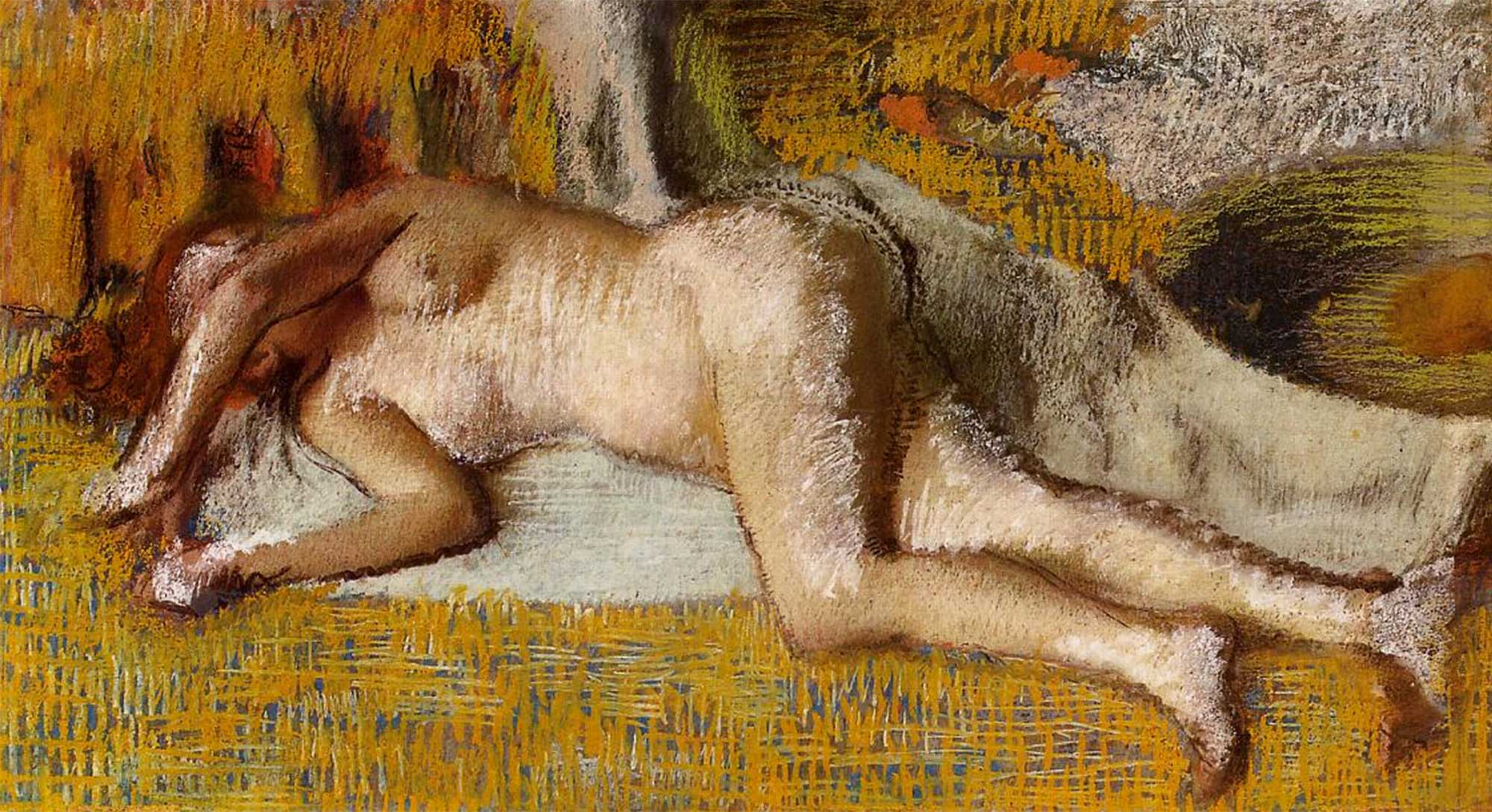
Edgar Degas, Après le bain (femme nue couchée), 1885, pastel on paper, height: 48 cm (18.8 in) width: 88 cm (34.6 in), Private collection
Edgar Degas’s Après le bain (femme nue couchée) (1885) pushes the reclining female figure into the realm of modern, unvarnished intimacy. Seen from above, the woman’s body is twisted in a candid, unidealized pose that rejects the smooth artifice of academic nudes. Degas’s pastel strokes—rapid, granular, and vibrating with color—render flesh as a living surface rather than a perfected form, emphasizing the immediacy of touch and the contingency of the moment. The cropping feels almost photographic, as if the viewer has stumbled upon a private scene, and the awkwardness of the pose underscores Degas’s interest in bodies observed rather than staged. In this work, the reclining nude becomes a study in modern vision: unsentimental, fragmentary, and grounded in the raw physicality of everyday life.
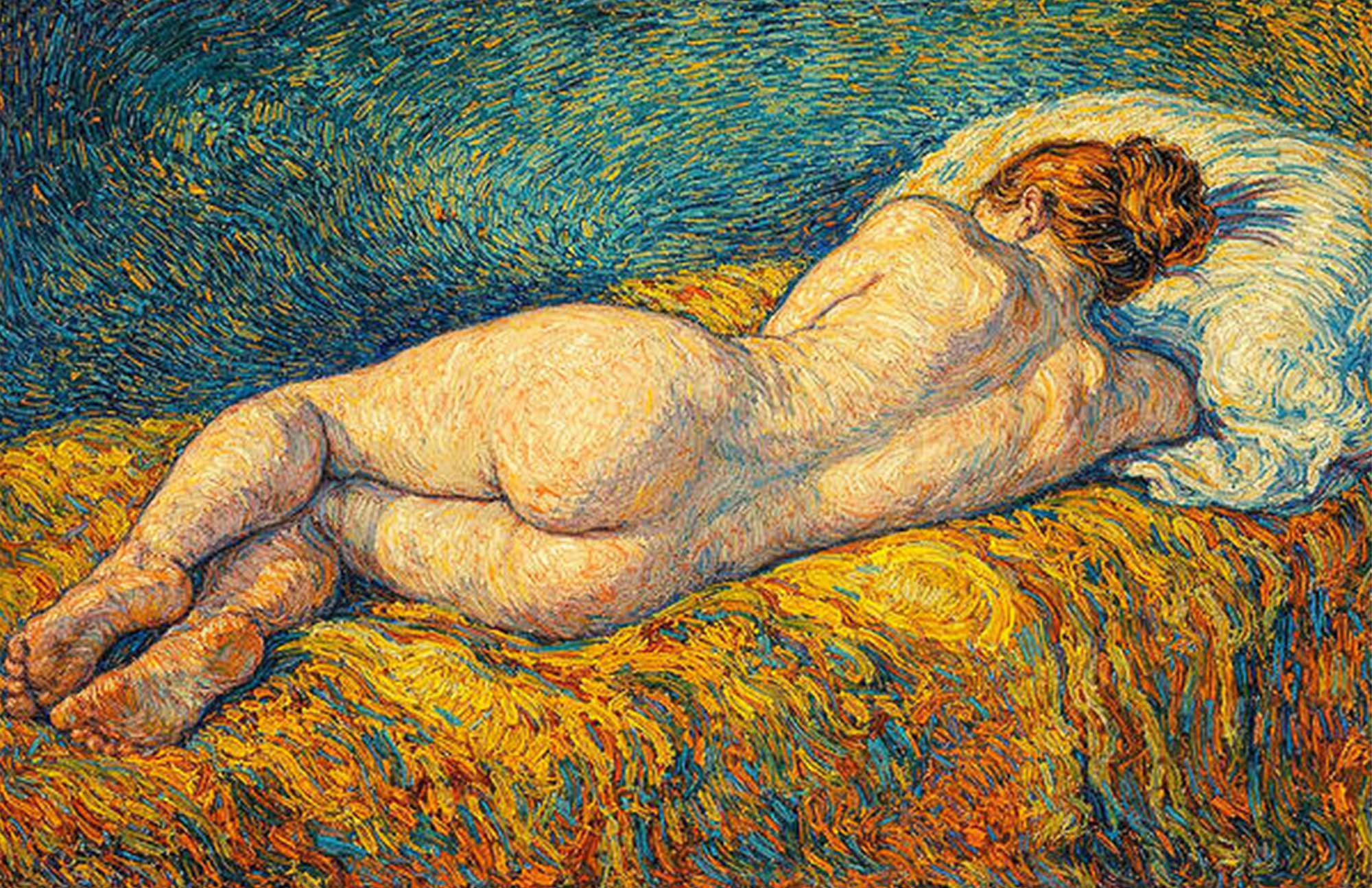
Vincent van Gogh, Recumbent Nude, 1887, oil-on-canvas, Kröller-Müller Museum, Otterlo, Netherlands
Vincent van Gogh’s Recumbent Nude (1887) reimagines the reclining female figure through the charged immediacy of his Paris period, when he was absorbing the chromatic daring of the Impressionists and the structural clarity of Japanese prints. The model’s body—outlined in firm, expressive contours and set against a field of vibrating complementary color—feels at once solid and flickering, a form caught in the act of becoming. Van Gogh rejects the soft eroticism of academic nudes in favor of a raw, searching directness: the pose is unidealized, the flesh modeled with abrupt strokes, the space compressed into a shallow, almost decorative plane. In this work, the reclining nude becomes a site of experimentation rather than seduction, marking van Gogh’s shift toward a modern vision in which the body is less an object of beauty than a catalyst for expressive intensity.
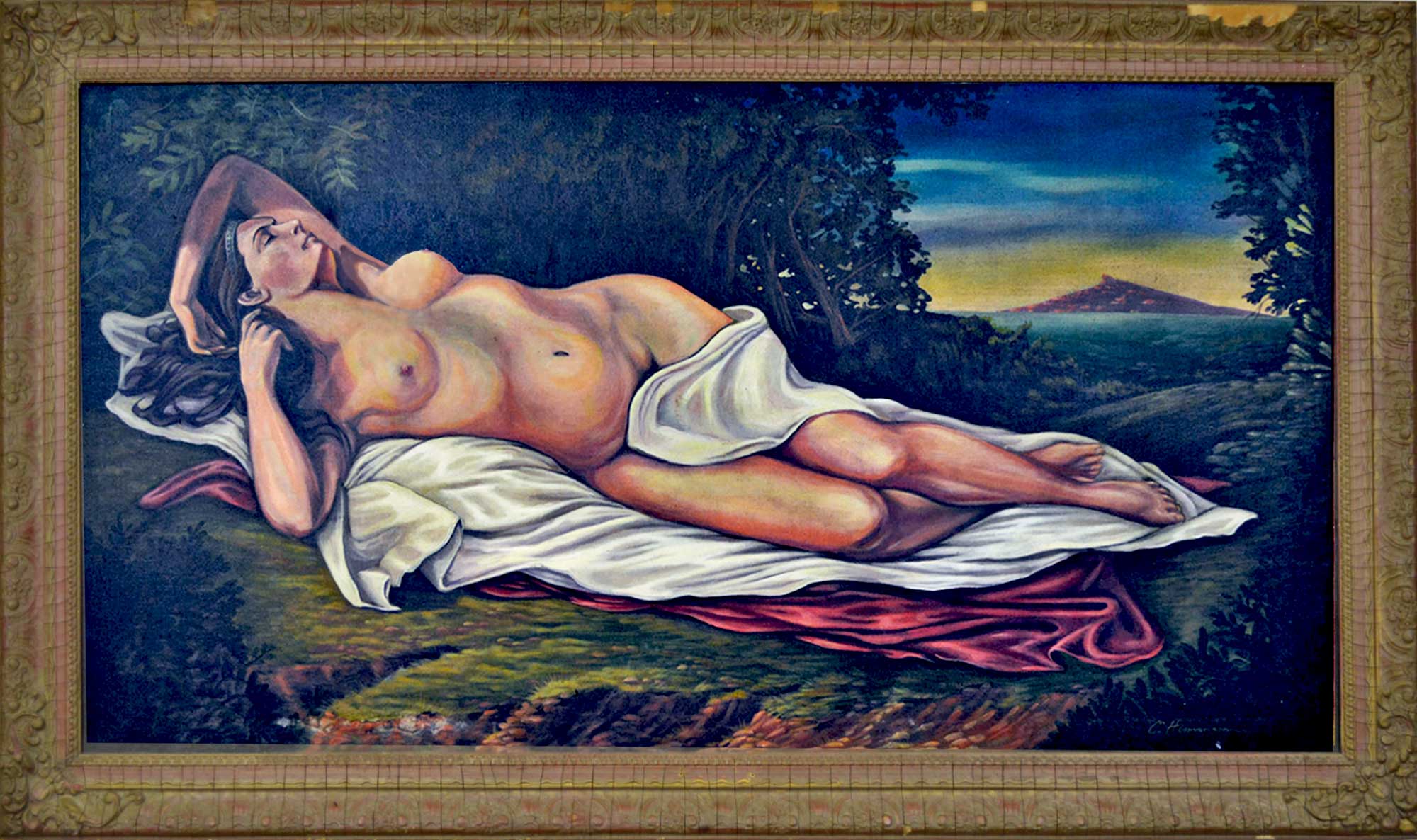
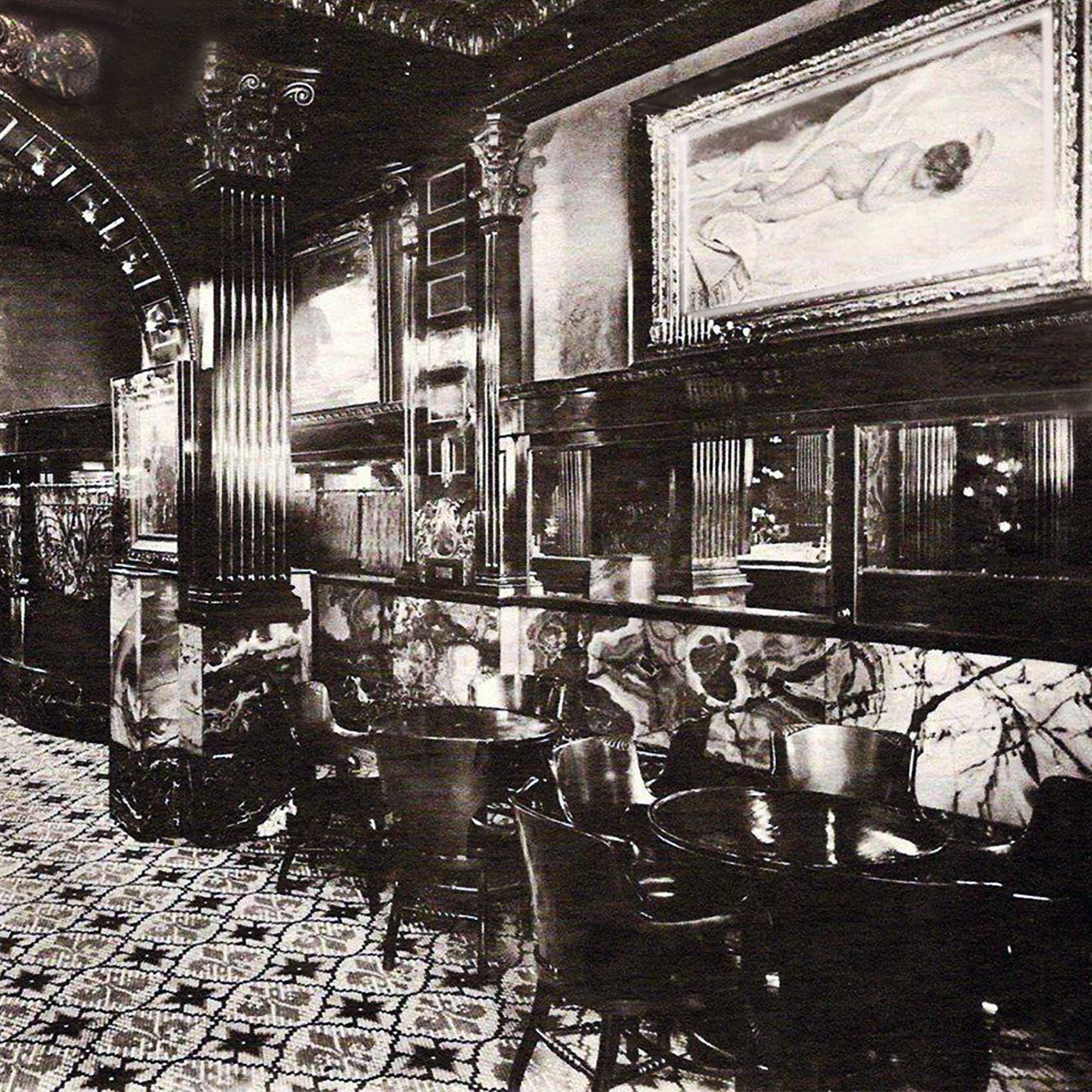
Ghost town saloon reclining nude, 1890, artist unknown, oil paint on canvas, from the Bloated Goat Saloon, in the deserted town of Flatwater, Mississippi
The Saloon Reclining Nude (1890) hung above bars in frontier taverns, mining camps, and railroad towns—became one of the most recognizable images of the American West. Borrowing from European traditions but stripped of classical pretense, these figures translated the lineage of Venus, Danaë, and the Maja into a distinctly American vernacular. No longer mythological ideals, they were mass‑produced fantasies: chromolithographs, pin‑ups, and studio photographs designed for a rough, male‑dominated world. In this setting, the nude functioned as a secular altar, presiding over drinking, gambling, and the rituals of masculine bravado. She offered both escape and illusion—a promise of sensuality in a landscape marked by scarcity, violence, and uncertainty. Unlike the allegorical nudes of Europe, the saloon nude was unapologetically direct, rooted in commerce, desire, and spectacle. At the same time, this democratized Venus signals a broader cultural shift. As art moved from elite patronage to popular consumption, the reclining nude became accessible to miners, cowboys, and drifters—men far removed from the museums and courts where the genre originated. The saloon nude thus marks a pivotal moment when high art’s most enduring motif entered everyday life, reshaped by the fantasies and anxieties of a rapidly expanding nation. She is the reclining nude recast for a new democracy: unrefined, unfiltered, and unmistakably American.
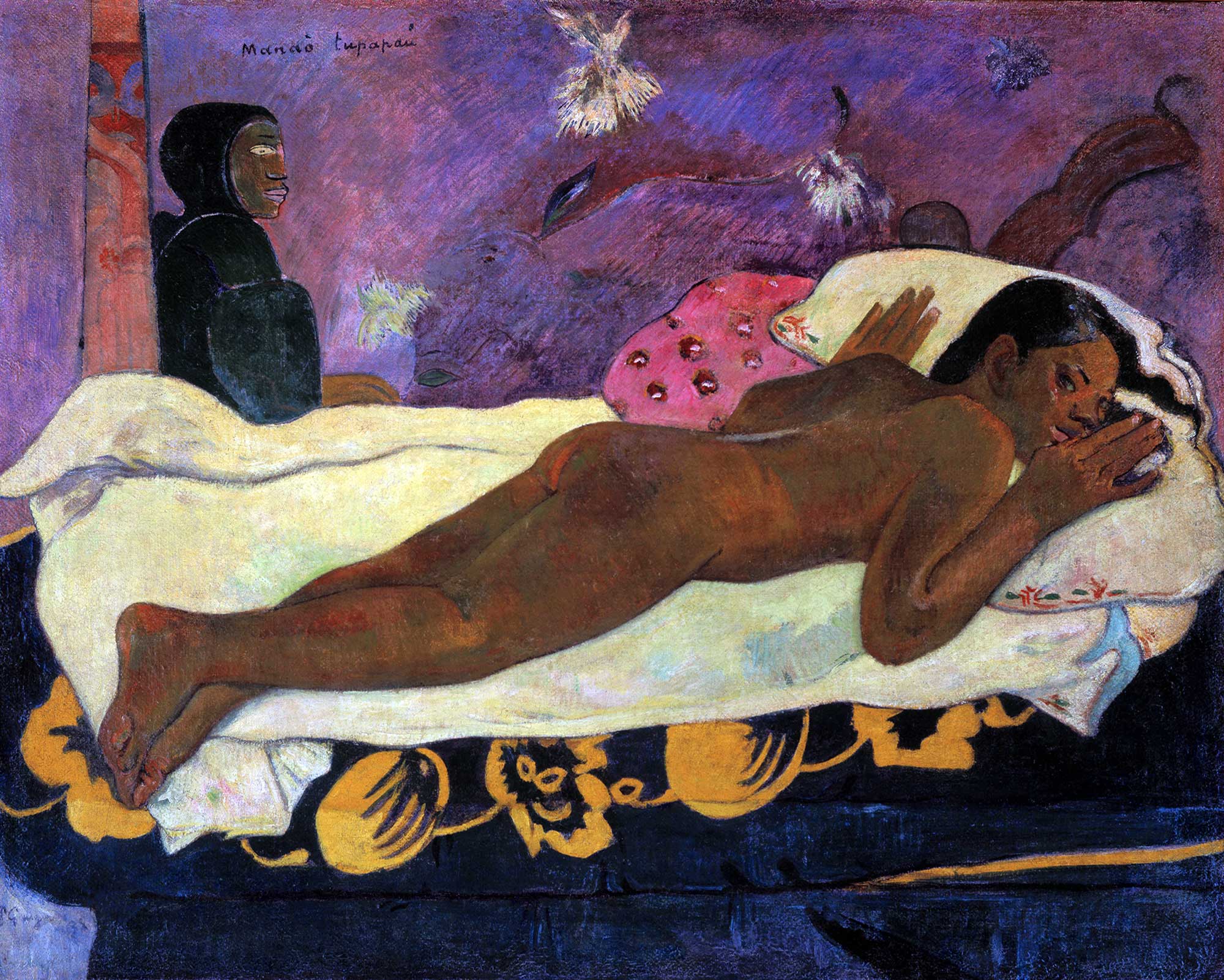
Paul Gauguin, Spirit of the Dead Watching, 1892, oil on hessian mounted on canvas, Albright–Knox Art Gallery, Buffalo, NY
Paul Gauguin’s Spirit of the Dead Watching (1892) reimagines the reclining female figure through the lens of Tahitian mythology, colonial fantasy, and personal projection. The young girl—often identified as Teha’amana, Gauguin’s teenage companion—lies face‑down in fear, her body illuminated by an eerie violet glow that replaces the warm sensuality of the European nude with something far more unsettling. Behind her, a shadowy figure evokes the tupapau, a spirit of the dead from Polynesian belief. Gauguin merges this local mythology with his own Symbolist imagination, creating a scene where desire, dread, and cultural misunderstanding collide. The painting stands as one of the most psychologically charged entries in the history of the reclining nude: a body not idealized or inviting, but vulnerable, haunted, and suspended between eroticism and terror.
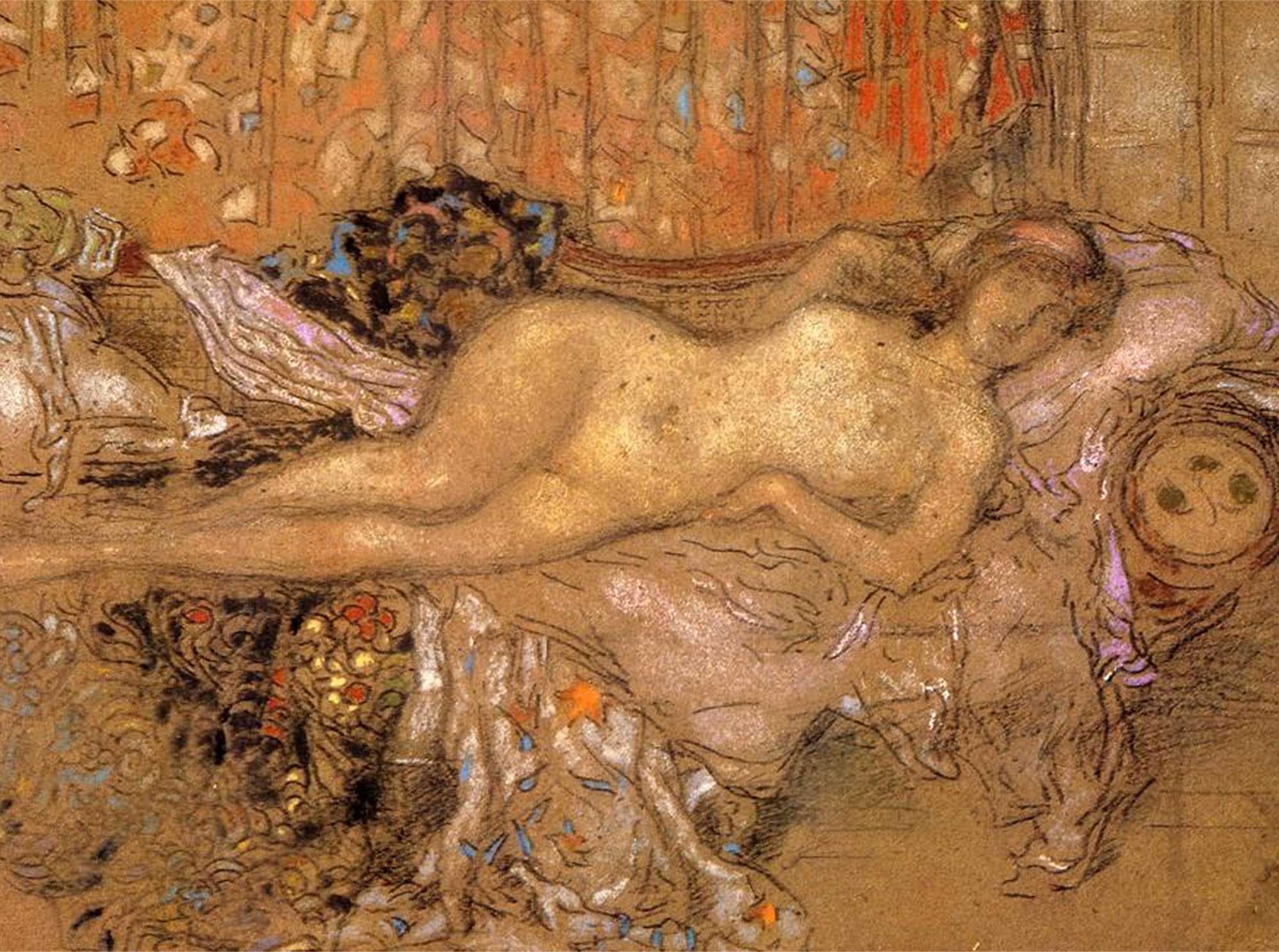
James Mcneill Whistler, The Arabian, 1892, Hunterian Museum, Glasgow Scotland
James Mcneill Whistler’s The Arabian (1892) offers a quiet, tonal reinterpretation of the reclining nude, filtered through the era’s taste for Orientalist fantasy. The figure reclines with languid ease, her body softened into a harmony of muted color and shadow. Rather than emphasizing sensuality or narrative, Whistler creates an atmosphere of contemplative reverie, where the exotic setting becomes a backdrop for his pursuit of pure aesthetic harmony. In this work, the reclining nude becomes less an object of desire than a study in mood, restraint, and visual music.
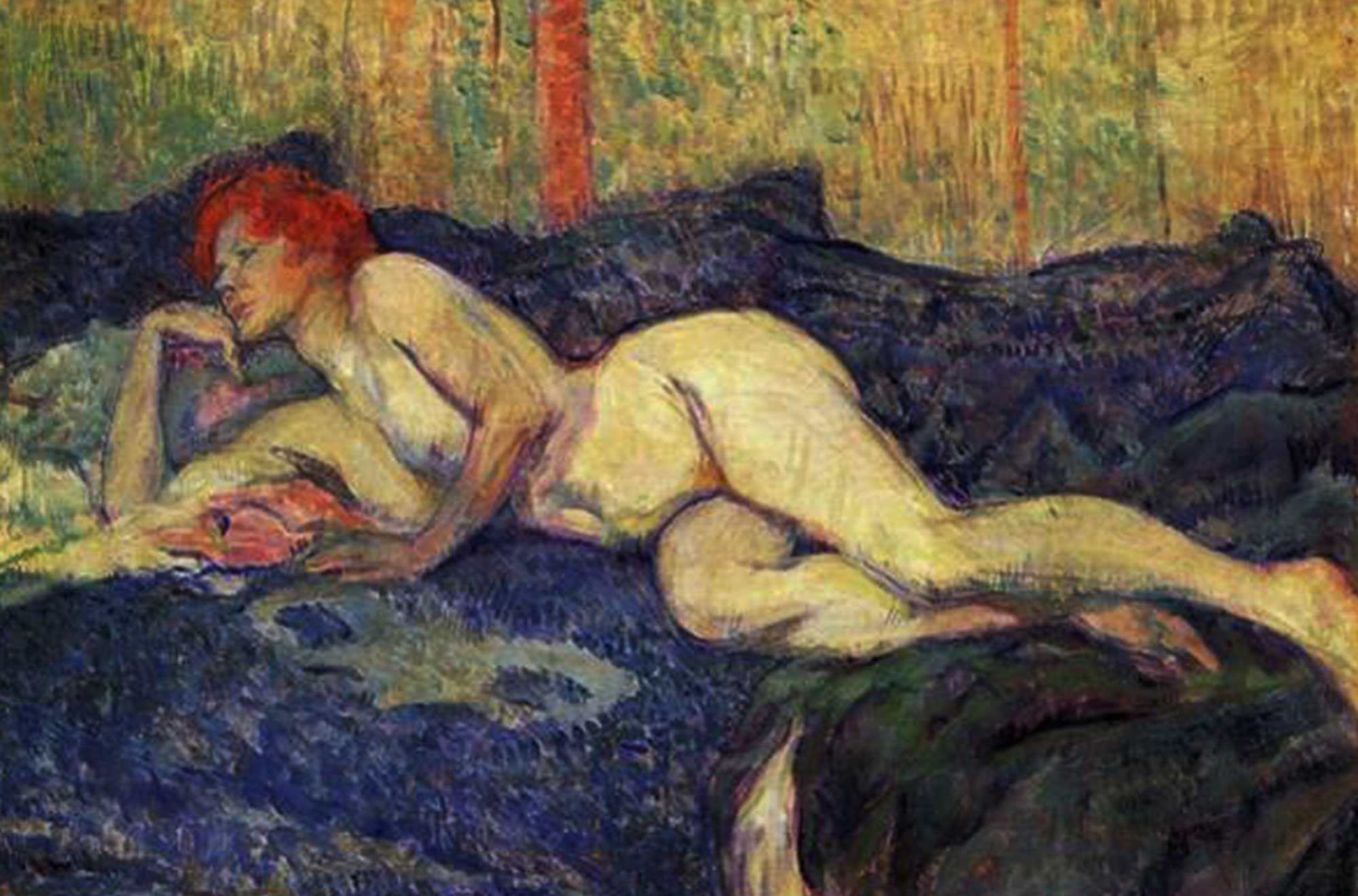
Henri de Toulouse Lautrec, Nude Lying on a Couch, 1897, 22x30cm, oil on cardboard, Barnes Foundation, Philadelphia
Henri de Toulouse‑Lautrec’s Nude Lying on a Couch (1897) brings the reclining nude into the realm of private, unguarded observation, far from the idealized poses of the academic tradition. The model’s body—soft, unposed, and turned partly away—feels captured in a moment of genuine rest rather than staged display. Lautrec’s quick, economical line and muted, powdery palette heighten the sense of immediacy, as if the viewer has entered a quiet room where the subject remains unaware of being seen. The surrounding space is sparse, almost provisional, emphasizing the intimacy of the encounter and the artist’s fascination with the everyday realities of women’s lives in Montmartre. In this work, the reclining nude becomes a study in tenderness and truth: a body observed without judgment, rendered with the frank, humane modernity that defines Lautrec’s vision.
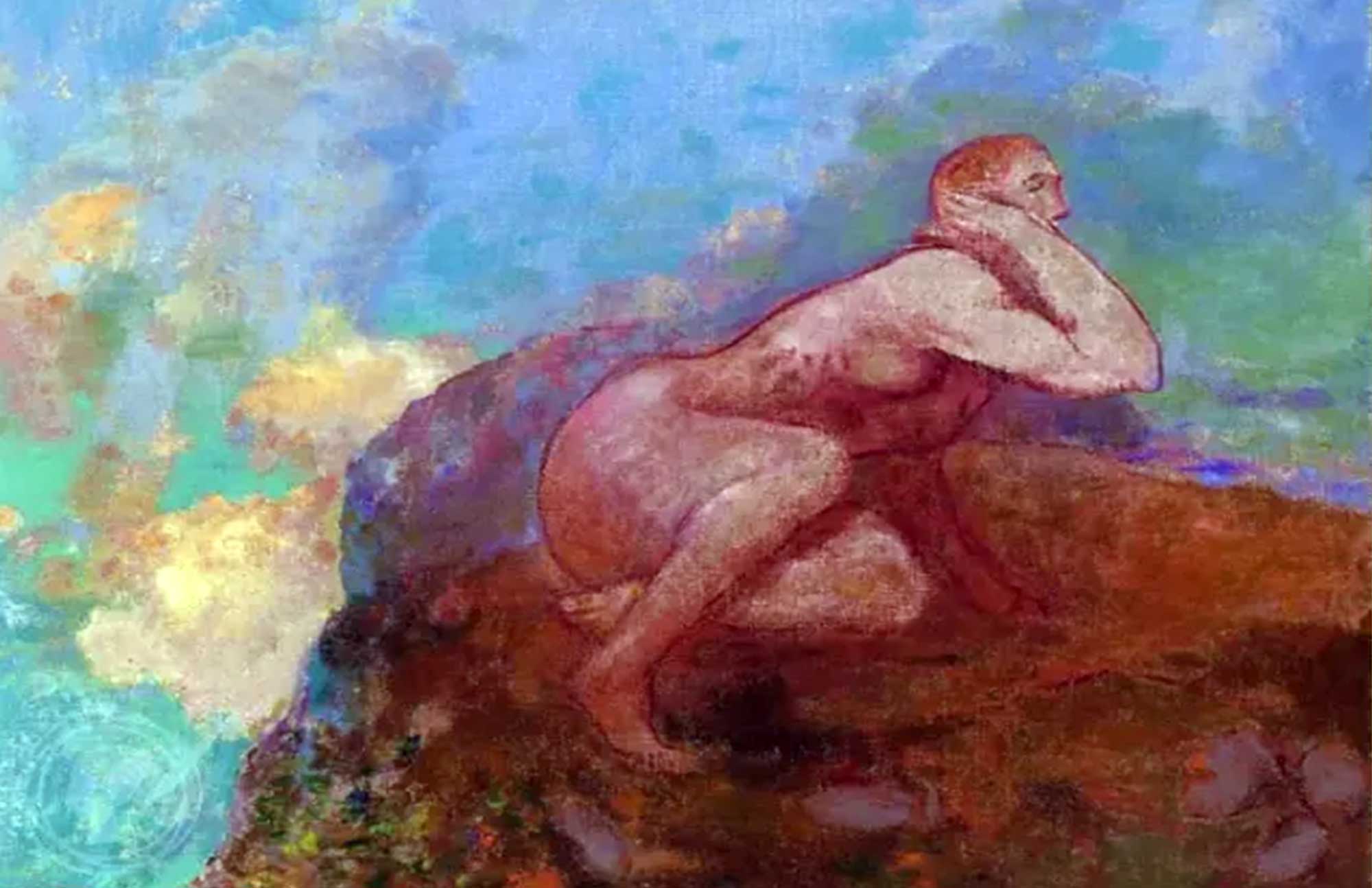
Odilon Redon, French Symbolist painter, Femme nue au rocher, 1900, oil on canvas, 
Odilon Redon’s Femme nue au rocher (1900) transforms the reclining nude into a dream‑image suspended between material presence and visionary atmosphere. The figure lies against a rocky outcrop, her body modeled with a gentle, pearly luminosity that seems to glow from within rather than reflect external light. Redon softens contour into haze, dissolving the boundary between flesh and landscape so that the nude appears to hover in a state of reverie. The surrounding space—part earth, part ether—evokes the Symbolist desire to locate the human body within realms of imagination and inner vision rather than classical nature. In this work, the reclining nude becomes an apparition: serene, remote, and touched by the mystical inwardness that defines Redon’s art at the turn of the century.
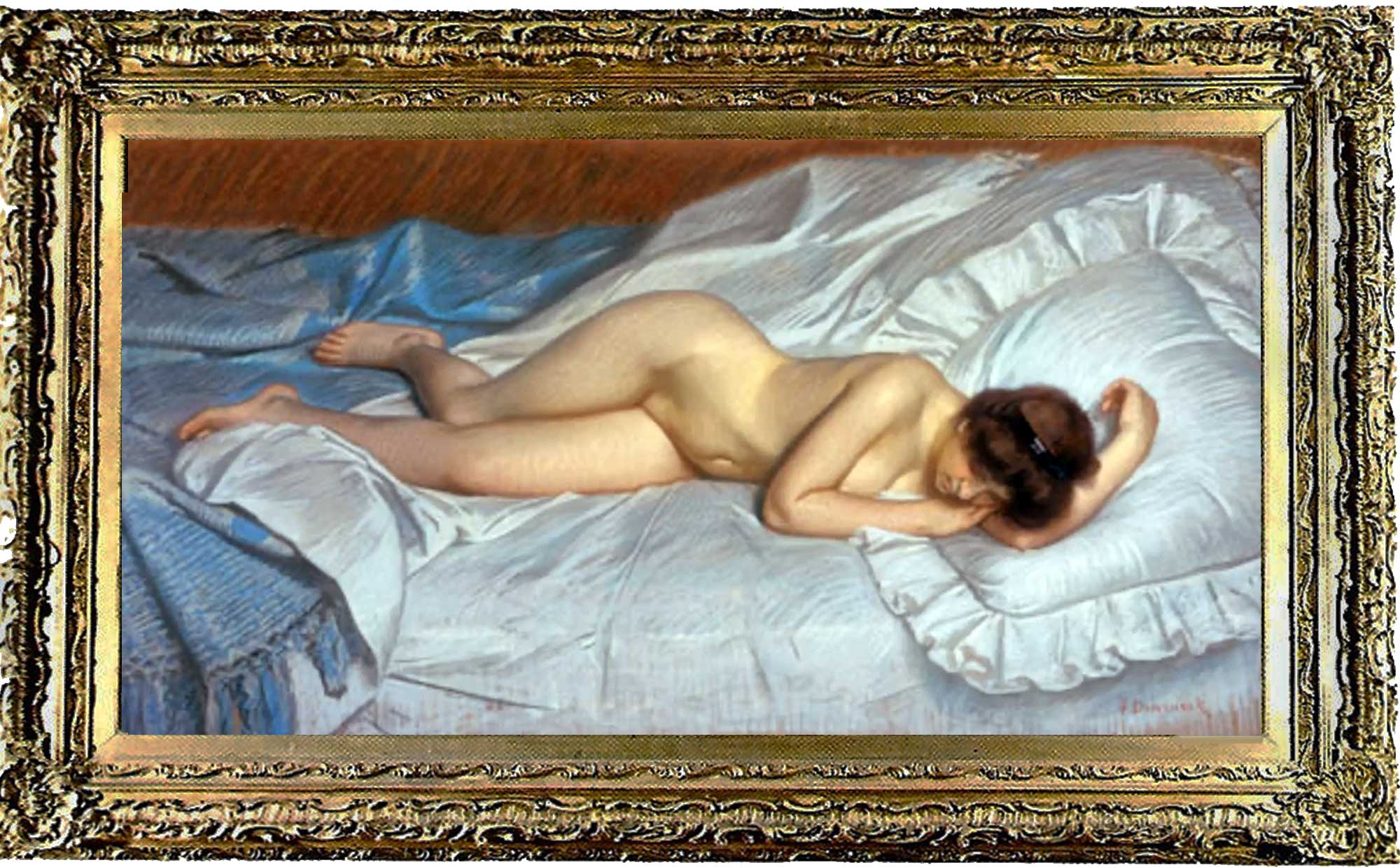
Frank Duveneck, Siesta, pastel on canvas, 1902, (Now in the Cincinnati Art Museum)
Frank Duveneck's life sized pastel nude in Foucar's bar saloon, downtown Cincinnati, 1902
Frank Duveneck’s Siesta (1902), a pastel on canvas, offers an unexpectedly intimate American variation on the reclining nude at the turn of the twentieth century. Though Duveneck is best known for his vigorous portraits and Munich‑trained bravura, here he turns toward a quieter, more atmospheric sensuality. The figure reclines with an ease that borders on languor, her body rendered in velvety pastel tones that soften the contours and dissolve the scene into a haze of warmth and repose. A saloon nude in the literal sense, Siesta resonates with the era’s popular imagery of reclining women—bridging the gap between high art and the vernacular fantasies circulating in American visual culture. Duveneck’s treatment elevates the motif beyond commercial pin‑up conventions, infusing it with tenderness, introspection, and painterly refinement. In this way, Siesta becomes a transitional moment: an American artist absorbing the long European lineage of the reclining nude while brushing against the emerging, democratized imagery that would soon dominate saloon walls and popular print culture.
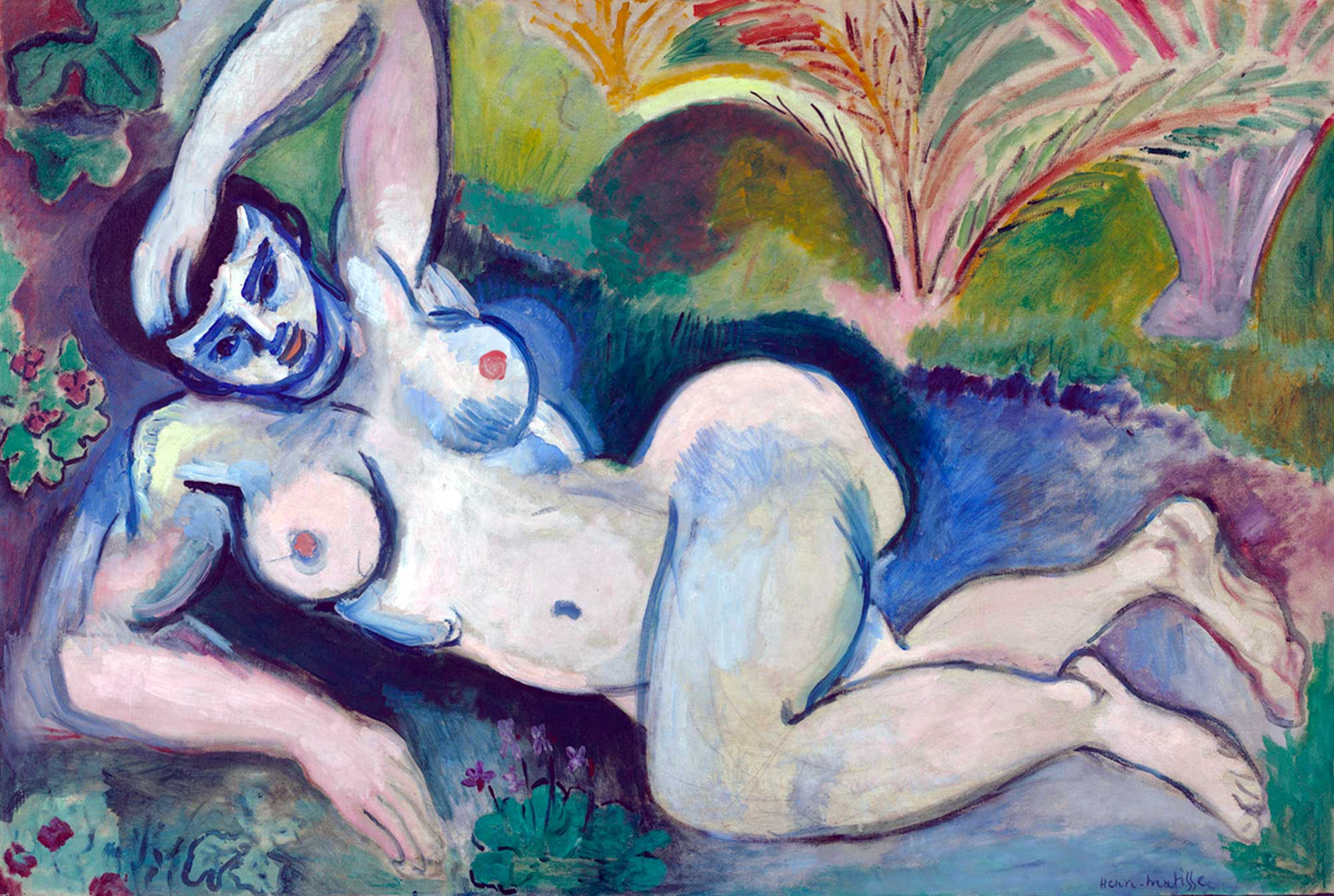
Henri Matisse, The Blue Nude (Souvenir of Biskra), 1907, Baltimore Museum of Art, Baltimore
Matisse’s Blue Nude (Souvenir of Biskra) (1907) detonates into the genealogy of the reclining nude like a provocation—an image that refuses the soft harmonies of the academic odalisque and instead asserts the body as a site of rupture, force, and modernity. Painted after Matisse’s North African travels, the figure is carved rather than caressed: limbs torque into angular, almost sculptural planes, the blue shadows slicing across her skin like a new syntax of desire. This is not the languid, compliant nude of the salon but a body that resists containment, its pose both defensive and confrontational. The palette—acidic greens, burning oranges, and that electric blue—signals Matisse’s break with naturalism and his embrace of Fauvist intensity. In this work, the reclining nude becomes a catalyst for modernism’s reordering of form, color, and the politics of looking, a figure whose very distortion announces a new, unruly freedom.
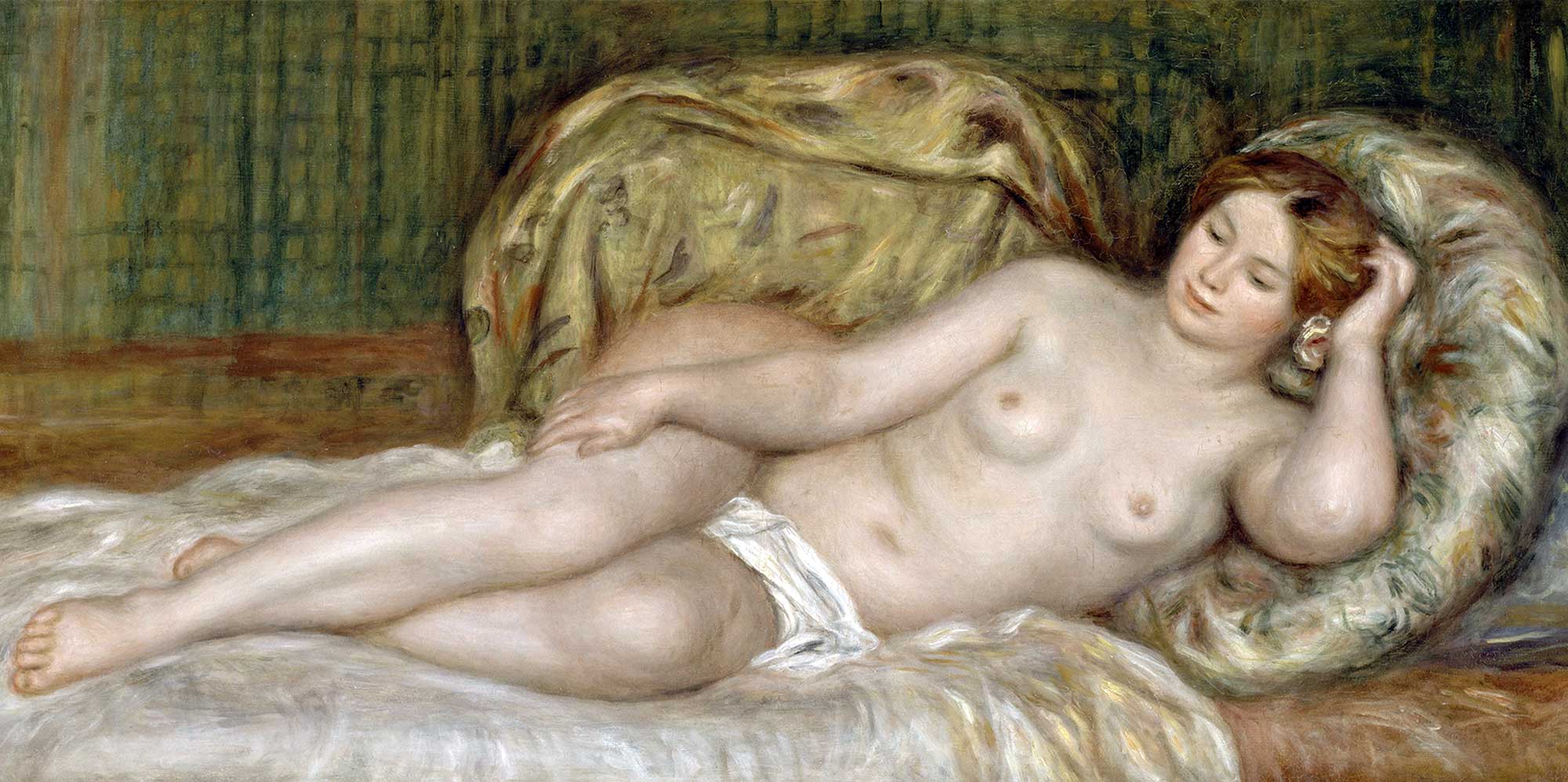
Pierre Auguste Renoir, Grand nu (Nu sur les coussins), 1907, oil on canvas, height: 70 cm (27.5 in); width: 155 cm (61 in), Musée d'Orsay
Pierre‑Auguste Renoir’s Grand nu (Nu sur les coussins) (1907) reasserts the sensual fullness of the female body at a moment when Impressionism was redefining modern vision. Bathed in warm, diffused light, Renoir’s model stretches across the canvas with a luxuriant softness that dissolves contour into shimmering color. Her rounded forms—so characteristic of Renoir’s mature style—reject classical idealization in favor of a more tactile, lived corporeality. The surrounding fabrics and flushed skin tones merge in a haze of brushwork that makes the body feel both immediate and enveloped by atmosphere. In this work, the reclining nude becomes less a mythic archetype than a celebration of physical presence itself, marking Renoir’s distinct contribution to the modern reinvention of the genre.
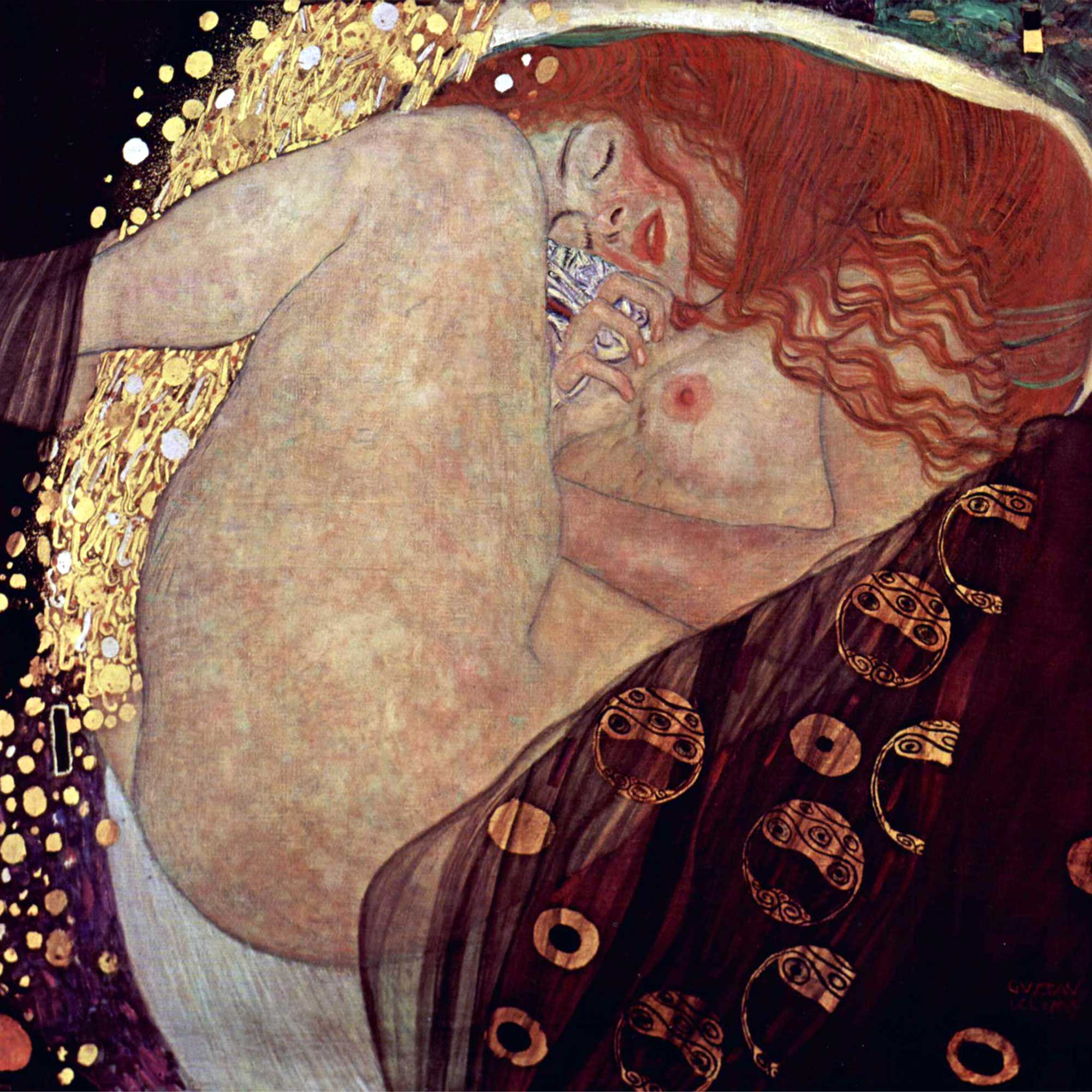
Gustav Klimt, Danaë, 1907, oil on canvas, in the art collection of Hans Dichand, Vienna, 77 cm × 83 cm (30 in × 33 in)
Gustav Klimt’s Danaë (1907) reinterprets the classical subject through the lens of Viennese Symbolism. Enveloped in a purple veil signifying her royal lineage, Danaë receives the divine presence of Zeus, represented as a cascade of golden light. Klimt’s treatment emphasizes transcendence, sensuality, and the merging of mortal and divine. The theme of Danaë—long associated with erotic transformation—appears throughout Klimt’s oeuvre, including works such as Medicine and Water Snakes, where mythological subjects become vehicles for exploring desire, spirituality, and the unconscious.
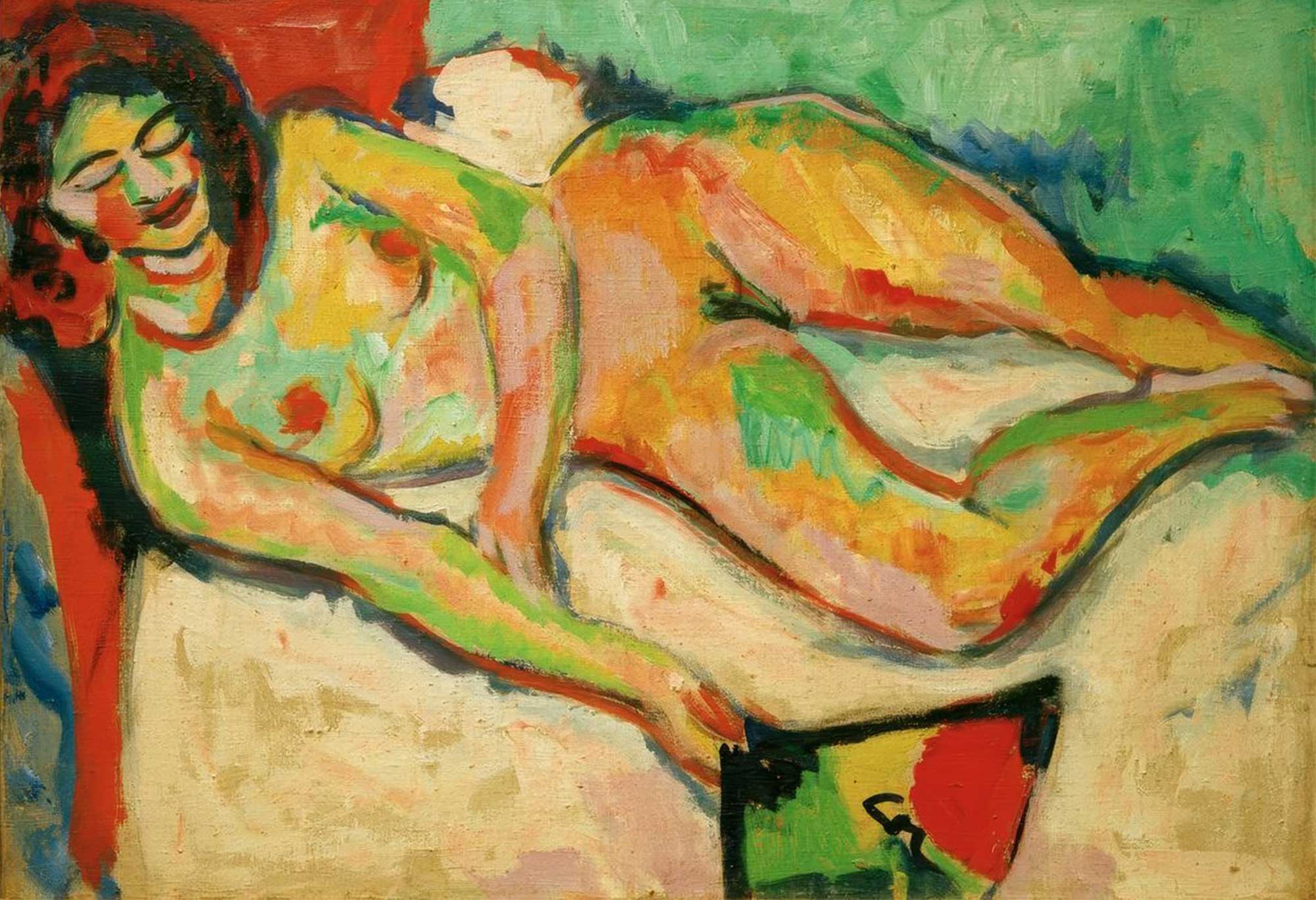
Ernst Ludwig Kirchner, Reclining Nude with Fan, 1909, Kunsthalle Bremen Museum, Germany
Ernst Ludwig Kirchner’s Reclining Nude with Fan (1909) thrusts the reclining female figure into the raw, electric language of early German Expressionism. The model’s body—angular, elongated, and outlined in urgent, slashing strokes—rejects the softness and sensual ease of nineteenth‑century nudes. Kirchner’s acidic palette and compressed, unstable space heighten the sense of psychological immediacy, turning the pose into an encounter charged with nervous energy rather than repose. The fan, held awkwardly across the torso, reads less as an accessory than as a jagged punctuation mark within the composition’s rhythmic distortions. In this work, the reclining nude becomes a site of modern anxiety and desire, a figure shaped not by ideal beauty but by the volatile, subjective intensity that defines Kirchner’s art on the eve of Die Brücke.
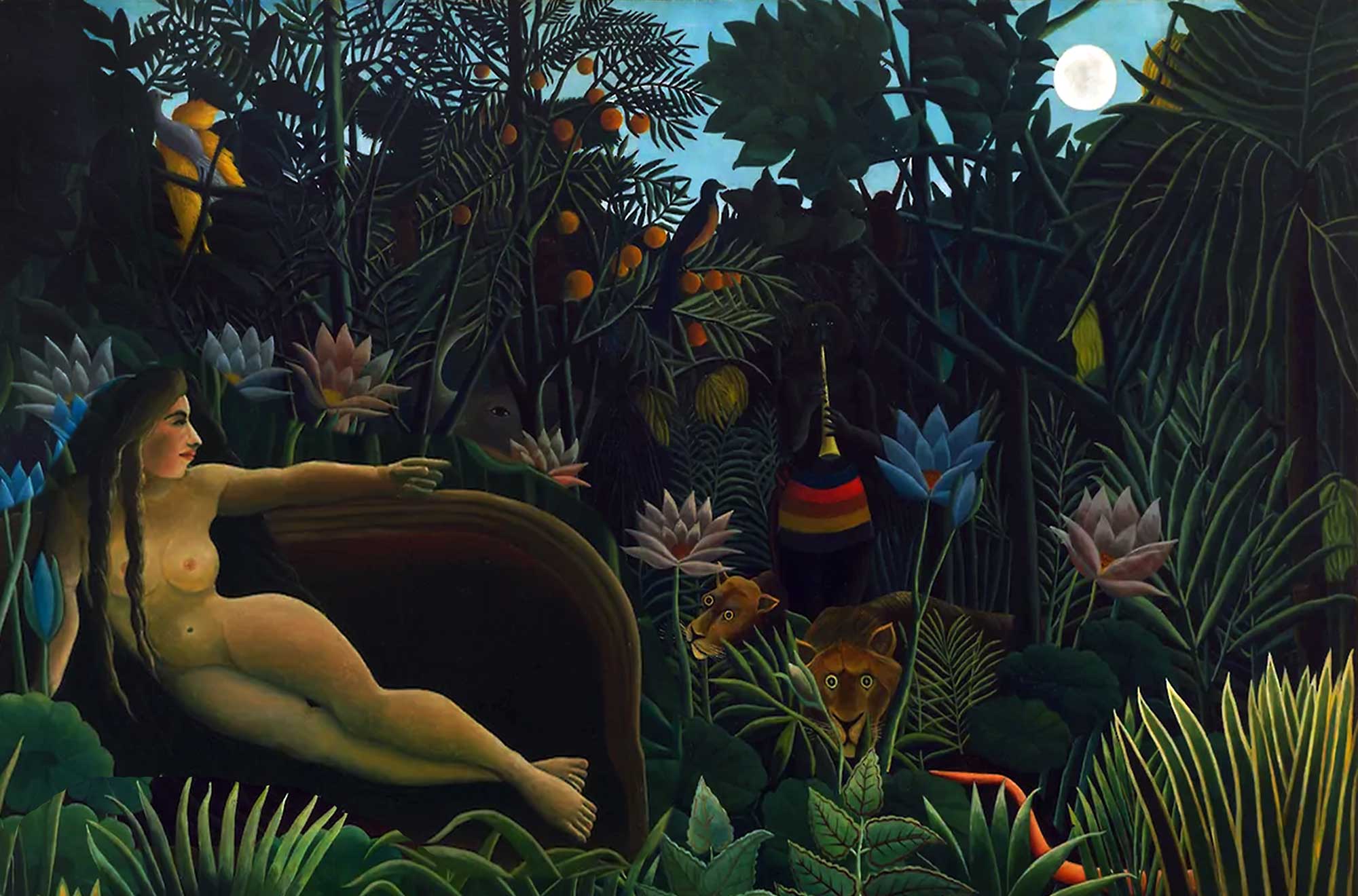
Henri Rousseau, Le Rêve, (The Dream), 1910, Oil on canvas, 204.5 cm × 298.5 cm (80.5 in × 117.5 in), Museum of Modern Art, New York
Henri Rousseau’s Le Rêve (1910) transports the reclining nude into an oneiric, otherworldly realm. The figure—Yadwigha, Rousseau’s Polish muse—reclines on a plush sofa improbably situated in a lush, fantastical jungle teeming with oversized foliage, exotic animals, and a mysterious flute‑playing figure. Unlike the sensual immediacy of Titian or the psychological tension of Gauguin, Rousseau’s nude exists in a space of pure dream logic, suspended between innocence and eroticism, domestic comfort and wild, untamed nature. Her calm, self‑possessed pose anchors the painting’s surreal disjunctions, turning the reclining body into a portal between waking life and the subconscious. In Le Rêve, the nude becomes not an object of desire or mythic narrative but the dreamer herself—an emblem of imagination’s boundless, unpredictable terrain.
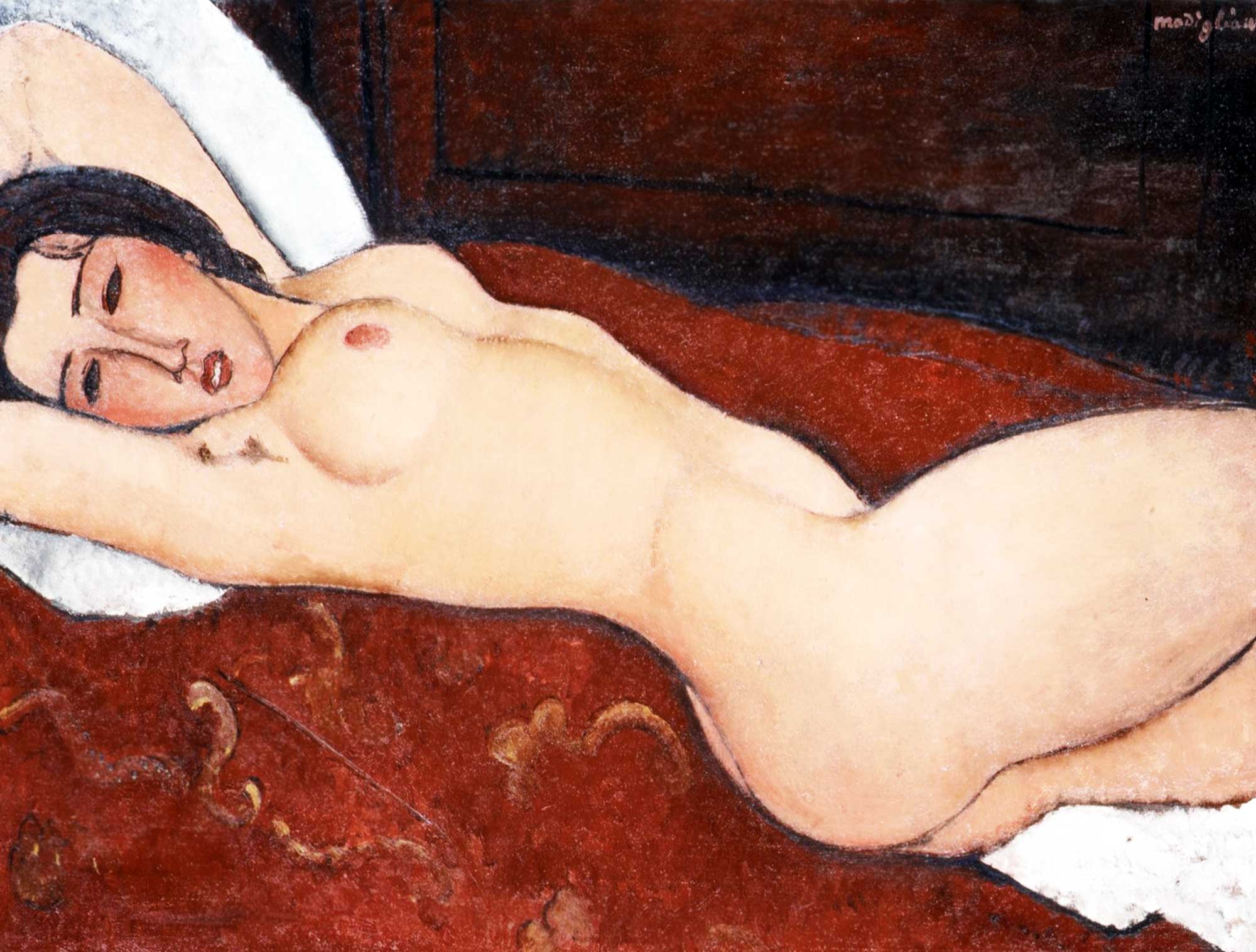
Amedeo Modigliani, Reclining Nude, 1917, Oil on canvas, 60.6 x 92.7 cm (23 7/8 x 36 1/2 in), Oil on canvas, 60.6 x 92.7 cm (23 7/8 x 36 1/2 in), Metropolitan Museum of Art, New York City
Amedeo Modigliani’s Reclining Nude (1917) redefines the classical pose through the lens of modernism, reducing the body to a lyrical interplay of elongated curves, warm flesh tones, and sculptural simplicity. Painted during his explosive 1917 exhibition—shut down by police for indecency—the work embodies both sensual immediacy and formal abstraction. The model’s unabashed pose, her direct, unflinching presence, and the rhythmic sweep of Modigliani’s line collapse the distance between viewer and subject. Gone are the mythological veils of Titian or the psychological narratives of Rembrandt; instead, Modigliani offers a nude who is at once timeless and unmistakably modern, her body transformed into a vessel of pure form, desire, and painterly elegance. In this moment, the reclining nude becomes a modern icon—stripped down, stylized, and charged with a quiet, radical confidence.
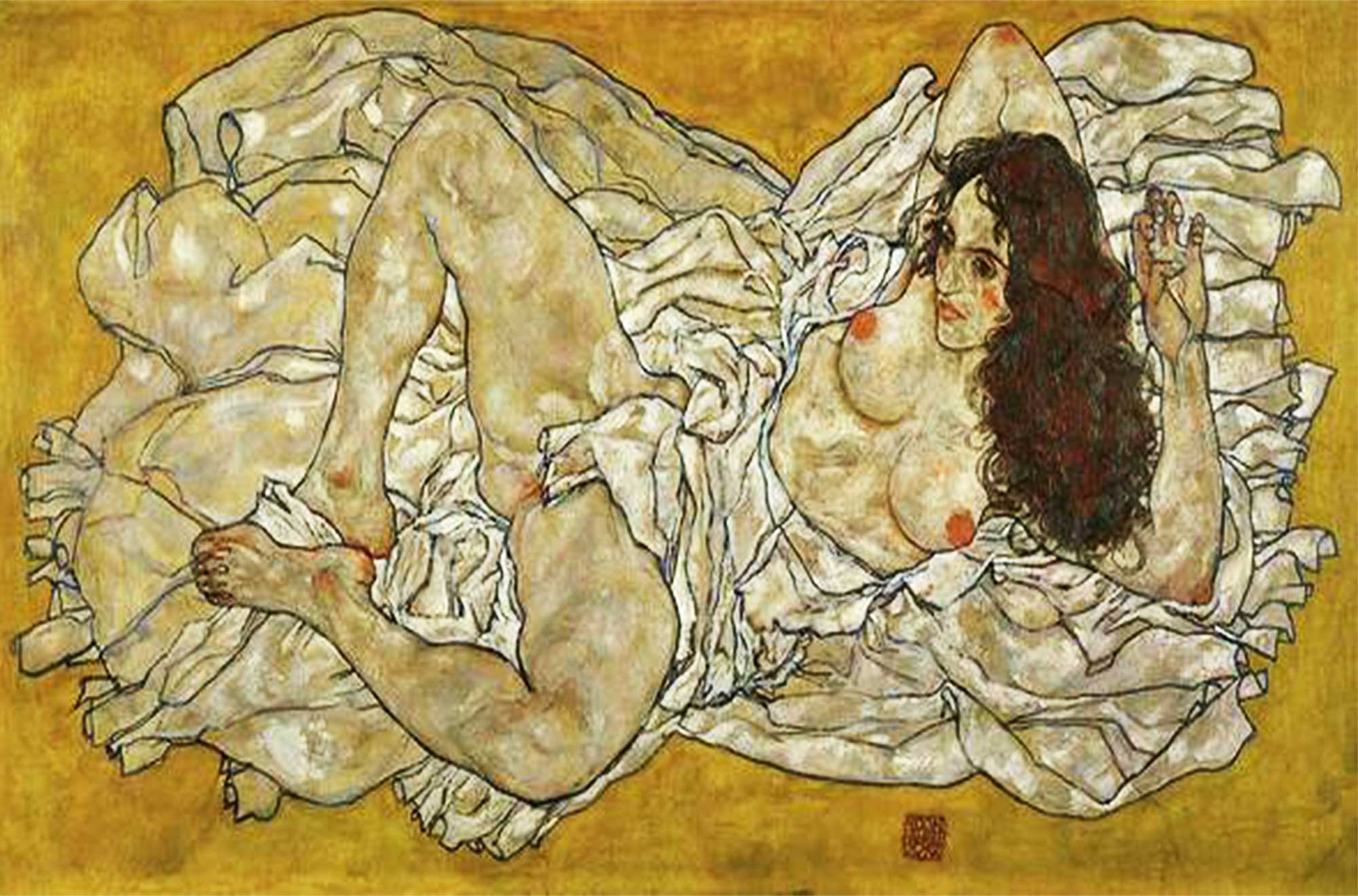
Egon Schiele, Liegende frau reclining woman, 1917, oil on canvas, Leopold Museum, Vienna
Egon Schiele’s Liegende Frau (Reclining Woman) (1917) distills the reclining nude into a stark, electrified study of vulnerability and psychic tension. The model’s body—angular, emaciated, and contorted into an uneasy diagonal—rejects every trace of classical repose. Schiele’s wiry contour lines, pulsing with nervous energy, carve the figure into a raw declaration of presence, while the patches of mottled, bruised color heighten the sense of corporeal fragility. The surrounding space is stripped to near‑nothingness, making the body feel exposed, suspended, and psychologically unguarded. Painted during the final years of his short life, the work transforms the reclining nude into an existential statement: a body not idealized but laid bare, trembling with the intensity of modern subjectivity.
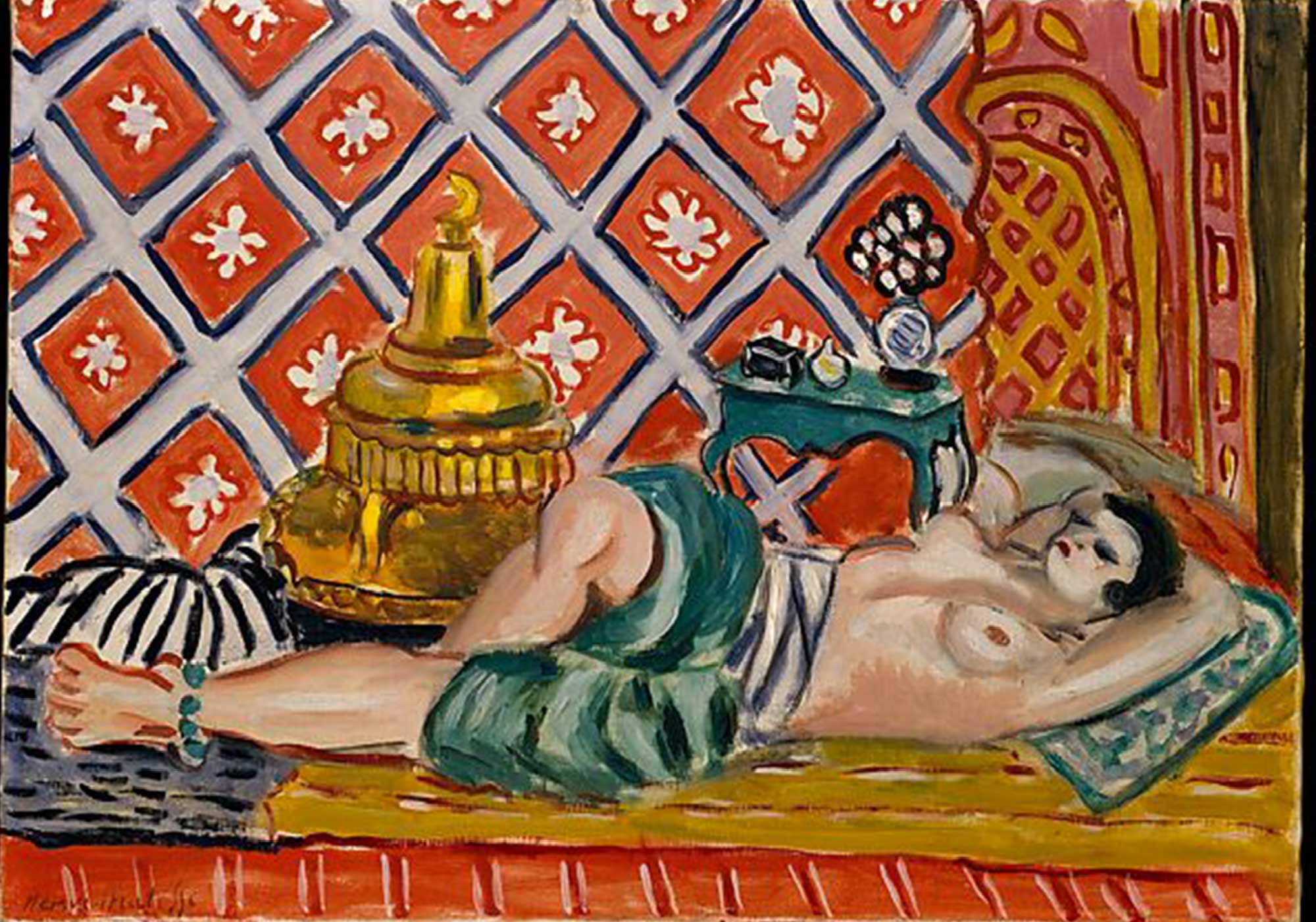
Henri Matisse, Reclining Odalisque, 1926, Oil on canvas, Fauvism, 92.1 cm × 140.3 cm (36.3 in × 55.2 in), The Met, New York City
Henri Matisse’s Reclining Odalisque (1926) distills his Nice‑period fascination with patterned interiors, saturated color, and the languid odalisque motif into a compact, carefully orchestrated composition. The painting shows a reclining woman arranged among richly patterned textiles, a geometric orange‑and‑white wall, and studio props such as a gilt vessel and turquoise table, all of which create a shallow, theatrical space where the body becomes one element in a larger decorative harmony. Rather than pursuing narrative or psychological depth, Matisse uses the odalisque as a flexible studio device—an excuse to explore rhythm, contrast, and the interplay of pattern and form. The diagonal sweep of the figure’s pose anchors the composition, while counter‑rhythms in the wall pattern, striped floor covering, and scattered objects keep the scene from slipping into static repose. The result is a poised equilibrium: sensual without sentimentality, ornamental without excess, and emblematic of Matisse’s shift from Fauvist intensity to a more lyrical, classical clarity.
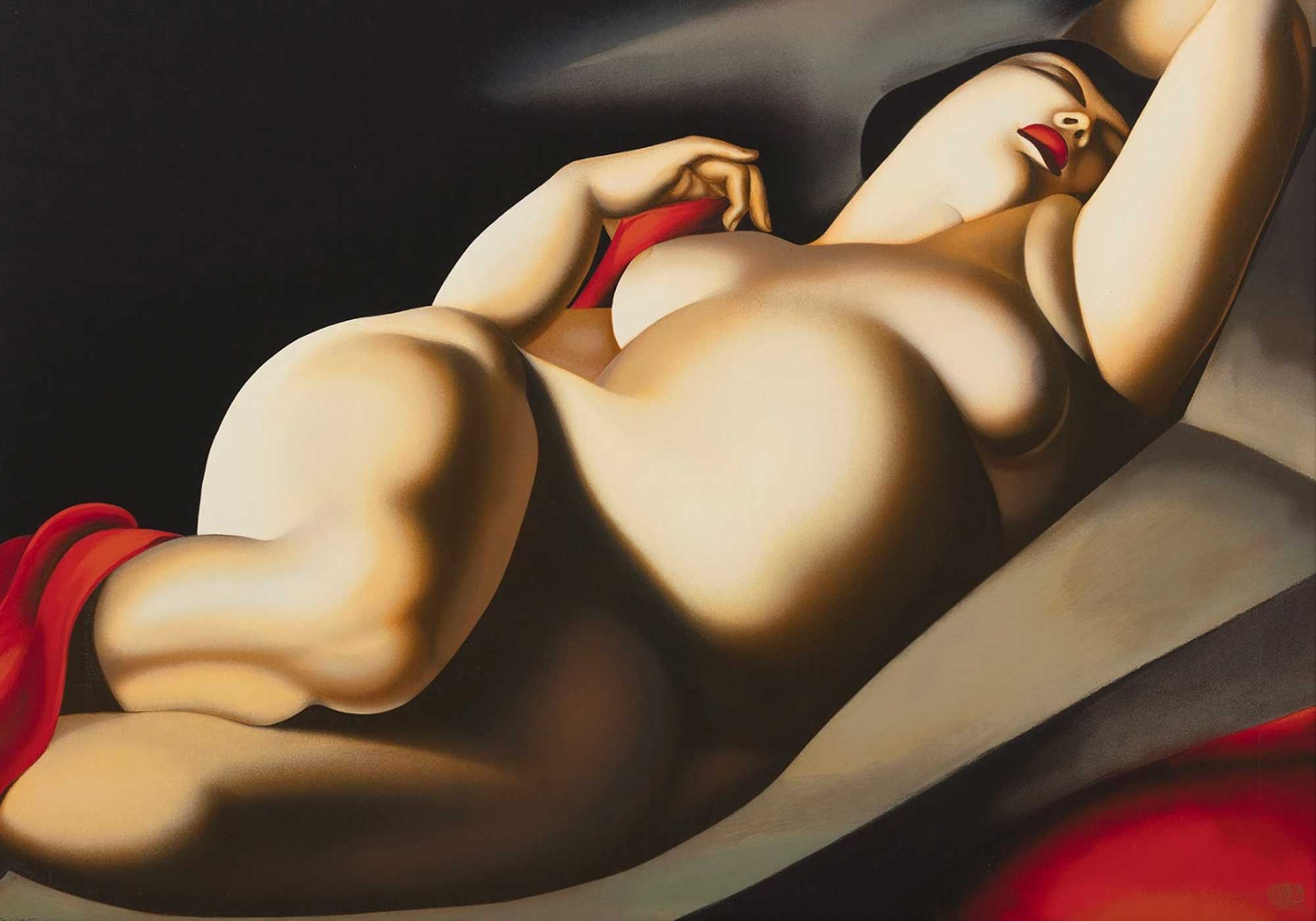
Tamara de Lempicka, (Pronunciation: Lem-PEET-ska) La Belle Rafaela, 1927, Oil on canvas
Tamara de Lempicka’s La Belle Rafaela (1927) reimagines the reclining nude with the sleek glamour of Art Deco. Sculpted in cool, polished planes, Rafaela’s body blends classical voluptuousness with modern, machine‑age precision. Confident and unapologetically sensual, she embodies the liberated femininity of the interwar avant‑garde. In Lempicka’s hands, the reclining nude becomes a symbol of modern desire—stylized, commanding, and unmistakably contemporary.
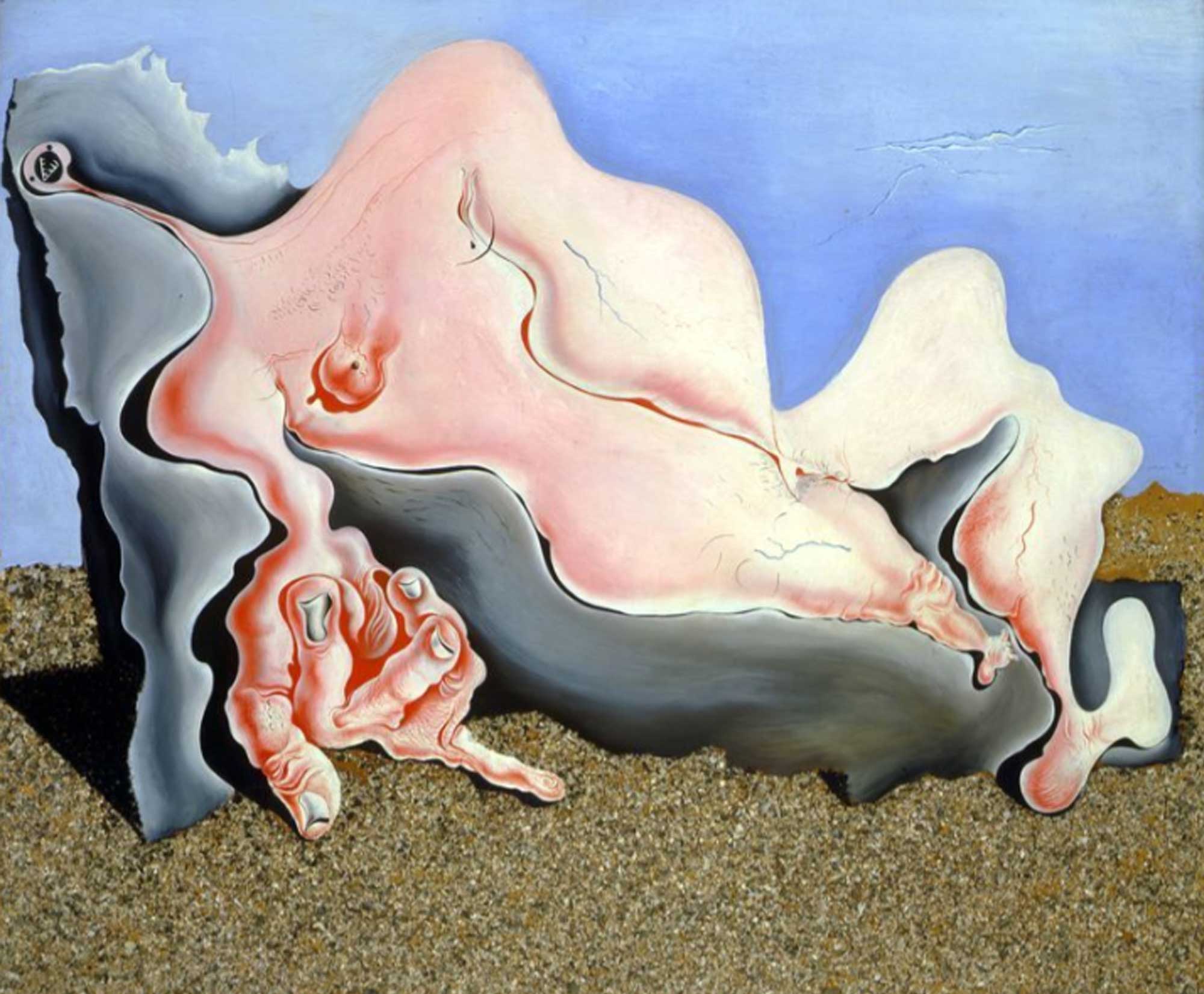
Salvador Dalí, Nu féminin (Female Nude), 1928, Oil on canvas, 63.5 x 75 cm, The Dalí Museum, St. Petersburg (Florida)
Salvador Dalí’s Nu féminin (1928) marks the young artist’s transition from Catalan modernism toward the dream‑charged language of Surrealism, reimagining the reclining nude as a site of psychic dislocation rather than sensual repose. The figure’s body—fragmented, simplified, and set against an ambiguous, sun‑bleached ground—feels less like a classical nude than a hallucinated form emerging from the unconscious. Dalí’s crisp contours and dry, almost brittle handling of paint heighten the sense of estrangement, as if the body were an object glimpsed in a fevered vision. The pose is recognizable, yet its emotional temperature is cool, remote, and faintly uncanny. In this early work, the reclining nude becomes a threshold image: no longer anchored in naturalism or erotic display, but poised on the brink of the surreal, where desire, memory, and dream begin to fuse.
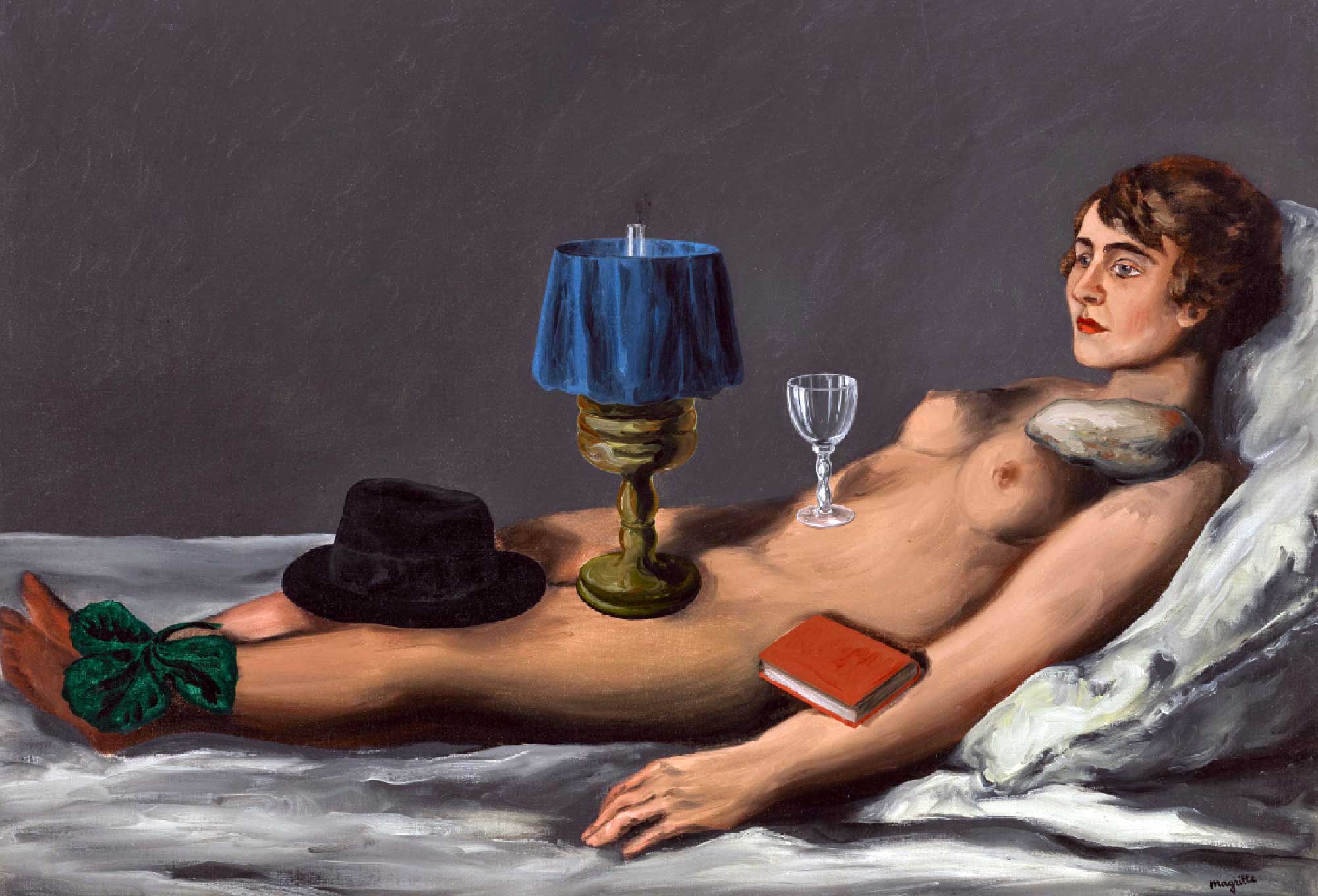
René Magritte, Le nu couché, 1928, private collection
René Magritte’s Le nu couché (1928) treats the reclining nude not as a sensual presence but as a conceptual riddle, stripping the figure of erotic charge and placing her within the cool, cerebral logic of early Surrealism. The body—rendered with Magritte’s characteristically flat, deliberate clarity—lies in a space that feels both ordinary and estranged, as if the familiar pose had been emptied of its traditional meanings. Instead of inviting the gaze, the nude becomes an object of thought: a form suspended between representation and idea, presence and disguise. Magritte’s refusal of atmosphere, depth, or emotional temperature turns the reclining figure into a philosophical proposition, a quiet but decisive break from the lineage of desire that had defined the genre for centuries. In Le nu couché, the nude becomes a puzzle—precise, enigmatic, and unsettling in its very neutrality.
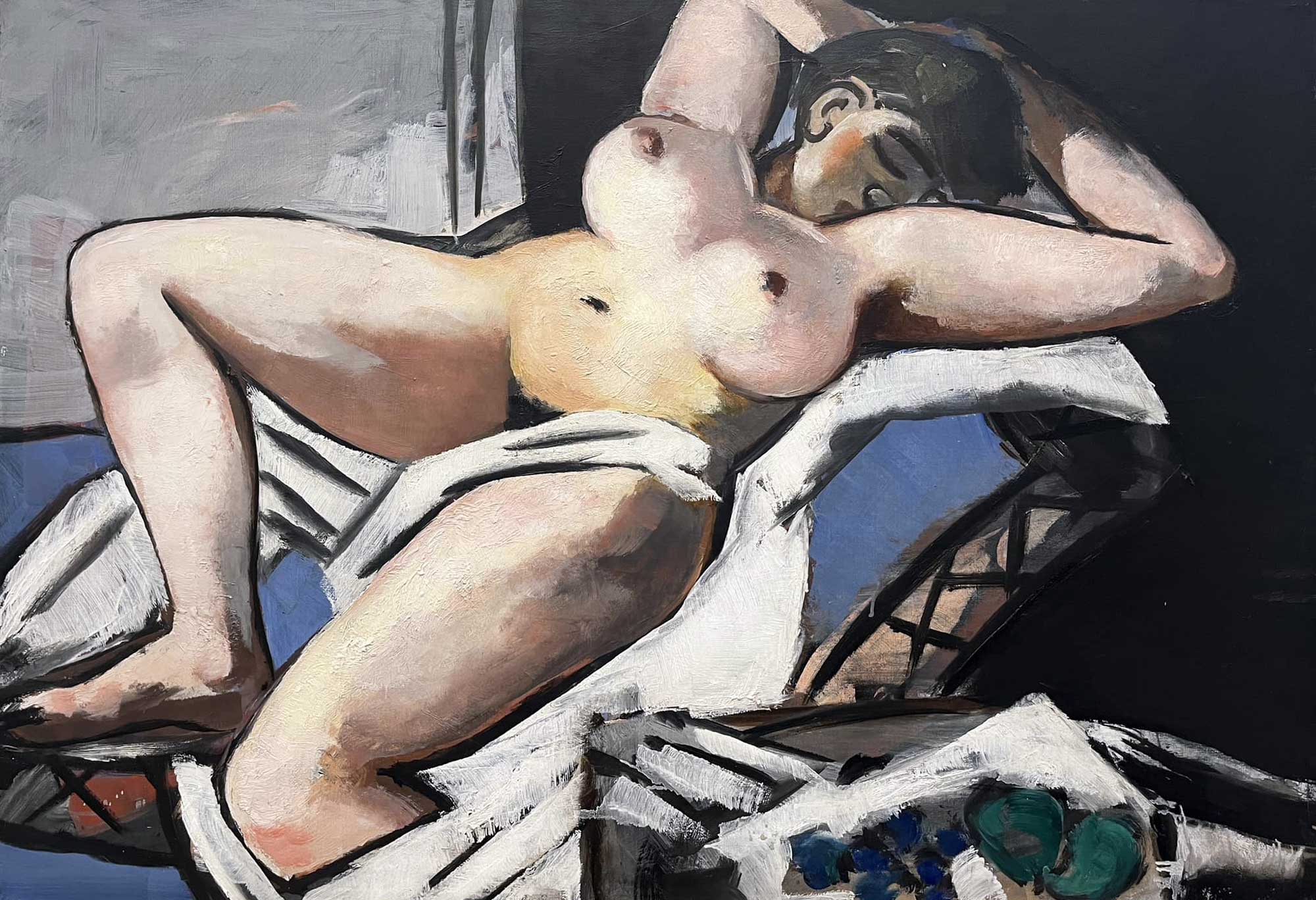
Max Beckmann, Reclining Nude, 1929, Oil on canvas, The Art Institute of Chicago
Max Beckmann’s Reclining Nude (1929) transforms the reclining female figure into a tense, sculptural presence shaped by the anxieties of the Weimar era. The model’s body—heavy, angular, and compressed into a shallow, claustrophobic space—rejects the languor traditionally associated with the pose. Beckmann’s thick, assertive contours and dense, shadowed color fields give the figure a monumental weight, as if she were carved rather than painted. Her sleeping gaze, confronts the viewer as a voyeur with a psychological force that destabilizes the usual dynamics of desire. In this work, the reclining nude becomes a site of existential confrontation: a body marked by the turbulence of modern life, rendered with the uncompromising intensity that defines Beckmann’s vision.
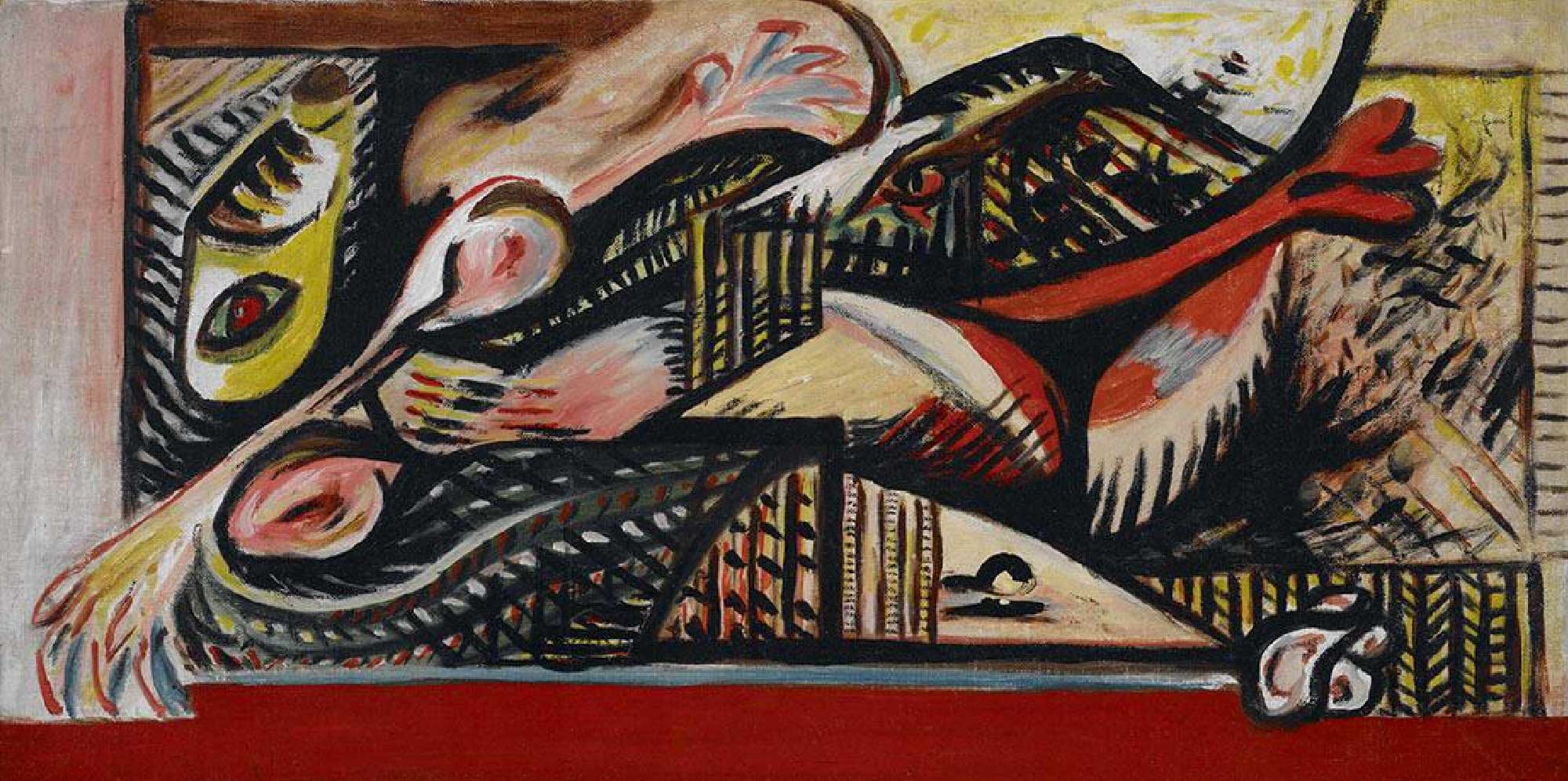
Jackson Pollock, Reclining Woman, 1941, oil on canvas, 10.7 x 21.5 inches, Crystal Bridges Museum, Arkansas
Jackson Pollock’s Reclining Woman (1938–1941) marks a pivotal early moment in his transformation of the reclining nude, fracturing the figure into a tense, angular constellation of forms that anticipates his later breakthroughs in abstraction. The body is splintered into unusual, anatomically distorted shapes, intensified by repetitive black lines that carve the figure into a restless, almost violent geometry. Limbs stretch at improbable angles, and a floating eye with a red pupil hovers as if disconnected from the body, heightening the sense of psychic dislocation. Pollock reshapes the reclining nude from sensual repose to psychological rupture, instead of the traditional languid pose. Pollock presents a body in pieces—charged with anxiety rather than eroticism. The Surrealist and Picasso-inflected fragmentation and distortions echo the influence of Picasso’s Guernica, which Pollock had seen in New York in 1939. A precursor to the drip paintings, though still figurative, the painting’s energy, tension, and linear aggression foreshadow the all‑over dynamism of Pollock’s later work. Pollock’s Reclining Woman breaks decisively from the lineage of Titian, Ingres, and even the modernists who preceded him. The nude is no longer an object of beauty or desire but a site of psychic fragmentation, a body under pressure from the interior forces that would soon erupt into his signature abstract expressionism. It marks the moment when the reclining figure becomes not a subject to be depicted but a field of emotional and formal experimentation.
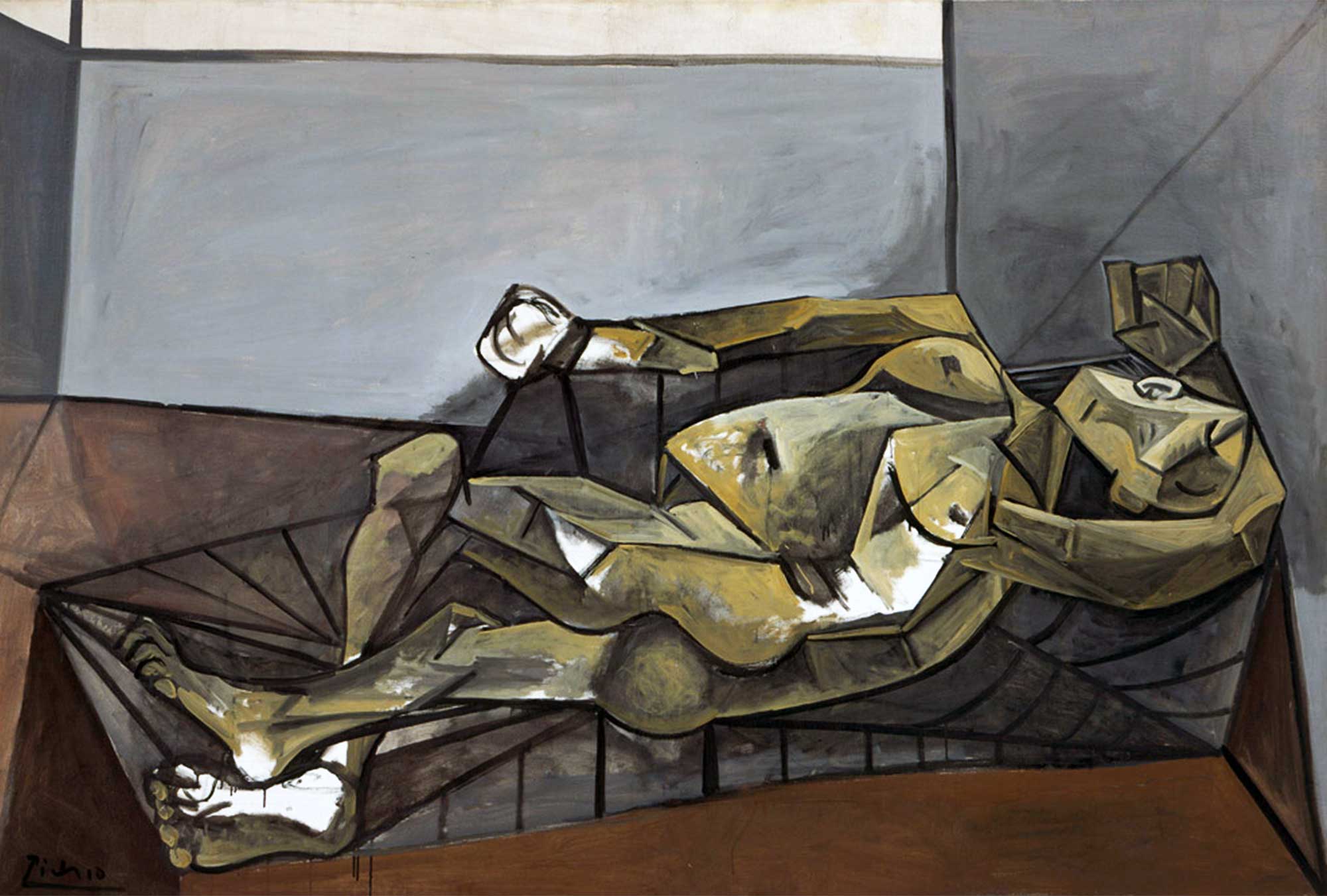
Pablo Picasso, Reclining Nude (Grand nu couché), 1942, Oil on canvas, 129.5 x 195 cm. Staatliche Museen zu Berlin, Nationalgalerie, Museum Berggruen
Pablo Picasso’s Reclining Nude (Grand nu couché) (1942) transforms the reclining female body into a monumental engine of fractured form and psychic intensity. Painted during the dark years of the Occupation, the figure’s massive, interlocking planes—part armor, part anatomy—convey both erotic charge and emotional siege. Picasso stretches and rotates the body across the picture surface, turning limbs into geometric arcs and the torso into a compressed, sculptural mass that feels simultaneously sensual and embattled. The palette—acidic greens, bruised violets, and stark blacks—heightens the sense of internal turbulence, as if the nude were absorbing the pressures of history and desire at once. In this work, the reclining figure is no longer a site of repose but a battlefield of modern form: a body reconfigured by Cubism, charged with wartime anxiety, and pushed to the brink of abstraction without ever losing its visceral human presence.
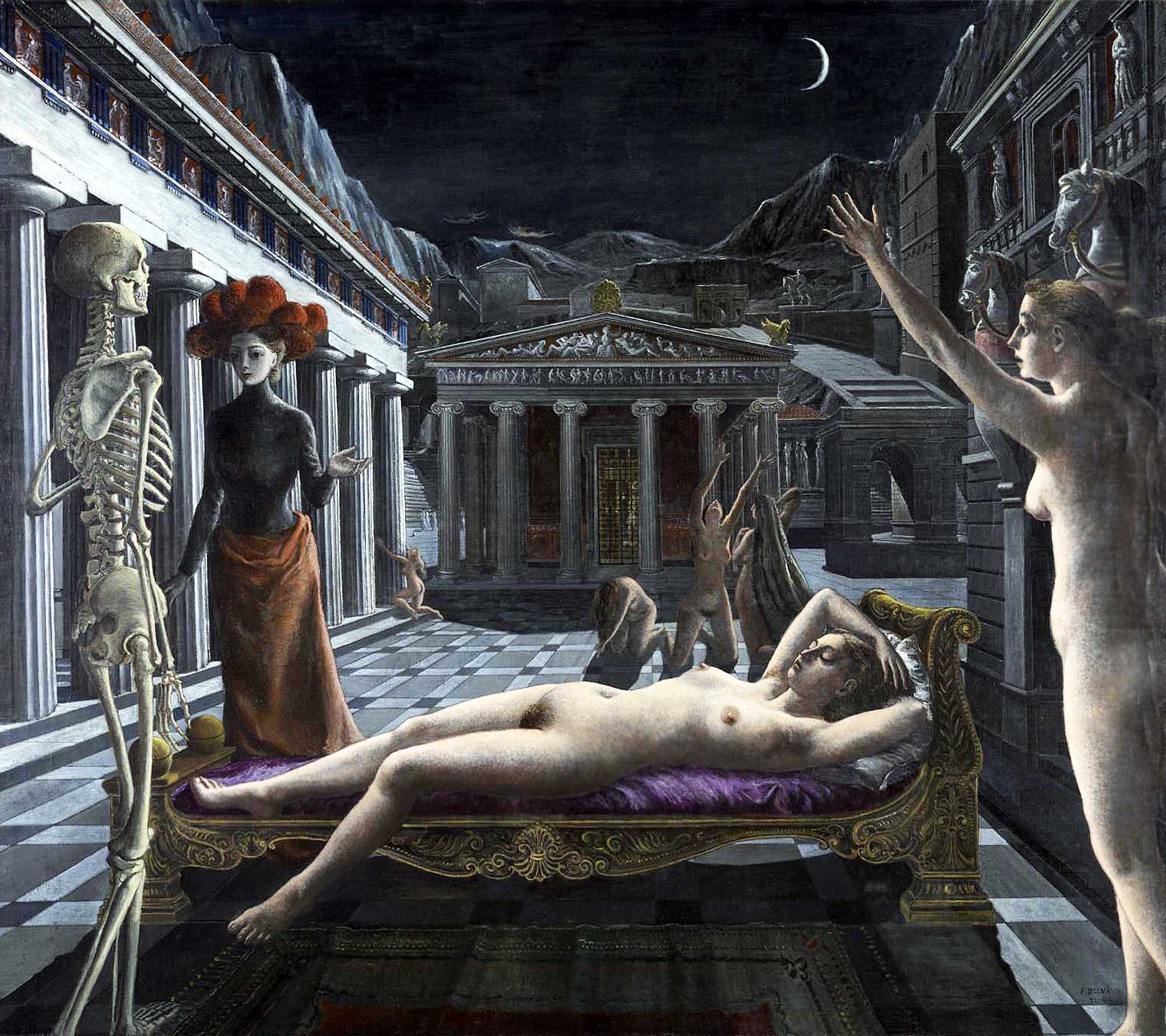
Paul Delvaux, Sleeping Venus, 1944, Oil on canvas, 172.7 cm × 199.1 cm (68.0 in × 78.4 in), Tate, London
Paul Delvaux’s Sleeping Venus 1944—painted in several variations beginning in the 1940s—transplants the classical reclining nude into the uncanny world of Surrealism. His Venus lies serenely asleep, untouched by the strange nocturnal cityscapes, wandering figures, and architectural fragments that surround her. Unlike the sensual immediacy of Titian or the psychological intimacy of Rembrandt, Delvaux’s Venus is withdrawn, inward, and unreachable—a dream within a dream. Her luminous, idealized body becomes a still point in a disquieting tableau, suggesting both timeless beauty and profound detachment. In Delvaux’s hands, the reclining nude becomes an emblem of mystery and subconscious desire, suspended between antiquity and modernity, myth and dream.
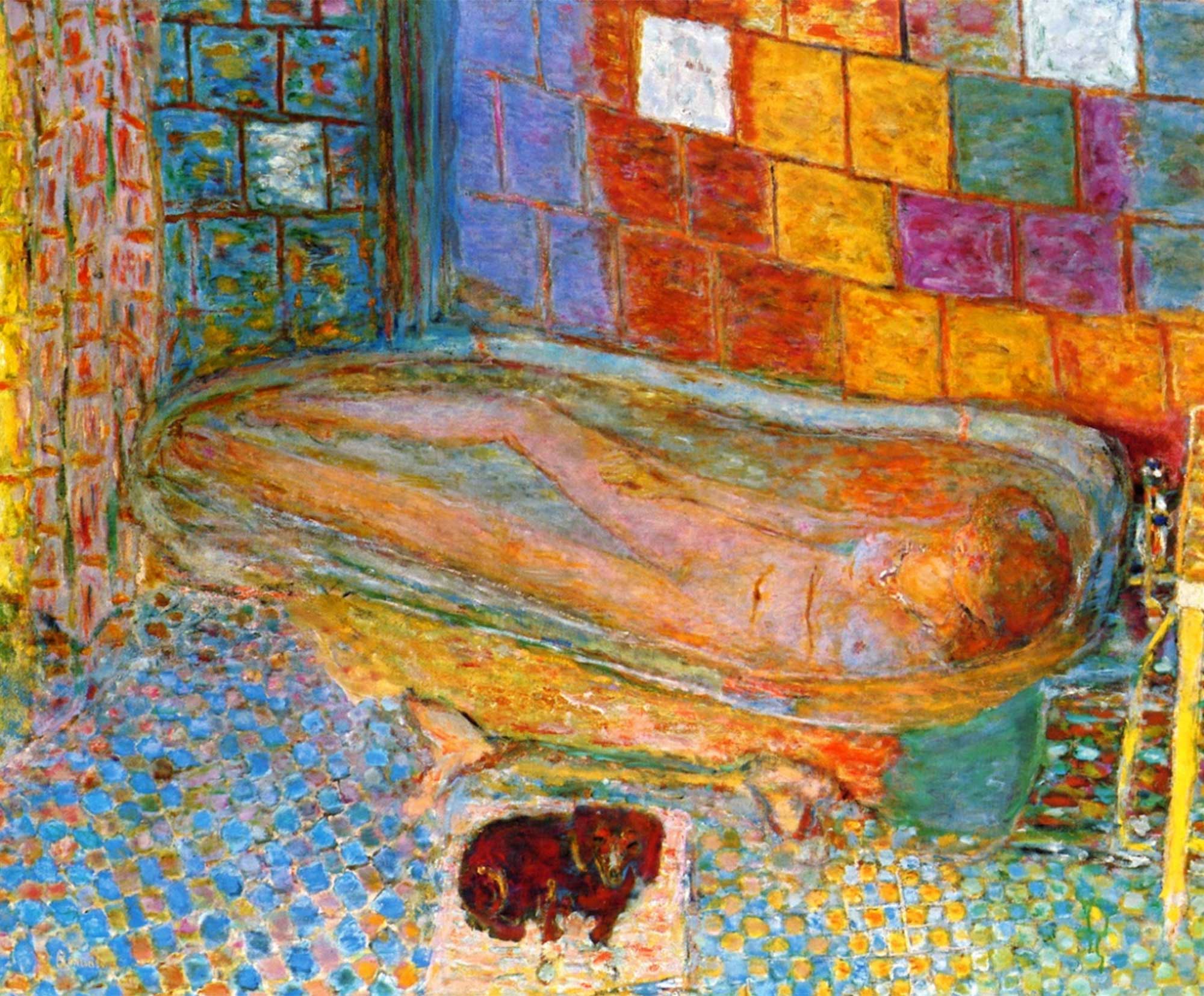
Pierre Bonnard, Nude in the Bath and Small Dog, 1946, oil on canvas, 48 x 59 1/2" (121.9 x 151.1 cm), Carnegie Museum of Art, Pittsburgh, Pennsylvania
Pierre Bonnard’s Nude in the Bath and Small Dog (1946) transforms the reclining female body into a shimmering field of color and sensation, dissolving the boundaries between figure, water, and interior space. Marthe—Bonnard’s lifelong companion and most frequent model—lies submerged in the tub, her elongated form rendered in cool, iridescent tones that make the body appear both present and dreamlike. The small dog at the bath’s edge anchors the scene in domestic intimacy and symbolic fidelity, yet the overall atmosphere is one of quiet reverie, as if time has slowed to a luminous pause. Bonnard’s loose, vibrating brushwork and tilted perspectives turn the bathroom into a psychological interior, a place where memory, tenderness, and melancholy intermingle. In this late work, the reclining nude becomes less an object of desire than a vessel of introspection, suspended in a bath of light that feels at once private, tender, and hauntingly remote.
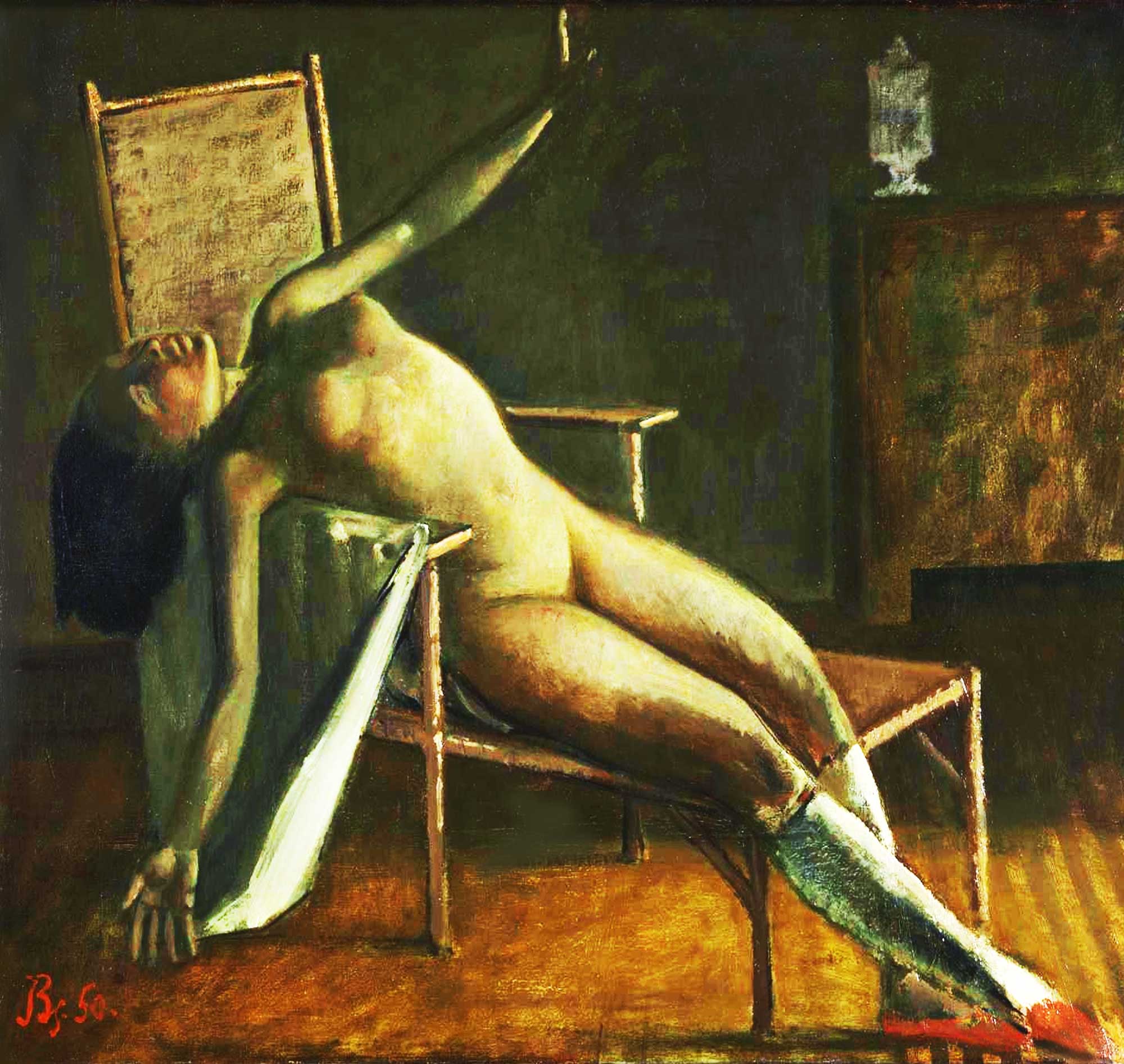
Balthus, Nude on a Chaise Longue, 1950, Tate, UK
Balthus’s Nude on a Chaise Longue (1950) represents another strand of twentieth century engagement with the reclining figure, one marked by psychological ambiguity and a charged stillness. Across the century, artists approached the nude with increasing frankness, shaped by shifting social attitudes, psychoanalytic theory, and the collapse of earlier taboos. The reclining female nude had been a dominant motif in nineteenth century French painting, often filtered through orientalist fantasies of the odalisque—figures imagined as sexually available and culturally “exotic.” Twentieth century artists abandoned these conventions, presenting sexuality more directly while also grappling with the complexities of desire revealed by Freud and explored by the Surrealists.
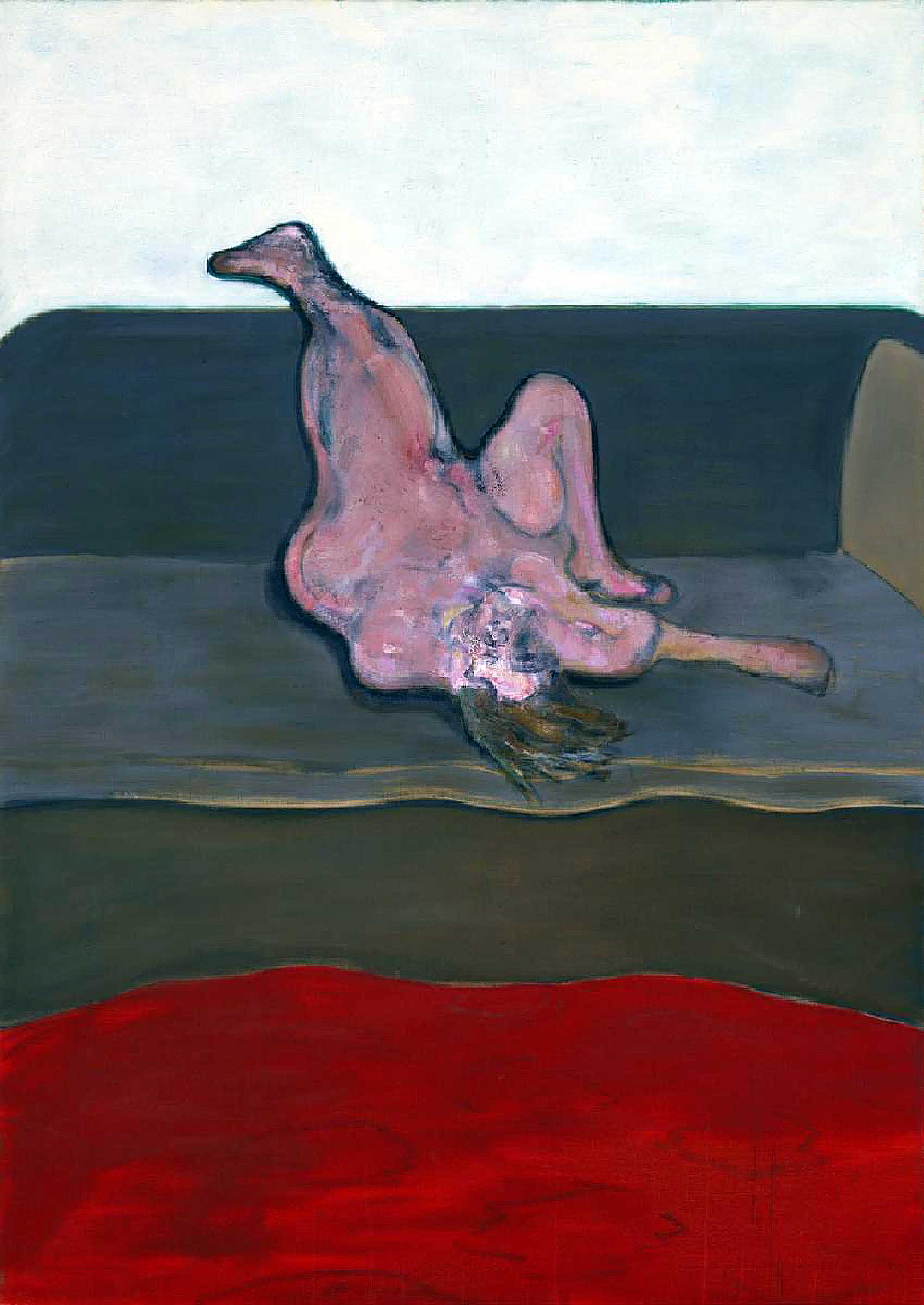
Francis Bacon, Reclining Woman, 1961, Tate, UK
Francis Bacon’s Reclining Woman (1961) tears the reclining nude away from any vestige of serenity, reconfiguring the body as a site of visceral tension and psychic rupture. The figure—twisted, smeared, and partially dissolved into the surrounding void—seems caught between material presence and annihilation, her flesh rendered with Bacon’s signature blend of brutality and tenderness. The bed or couch becomes an arena rather than a resting place, its geometry warped by the force of the body’s contortions. Color—sickly pinks, bruised purples, and sudden flashes of white—intensifies the sense of vulnerability, as if the figure were illuminated by an unforgiving, interrogatory light. In this work, the reclining nude becomes an existential event: a body stripped of idealization, suspended in a space where desire, fear, and mortality collide.
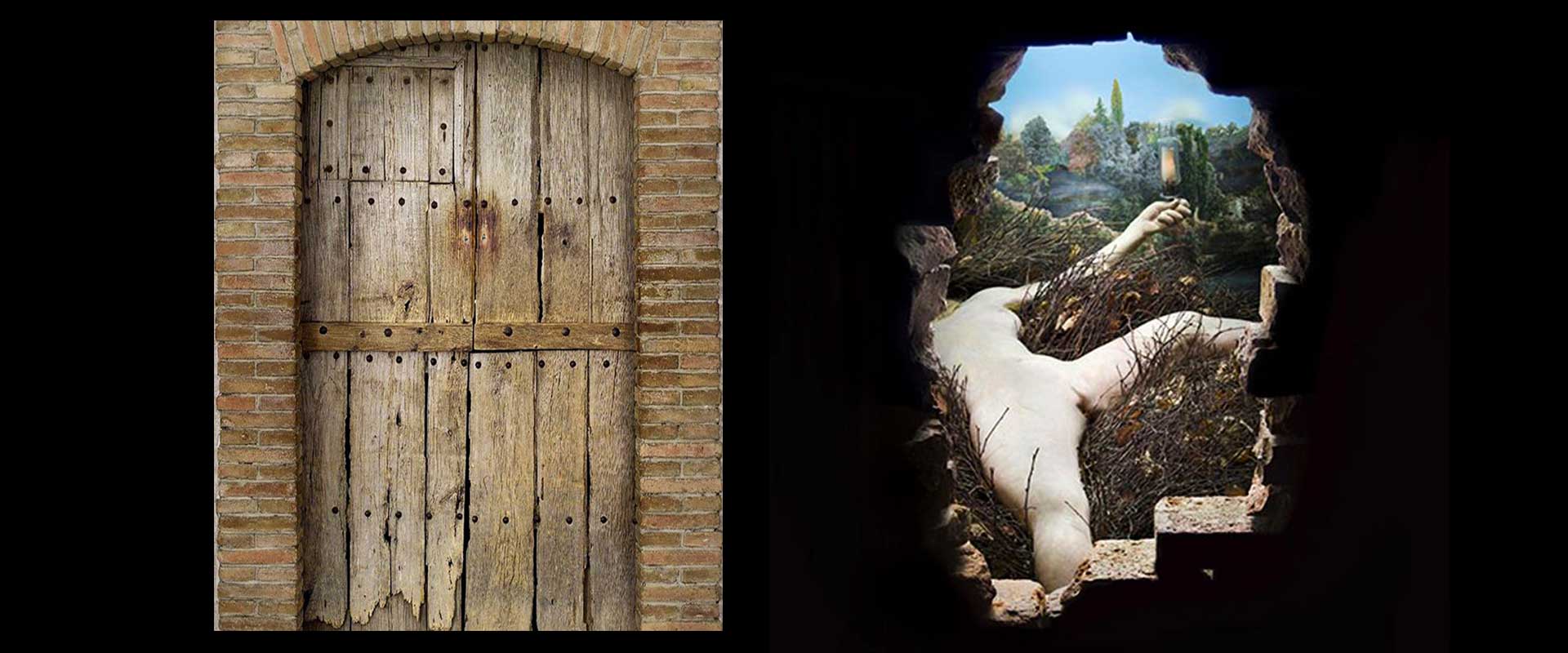
Marcel Duchamp, Étant donnés, Through the peepholes, Assemblage/Installation, 1946–1966,  Philadelphia Museum of Art, Philadelphia
Marcel Duchamp’s Étant donnés (1946–1966); Marcel Duchamp (1887–1968) is widely considered the "father of conceptual art" for shifting art from a "retinal" experience (pleasing to the eye) to an intellectual one, emphasizing ideas over craft, his (Étant donnés is French for "Given" or "Being Given," considered a foundational, pioneering example of installation art and site-specific art) detonates the very premise of the reclining nude by transforming it into a voyeuristic tableau accessible only through two peepholes in a heavy wooden door. Inside, an uncanny assemblage of a nude female figure—lifelike yet unmistakably artificial—lies sprawled on a bed of twigs, legs parted, one arm raised to hold a gas lamp that casts a cold, theatrical glow across the scene. The body’s hyper‑real skin, fragmented pose, and waxen stillness collapse the boundary between sculpture, photography, and staged illusion, turning the viewer into an unwilling participant in an act of looking that feels both forbidden and compulsory. Created in secret over two decades, the installation exposes the mechanics of desire, surveillance, and objectification with a clinical precision that makes the traditional reclining nude seem almost naïve by comparison. In Étant donnés, the nude becomes a trap for the gaze—a meticulously engineered confrontation with the darker, more unsettling undercurrents of modern visuality.
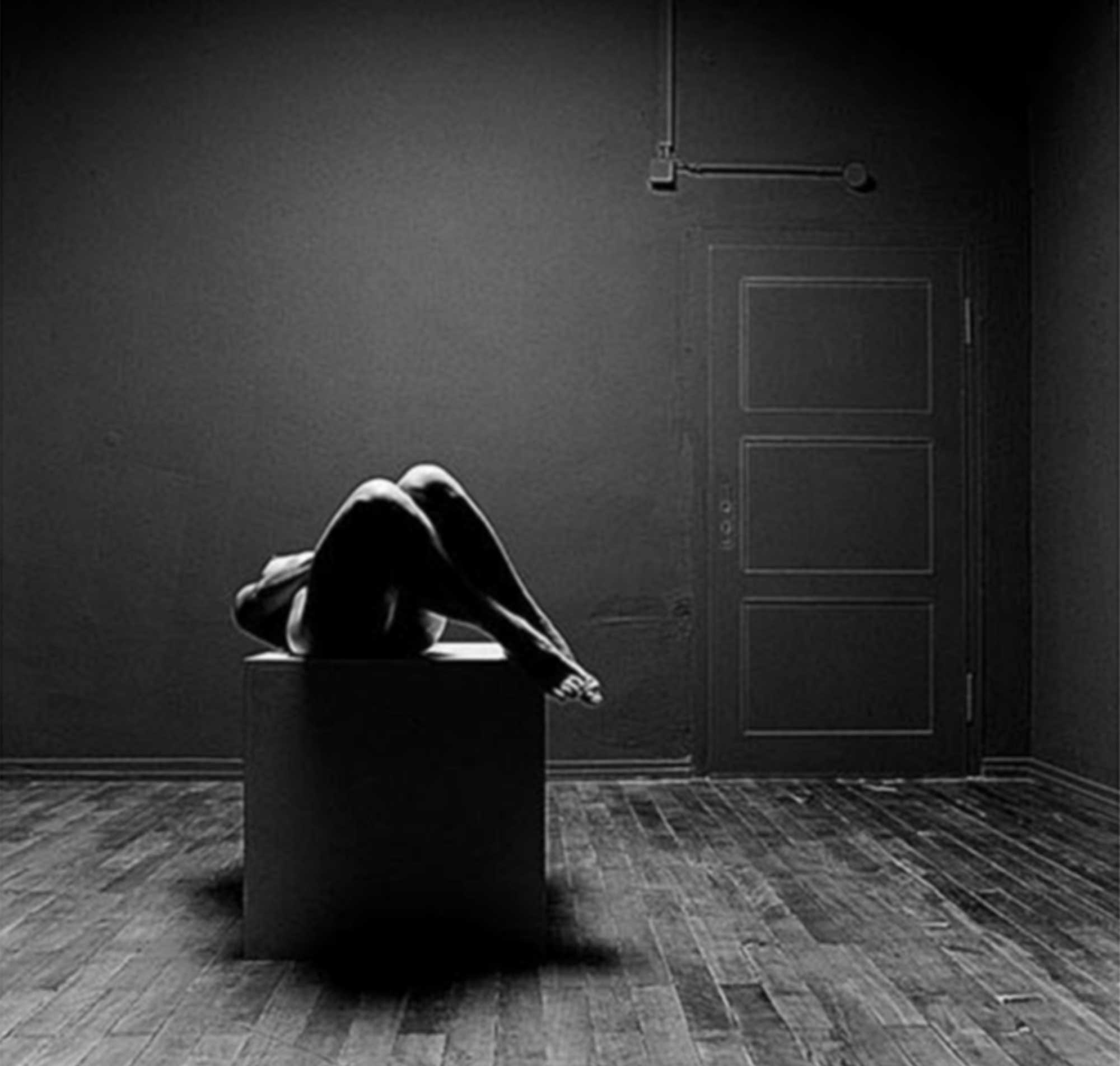
Yves Noir, Le Grand Noir, 1967
Yves Noir’s Le Grand Noir (1967) recasts the reclining nude as a brooding, near‑monolithic presence, pushing the genre toward the threshold of abstraction. The figure—reduced to a dark, weighty silhouette—seems to emerge from and dissolve back into a field of dense, velvety blacks, as if carved from shadow rather than modeled in light. Noir’s restrained palette and emphasis on contour over detail strip the body of sensual softness, replacing it with a stark, sculptural gravity that feels both monumental and remote. The reclining pose remains legible, but its traditional associations with repose and eroticism have been drained away, leaving a form that reads as psychological mass, an embodiment of opacity and inwardness. In Le Grand Noir, the nude becomes a cipher: a body distilled to essence, hovering between presence and void, marking the late‑modern shift from figuration to existential abstraction.
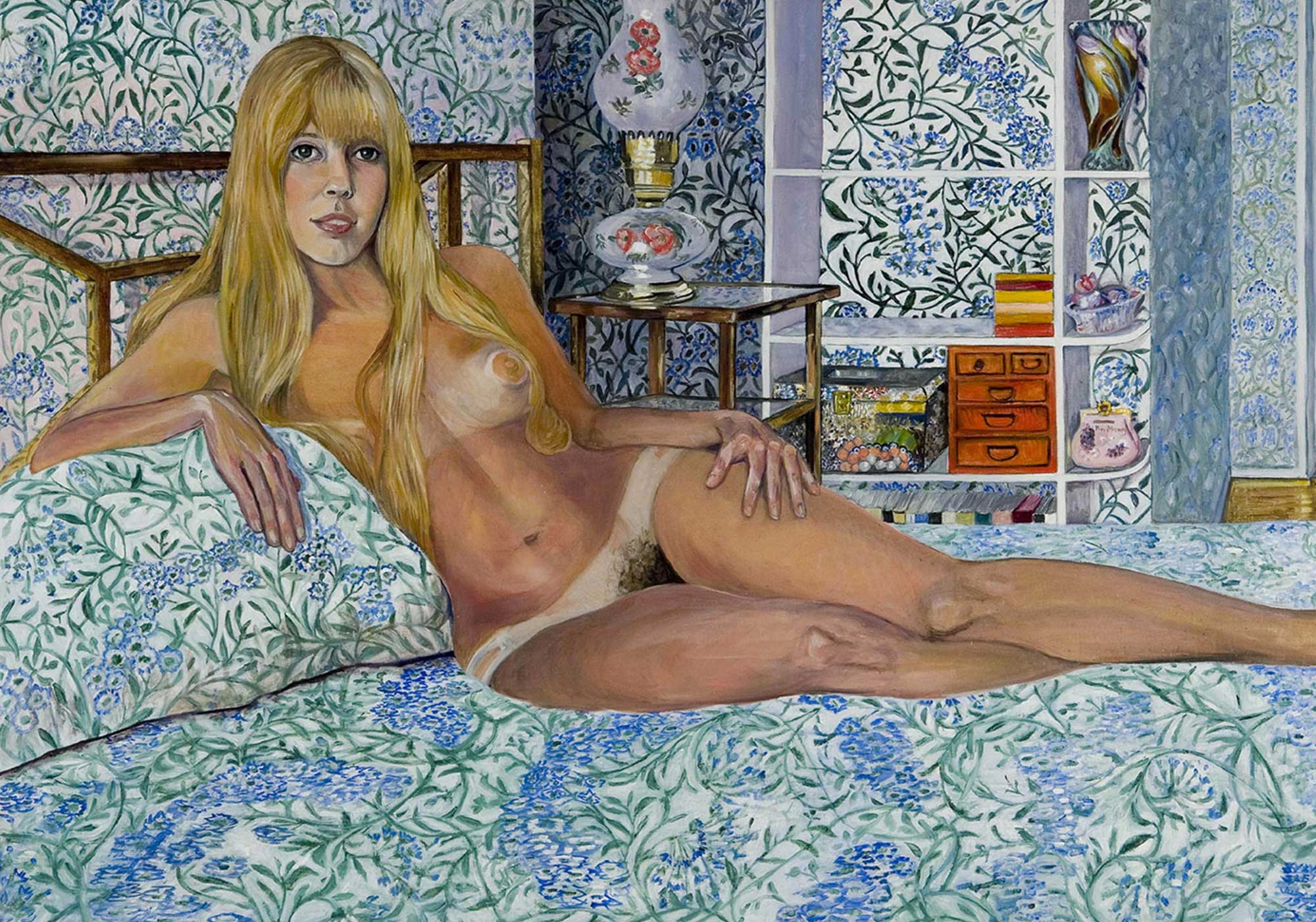
Sylvia Sleigh, Felicity Rainnie Reclining, 1972, oil on canvas, 152.4 x 107.3 cm, private collection, © The Estate of Sylvia Sleigh
Sylvia Sleigh’s Felicity Rainnie Reclining (1972) reimagines the reclining nude through a feminist lens, presenting her sitter not as an idealized object but as an individual with presence, personality, and agency. Painted with Sleigh’s characteristic realism and meticulous attention to detail, the work places Felicity Rainnie in a relaxed, unguarded pose that echoes the long tradition of odalisques while quietly overturning its power dynamics. Instead of eroticizing or anonymizing the figure, Sleigh emphasizes her subject’s specificity—her expression, her body as lived rather than perfected, and the intimate domestic setting that frames her. This approach aligns with Sleigh’s broader project in the 1970s, when she challenged the male gaze by painting friends, peers, and fellow artists with the same sensitivity and dignity historically reserved for idealized female nudes. Felicity Rainnie Reclining becomes a subtle but decisive act of feminist revision: a reclining figure who is neither passive nor symbolic, but fully herself, occupying the pose on her own terms. The Women’s Rights Movement in the 1970s reframed the reclining nude by exposing the power structures behind it and transforming the pose into a site of critique and self‑representation. Feminist scholars such as Linda Nochlin and Griselda Pollock argued that the classical nude—exemplified by Ingres’s Grand Odalisque—was built for a male spectator, and that Orientalist imagery compounded this with racialized fantasies shaped by empire. Women artists responded not by abandoning the genre but by rewriting it. Alice Neel painted bodies marked by age and lived experience; Sylvia Sleigh placed men in poses historically reserved for women; Jenny Saville monumentalized flesh to confront beauty norms. Performance‑based and photographic artists such as Ana Mendieta, Carolee Schneemann, Judy Chicago, and Laura Aguilar used their own bodies to assert presence, vulnerability, and cultural identity. Through these interventions, the reclining nude shifted from erotic spectacle to a declaration of agency—becoming a space where women could challenge inherited narratives and reclaim control over how bodies are seen.
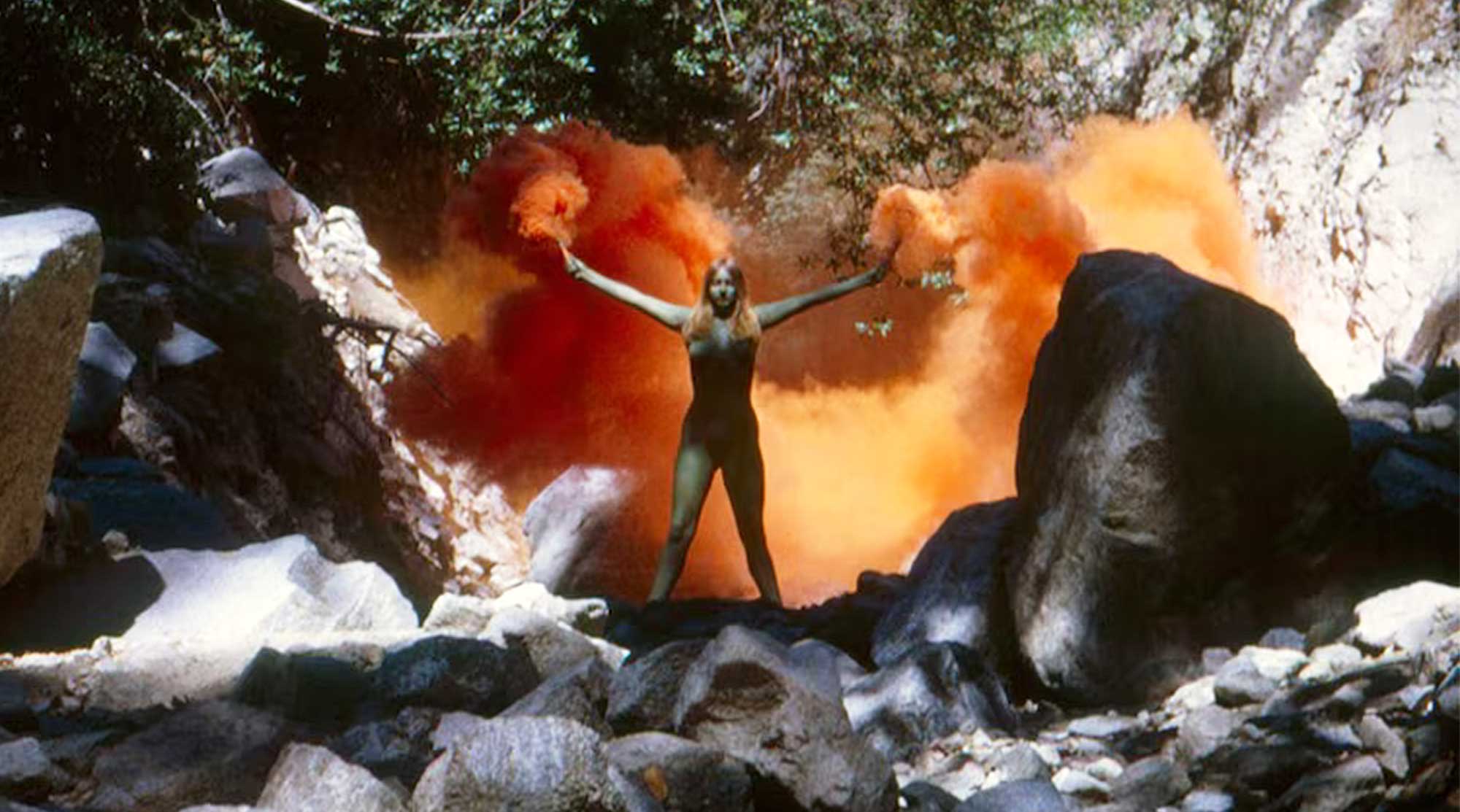
Judy Chicago, “Smoke Goddess/Woman with Orange Flares”, 1972, Photography Courtesy Judy Chicago/Art Resource, NY
Judy Chicago’s “Smoke Goddess/Woman with Orange Flares” (1972) reimagines the female body through the language of landscape, ritual, and environmental transformation. In this photograph—part of her early Atmospheres performances—Chicago stages a nude female figure enveloped in drifting plumes of orange smoke, using pyrotechnic color to dissolve the boundaries between body and environment. The woman does not recline for a voyeuristic gaze; instead, she becomes a monumental, elemental presence, her form partially obscured and partially revealed as the smoke billows around her. Chicago’s use of colored flares turns the scene into a feminist counter‑spectacle: the body is not displayed for consumption but transformed into a force of nature, radiant, ephemeral, and self‑possessed. The work challenges the historical nude by replacing passive sensuality with ritual power, aligning the female figure with fire, atmosphere, and the expansive, transformative energies that would define Chicago’s feminist practice throughout the 1970s.
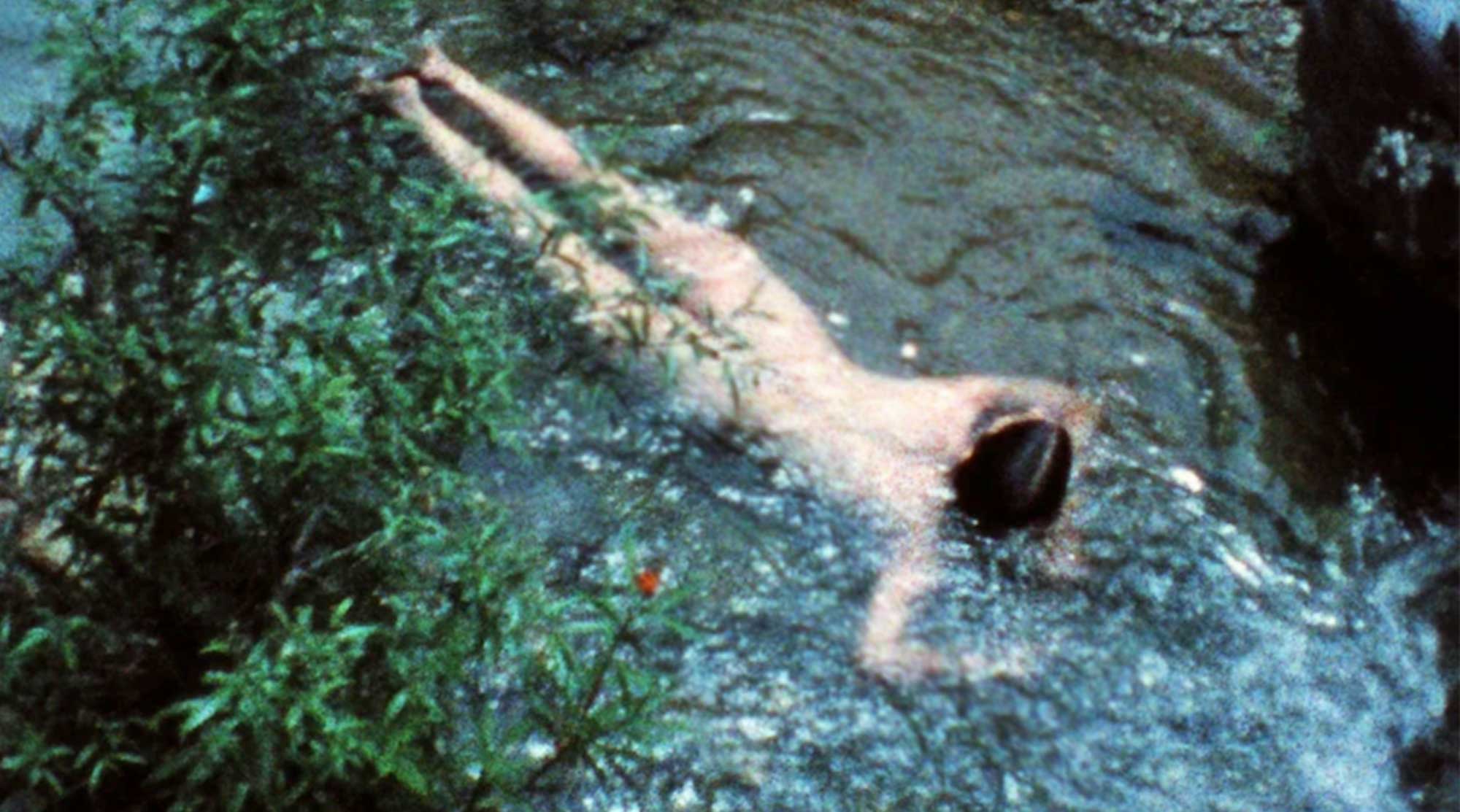
Ana Mendieta, “Creek”, 1974, Photographer and Director, Courtesy Galerie Lelong & Co. © Estate of Ana Mendieta Collection, LLC
"Covered in Time and History: The Films of Ana Mendieta" Jeu de Paume Concorde - Paris
Ana Mendieta’s film “Creek” (1974) presents the artist’s body lying motionless in a shallow stream, allowing water to flow around and over her until she seems to merge with the landscape. The film’s quiet, elemental imagery reflects Mendieta’s ongoing exploration of exile, belonging, and the body’s relationship to the natural world. By placing herself in nature rather than in a studio or under a voyeuristic gaze, she rejects the conventions of the traditional nude and instead asserts a form of embodied presence rooted in ritual, vulnerability, and self‑definition. The stillness of her body against the movement of the water creates a tension between disappearance and persistence, suggesting both surrender to the environment and a powerful reclamation of space. Within the broader history of the reclining figure, Creek becomes a radical alternative: a body not displayed for pleasure but absorbed into the earth, redefining what it means to recline, to be seen, and to belong.
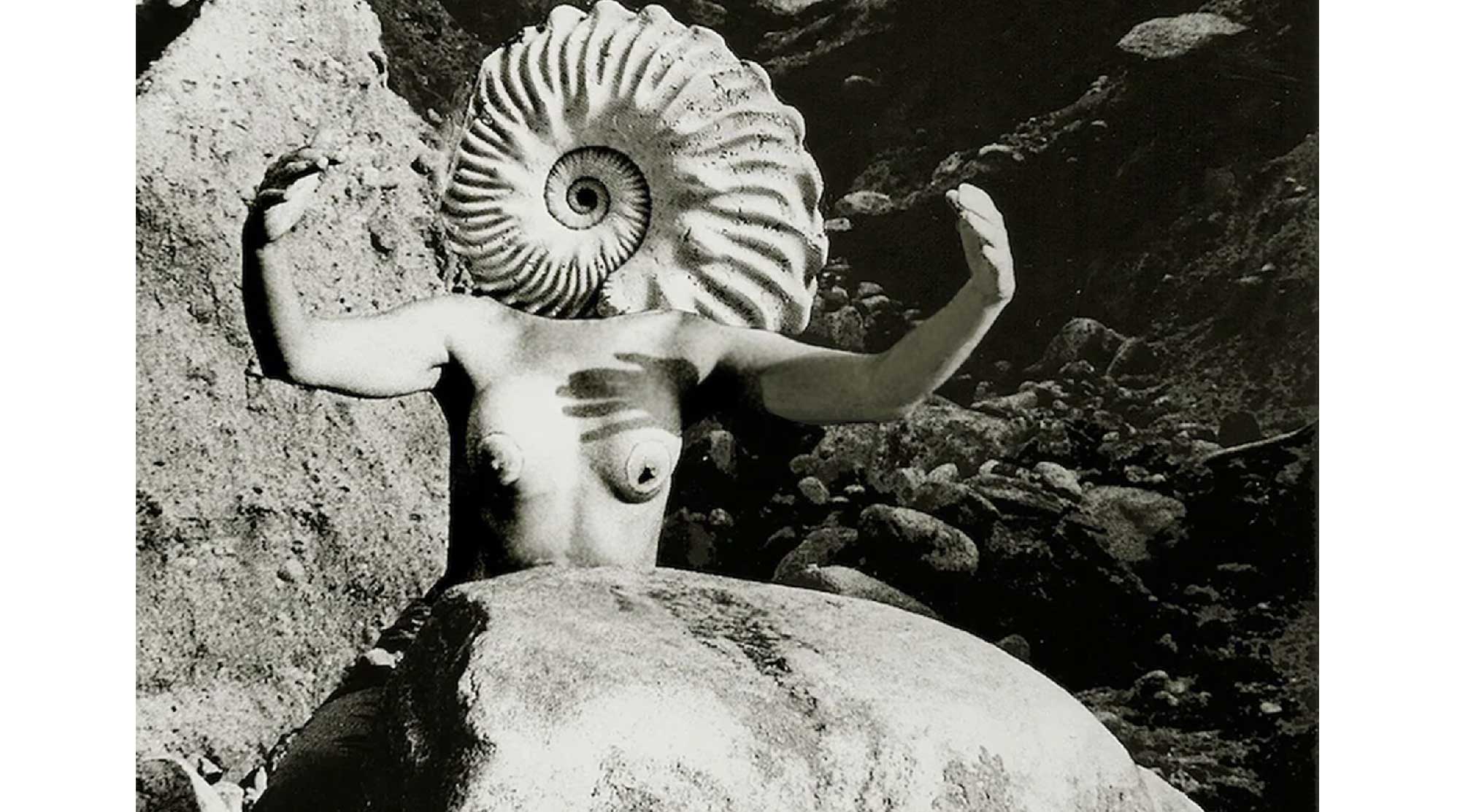
Mary Beth Edelson, “Goddess Head (Calling Series)”, 1975, Photography silver‑gelatin print, Courtesy David Lewis, New York © Mary Beth Edelson
Mary Beth Edelson’s “Goddess Head (Calling Series)” (1975) turns the female face into a symbol of spiritual force and feminist self‑authorship. By drawing radiating lines over a silver‑gelatin print, she transforms the image into an invocation rather than a portrait, aligning the woman depicted with ancient goddess traditions that challenge patriarchal art history. The work rejects the passive, idealized female body of the traditional nude and instead asserts a charged, self‑defined presence—an icon of agency, ritual power, and feminist reclamation.
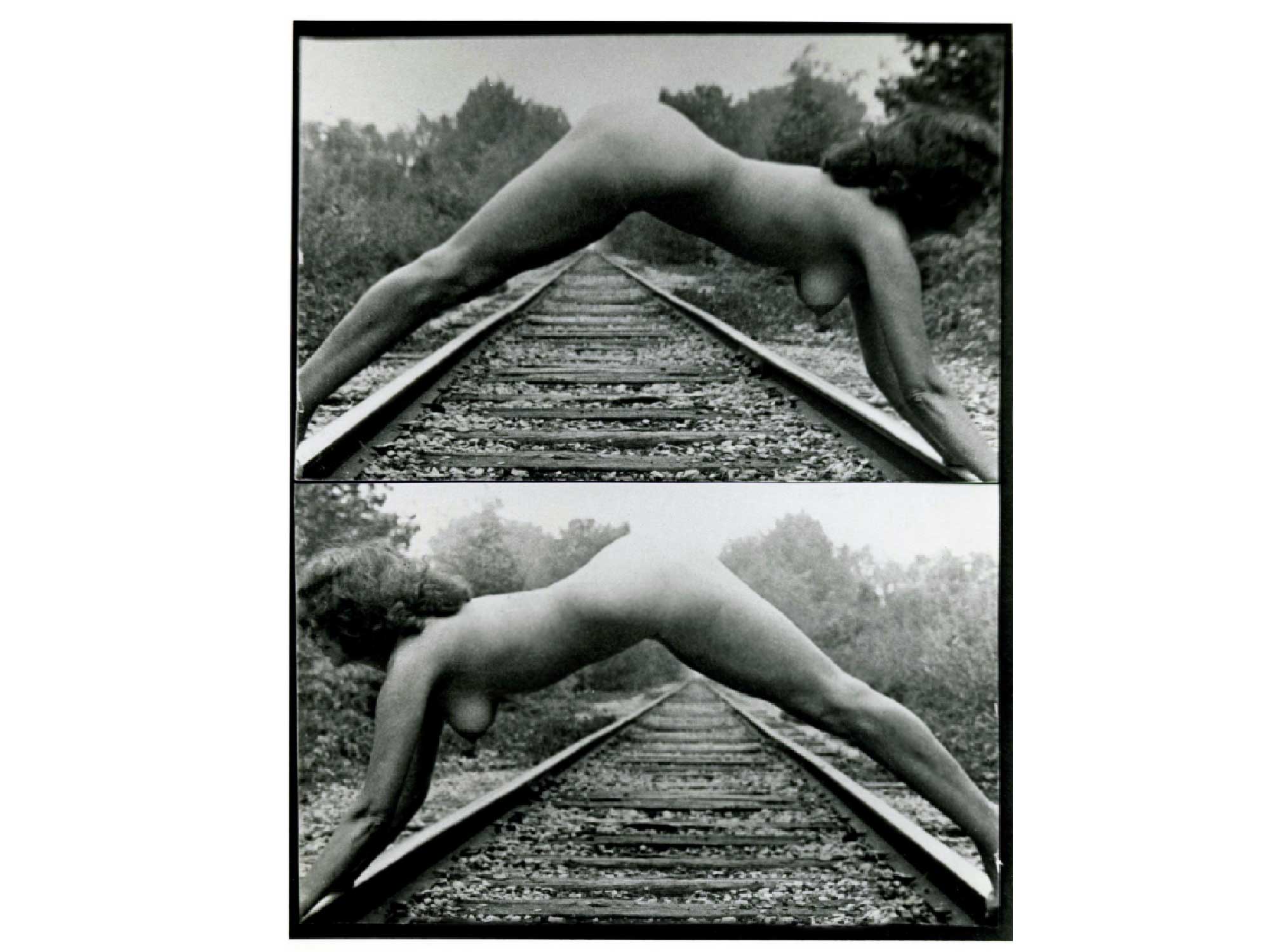
Carolee Schneemann, “Nude On Tracks”, 1975, Photography Courtesy of Carolee Schneemann
Carolee Schneemann’s “Nude On Tracks” (1975) stages the female body in a raw, exposed environment that collapses the distance between performance, photography, and a real physical risk. The image shows Schneemann nude on a set of railroad tracks, her body aligned with the steel rails in a gesture that is both vulnerable and defiantly present. Rather than offering herself to a voyeuristic gaze, she asserts authorship over her own image, using the stark industrial setting to counter the soft, idealized spaces of the traditional nude. The tension between flesh and metal, danger and control, transforms the reclining pose into a feminist provocation: a body that refuses passivity, insisting instead on agency, confrontation, and the right to occupy space on her own terms. This work extends Schneemann’s broader project of merging art and life, using her body as both subject and instrument to challenge the boundaries of representation and the politics of looking.
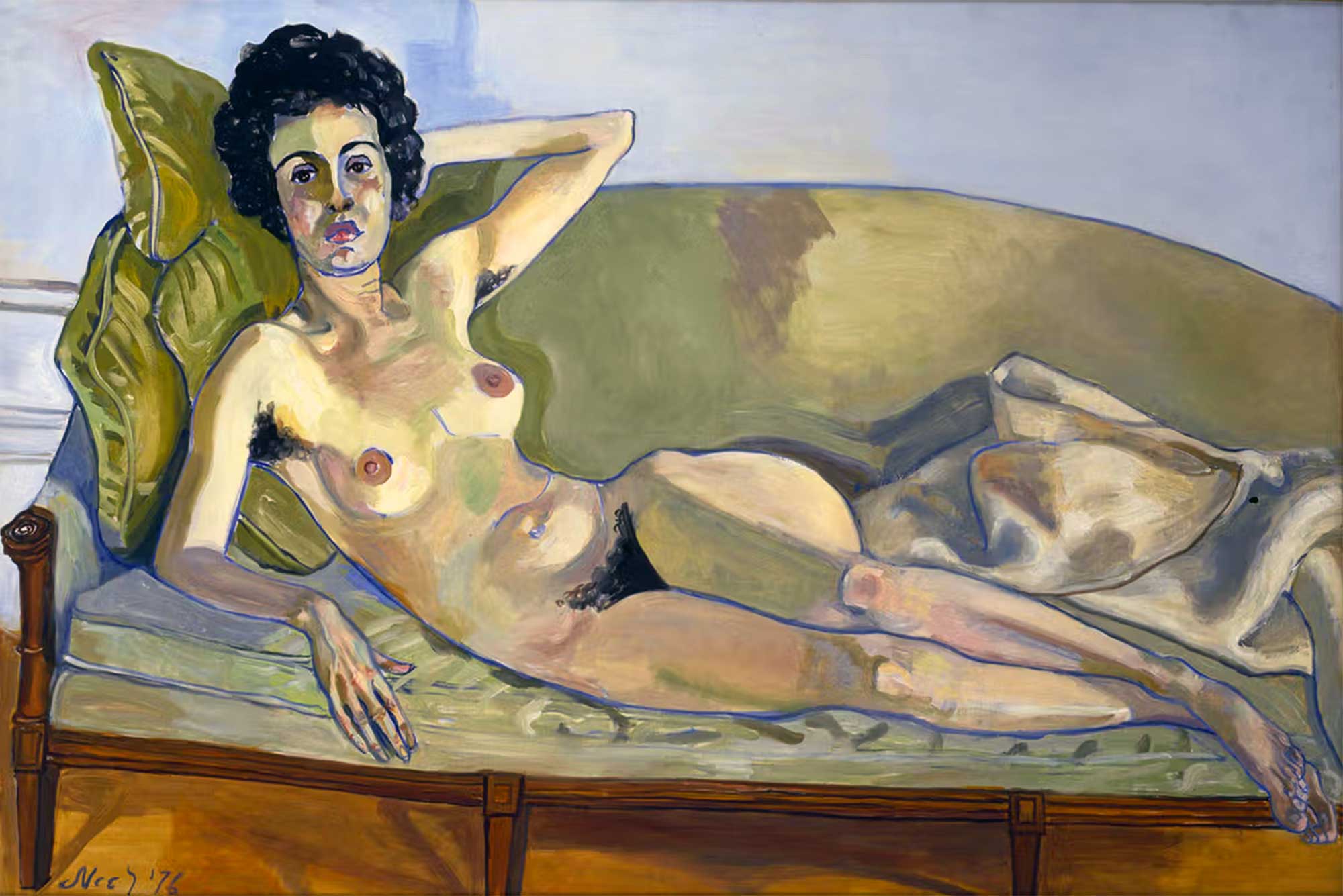
Alice Neel, Lucile Rhodes, 1976, Oil on canvas, 40 x 60 1/8 in. (101.6 x 152.7 cm), © The Estate of Alice Neel, Courtesy the Estate of Alice Neel and Victoria Miro
Alice Neel’s Lucile Rhodes (1976) captures the filmmaker with the psychological acuity and unvarnished directness that define Neel’s late portraits. Painted during a period when Neel was finally receiving broader recognition, the work reflects her commitment to portraying women with emotional truth rather than idealization. Rhodes sits upright rather than reclining, yet the portrait participates in the same feminist redefinition of representation that reshaped the reclining nude in the 1970s. Neel emphasizes Rhodes’s alert gaze, angular posture, and the tension between vulnerability and self‑possession, refusing the softened, compliant femininity that dominated earlier depictions of women. This approach aligns with Neel’s broader practice of depicting women as fully conscious subjects—aware of being seen, resistant to objectification, and grounded in their own interiority. The portrait becomes a record of presence rather than display, offering a counter‑image to the passive, idealized bodies that had long structured the visual history of women.
Mapplethorpe, Lisa Lyon, 1980
Robert Mapplethorpe’s Lisa Lyon (1980) reimagines the reclining nude through the sculptural authority of a female bodybuilder whose physique defies the traditional codes of softness and passivity. Lyon’s body—taut, muscular, and posed with classical deliberation—becomes a site where strength and eroticism converge, challenging the gendered expectations embedded in centuries of reclining‑female imagery. Mapplethorpe’s immaculate black‑and‑white photography heightens the sense of monumentality: the crisp lighting carves the body into marble‑like planes, while the controlled studio setting transforms Lyon into a contemporary Athena, both sensual and formidable. In this work, the reclining nude becomes a declaration of agency, a body that commands rather than invites the gaze, marking a pivotal moment when modern portraiture and feminist self‑presentation reshape the lineage of the nude.
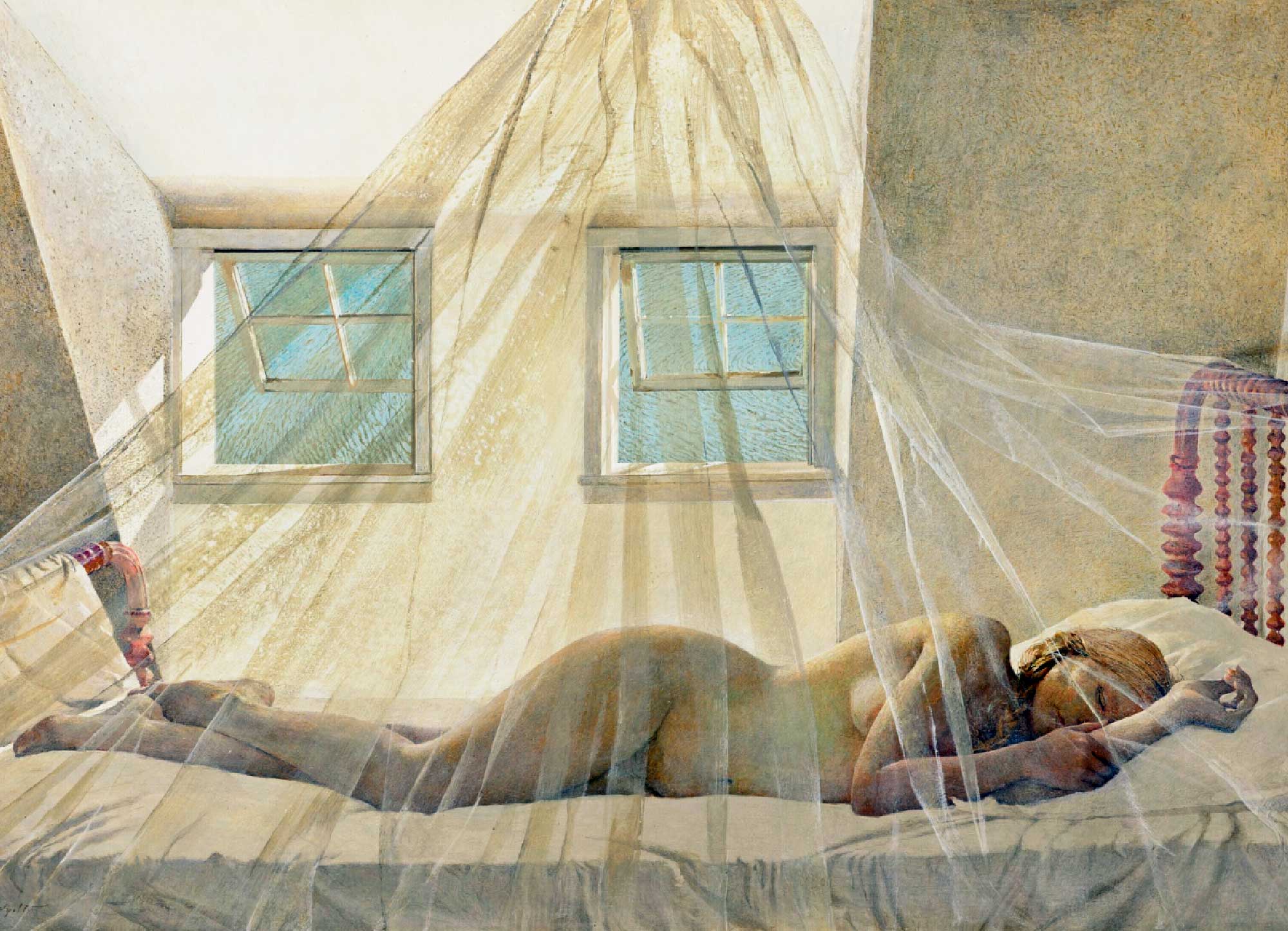
Andrew Wyeth, Day Dream, 1980, Tempera on panel, Private Collection, 48.3 x 69.2 cm. (19 x 27.2 in.), Hammer Museum, Los Angeles
Andrew Wyeth’s Day Dream (1980) belongs to the late‑twentieth‑century evolution of the reclining nude, where intimacy, atmosphere, and psychological quiet replace overt sensuality. The painting depicts a nude woman lying on her side on a bed, enveloped in soft natural light that filters through two windows and diffuses across the room. Wyeth’s tempera technique heightens the tactile realism of the linens, the gauzy drapery cascading from above, and the faint textures of the interior, creating a setting that feels suspended between waking and reverie. The figure’s pose is unguarded rather than erotic, her body integrated into the stillness of the space, turning the scene into a meditation on solitude, vulnerability, and the quiet drama of interior life. In this work, the reclining nude becomes a vessel of introspection, rendered with the contemplative precision that defines Wyeth’s realism.
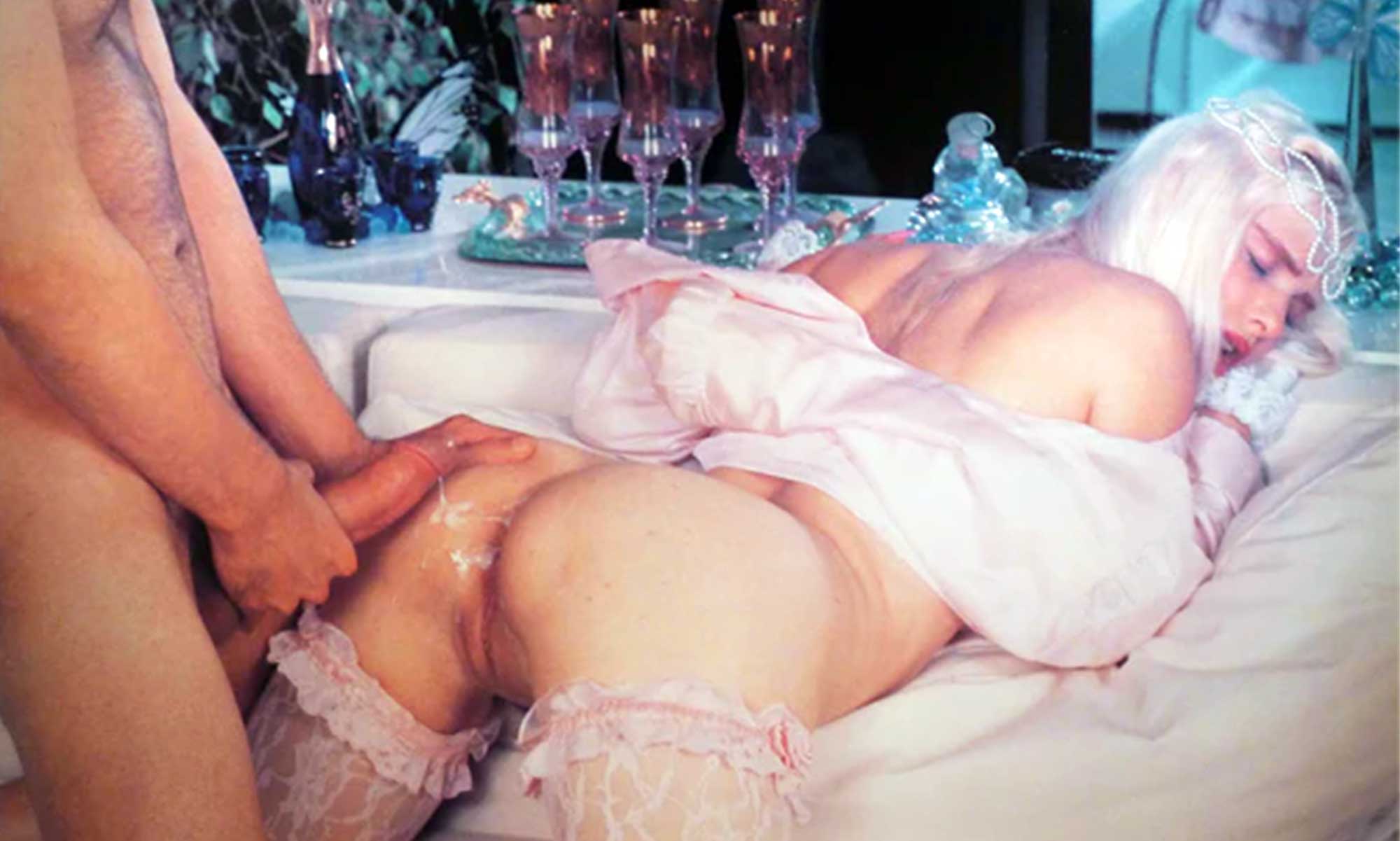
Jeff Koons, Made in Heaven series, 1989, Gagosian Gallery, New York
Jeff Koons’s Made in Heaven series (1989) detonates the historical conventions of the reclining nude by staging explicit sexual encounters between the artist and Ilona Staller (Cicciolina) with the glossy perfection of luxury advertising. The bodies—posed in variations of classical and pornographic tableaux—are rendered with a hyper‑polished, almost devotional sheen that collapses distinctions between sacred and profane, art and commodity, intimacy and performance. Koons inserts himself directly into the lineage of the nude, not as observer but as participant, turning the gaze inside out and exposing the machinery of desire, celebrity, and spectacle that undergirds late‑century visual culture. In these works, the reclining nude becomes a site of radical transparency: a body engineered for confrontation, where the erotic is neither veiled nor symbolic but staged with clinical, disarming candor. Made in Heaven marks a decisive rupture in the genealogy of the nude, replacing idealization with spectacle and transforming the genre into a mirror of contemporary media saturation.
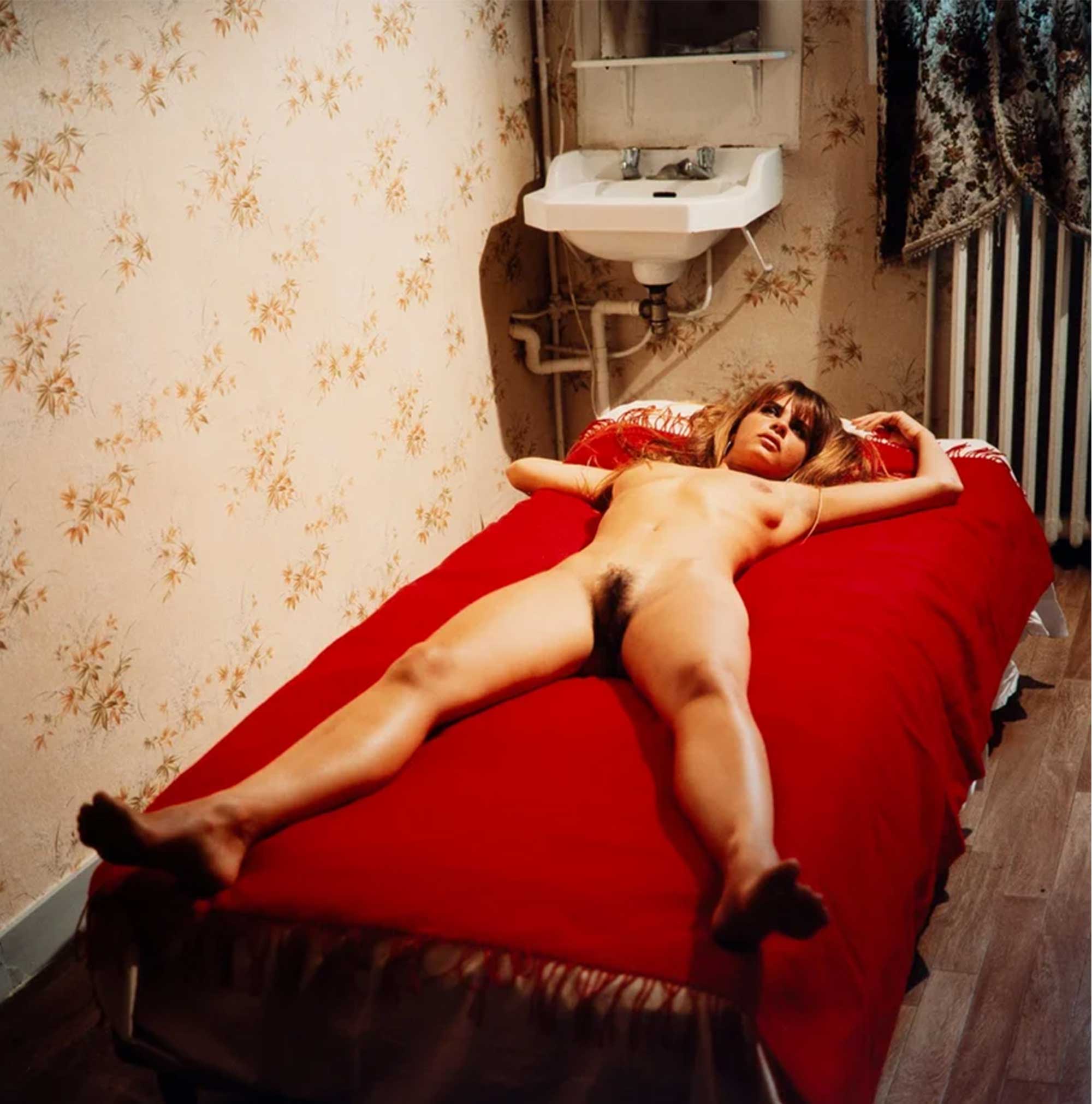
Bettina Rheims, 29 Octobre, Paris, 1991, Dye bleach photograph, 30 × 30 in | 76.2 × 76.2 cm, Edition 1/3
Bettina Rheims’s 29 Octobre, Paris (1991) reframes the reclining female figure through the charged, cinematic glamour that defines her early‑1990s portraiture. The model’s body—poised between languor and alert self‑presentation—occupies a space shaped as much by attitude as anatomy, its contours sharpened by Rheims’s signature high‑key lighting. The setting, unmistakably urban and faintly theatrical, situates the nude within a world of fashion, artifice, and self‑constructed identity rather than classical repose. Rheims’s photograph turns the reclining pose into a performance of agency: the subject is not offered to the gaze but meets it, aware of the camera’s power and her own. In this work, the nude becomes a contemporary icon—stylized, self‑possessed, and inseparable from the visual culture of desire and display that defined the early 1990s.
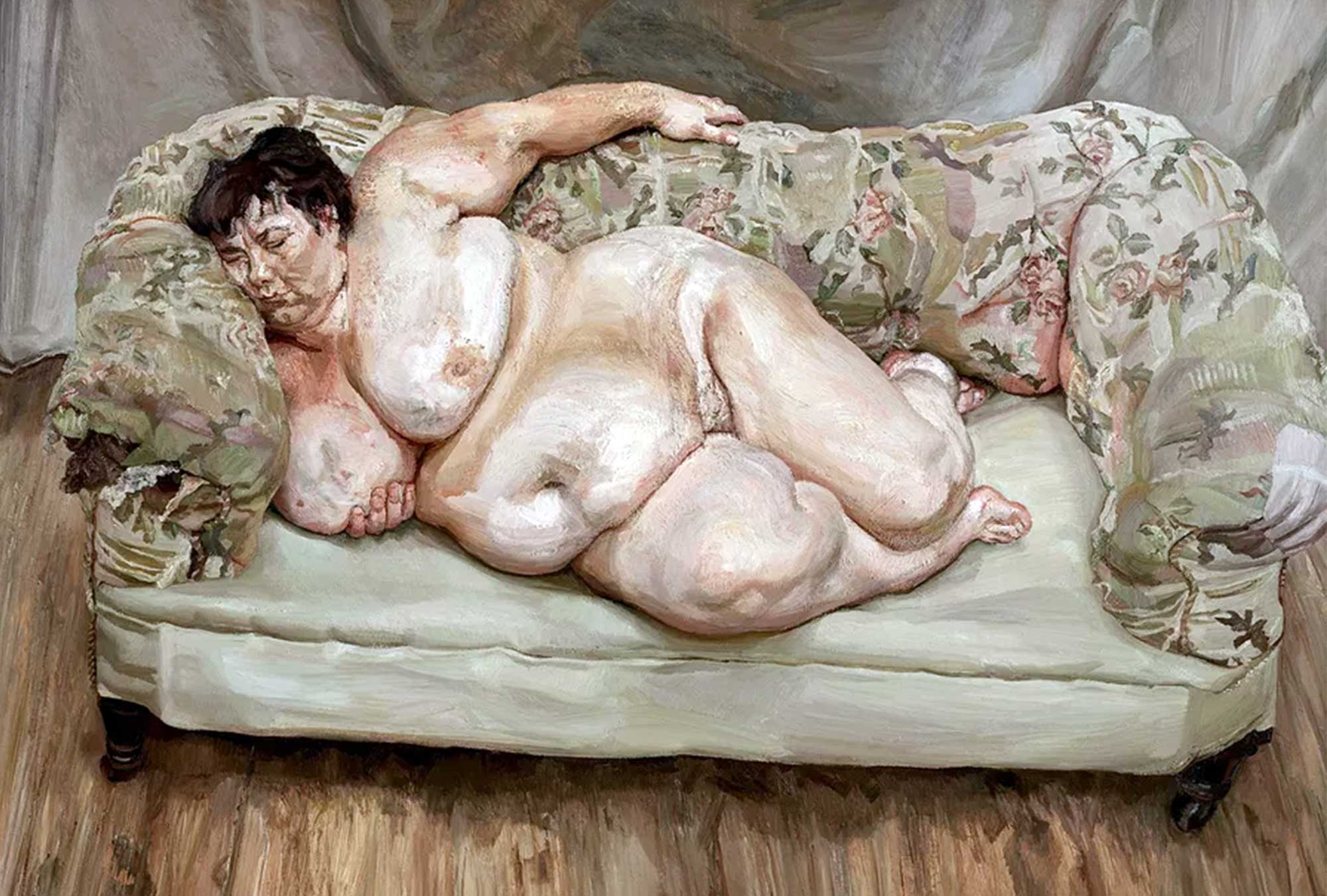
Lucian Freud, Benefits Supervisor Sleeping, Oil on canvas, 1995, 151.3 cm × 219 cm (59.6 in × 86 in), Private collection
Lucian Freud’s Benefits Supervisor Sleeping (1995) confronts the tradition of the reclining nude with an unflinching, corporeal gravity that strips the genre of idealization. Sue Tilley’s body—vast, unapologetically present, and rendered with Freud’s dense, tactile impasto—lies sprawled across a sagging sofa, her flesh modeled as landscape rather than ornament. The pose suggests sleep, but the painting’s psychological charge comes from its radical honesty: every fold, weight, and contour is observed with a near‑forensic tenderness that resists both eroticism and judgment. Freud transforms the reclining nude into a meditation on embodiment itself, insisting on the dignity and complexity of a body long excluded from the canon’s narrow ideals. In this work, the nude becomes a site of truth rather than fantasy, a monumental assertion of presence that redefines what it means to look—and to be looked at—in the late twentieth century.
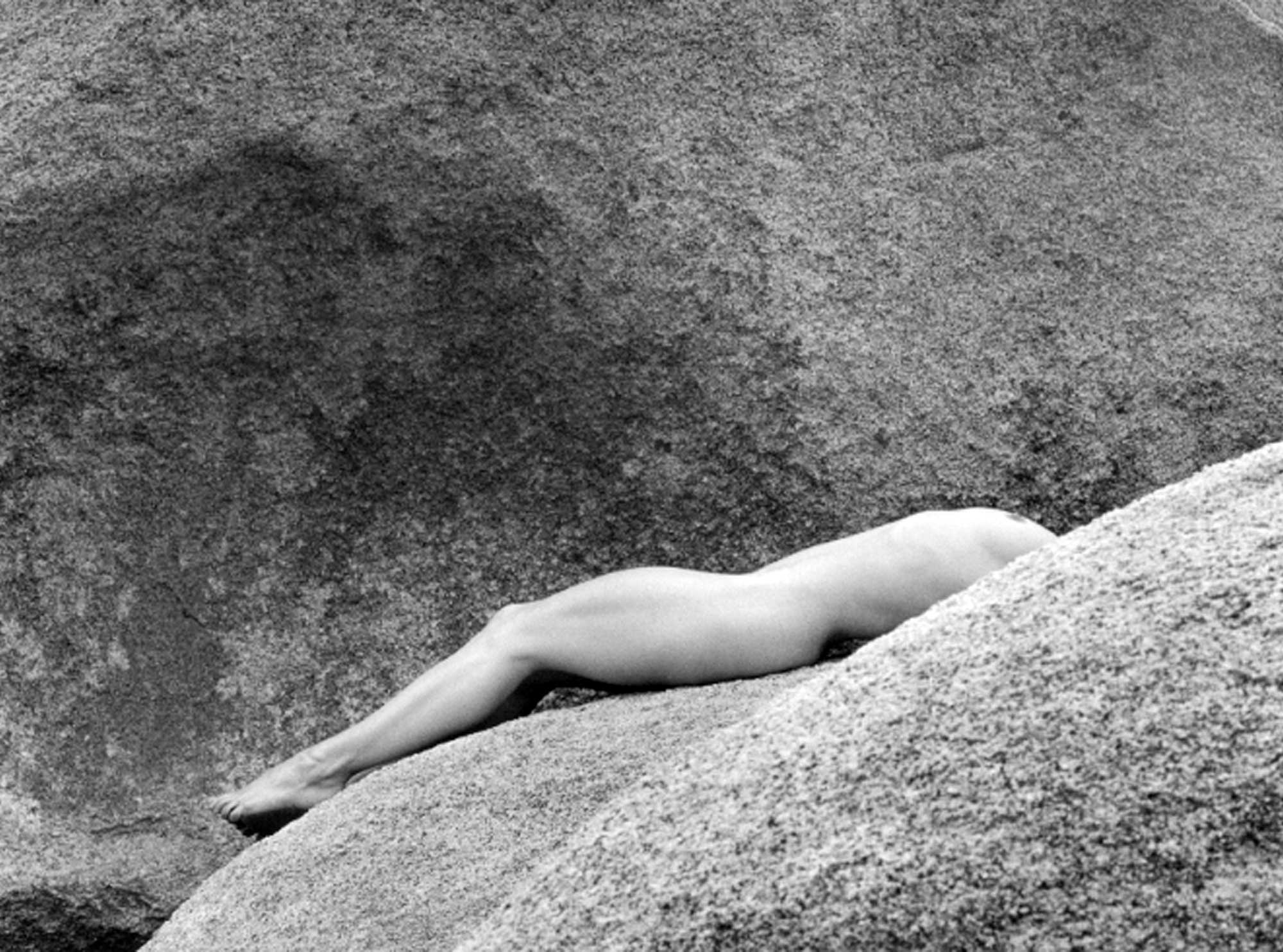
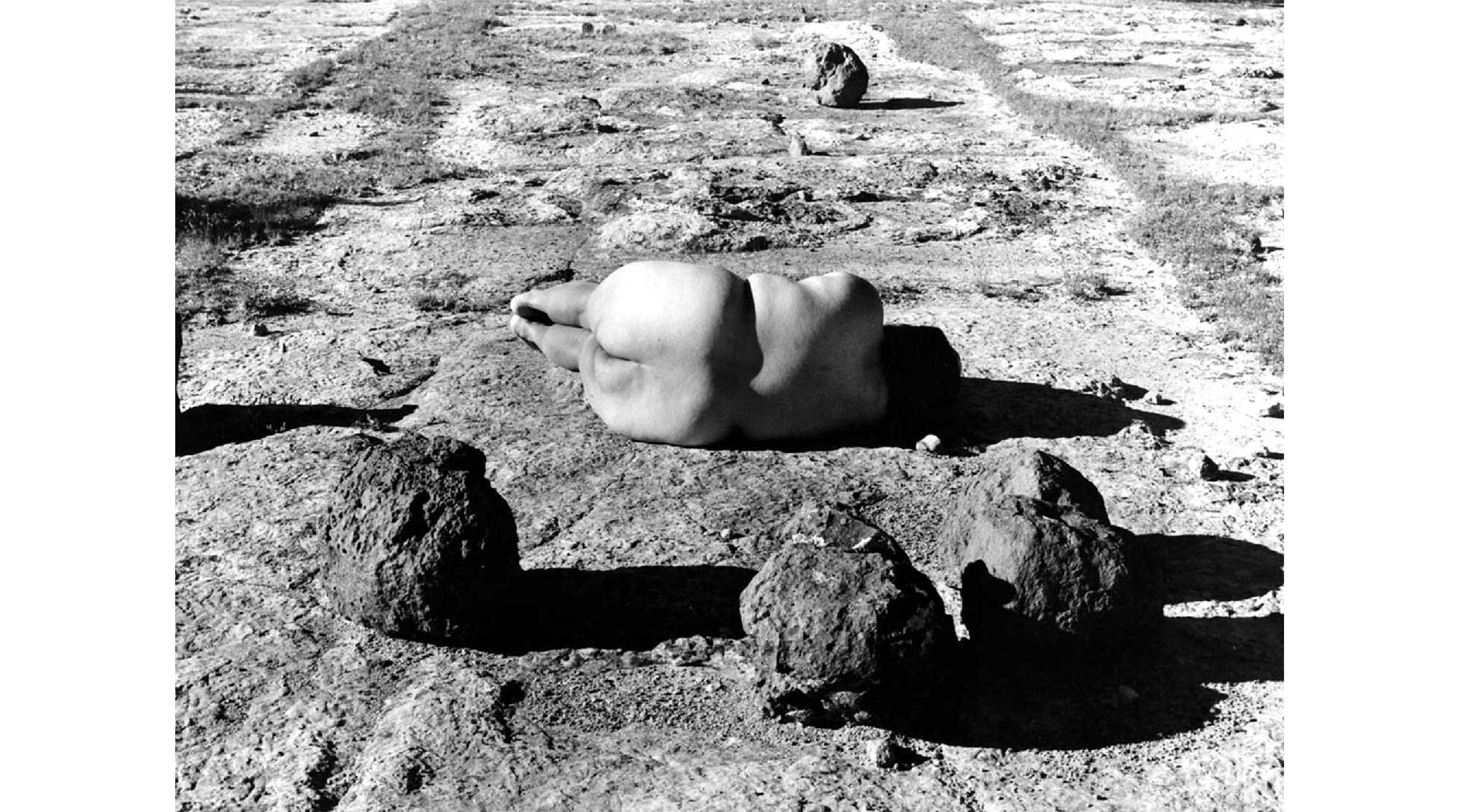
Laura Aguilar, Nature Self-Portrait #2, 1996, gelatin silver print. Copyright Laura Aguilar Trust  Laura Aguilar’s Nature Self-Portrait #2 (1996) places her nude body within a stark desert landscape, using the earth itself as both setting and collaborator. In this photograph, Aguilar lies on her side among boulders, her form echoing the shapes and shadows of the rocks around her. The composition creates a powerful visual equivalence between body and terrain, suggesting that her presence is not imposed on the landscape but emerges from it. This merging of figure and environment reflects Aguilar’s broader exploration of identity as a queer Chicana woman, using the natural world as a space of grounding, introspection, and reclamation. Rather than conforming to the idealized norms of the traditional nude, her body becomes sculptural, monumental, and deeply connected to place. The work challenges conventional beauty standards and reframes the reclining figure as an assertion of belonging—an intimate, vulnerable, and quietly radical act of self‑representation.
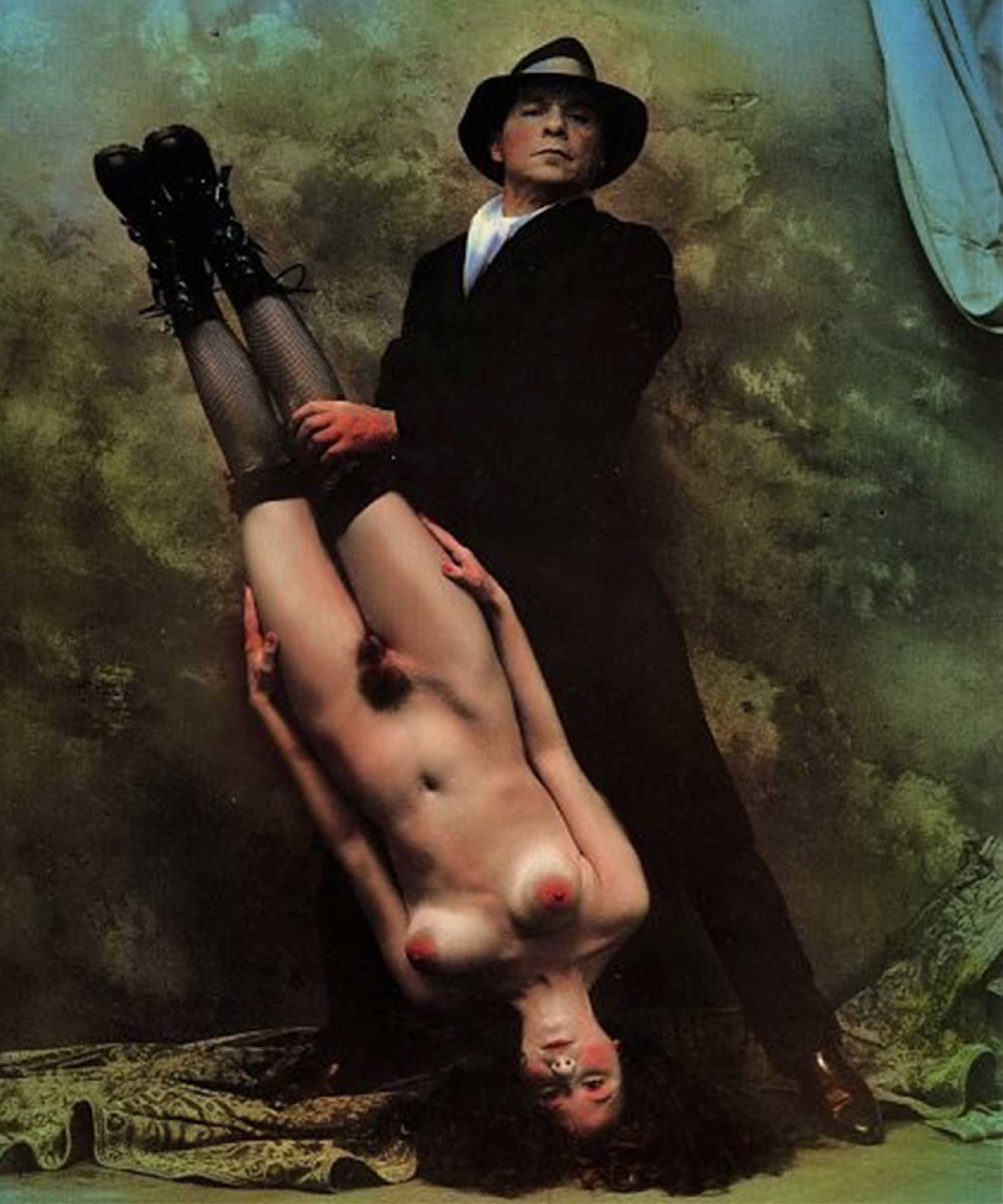
Jan Saudek, White Flesh Mergant, 1997
Jan Saudek’s White Flesh Mergant (1997) stages the reclining nude as a feverish, hyper‑stylized vision suspended between erotic fantasy and moral fable. The model’s pale body—posed with deliberate artifice against Saudek’s signature hand‑painted backdrop—glows with an almost spectral luminosity, its softness heightened by the photographer’s saturated, dreamlike palette. Yet the scene is never simply sensual: Saudek’s cramped, stage‑like space and his use of symbolic props infuse the composition with unease, as if the body were caught in a tableau of desire, vulnerability, and theatrical self‑exposure. The reclining pose becomes a site of psychological tension rather than repose, a body both offered and withheld, framed by the photographer’s unmistakable blend of kitsch, allegory, and emotional rawness. In this work, the nude becomes a charged emblem of late‑twentieth‑century introspection—lush, unsettling, and steeped in Saudek’s peculiar mixture of tenderness and provocation.
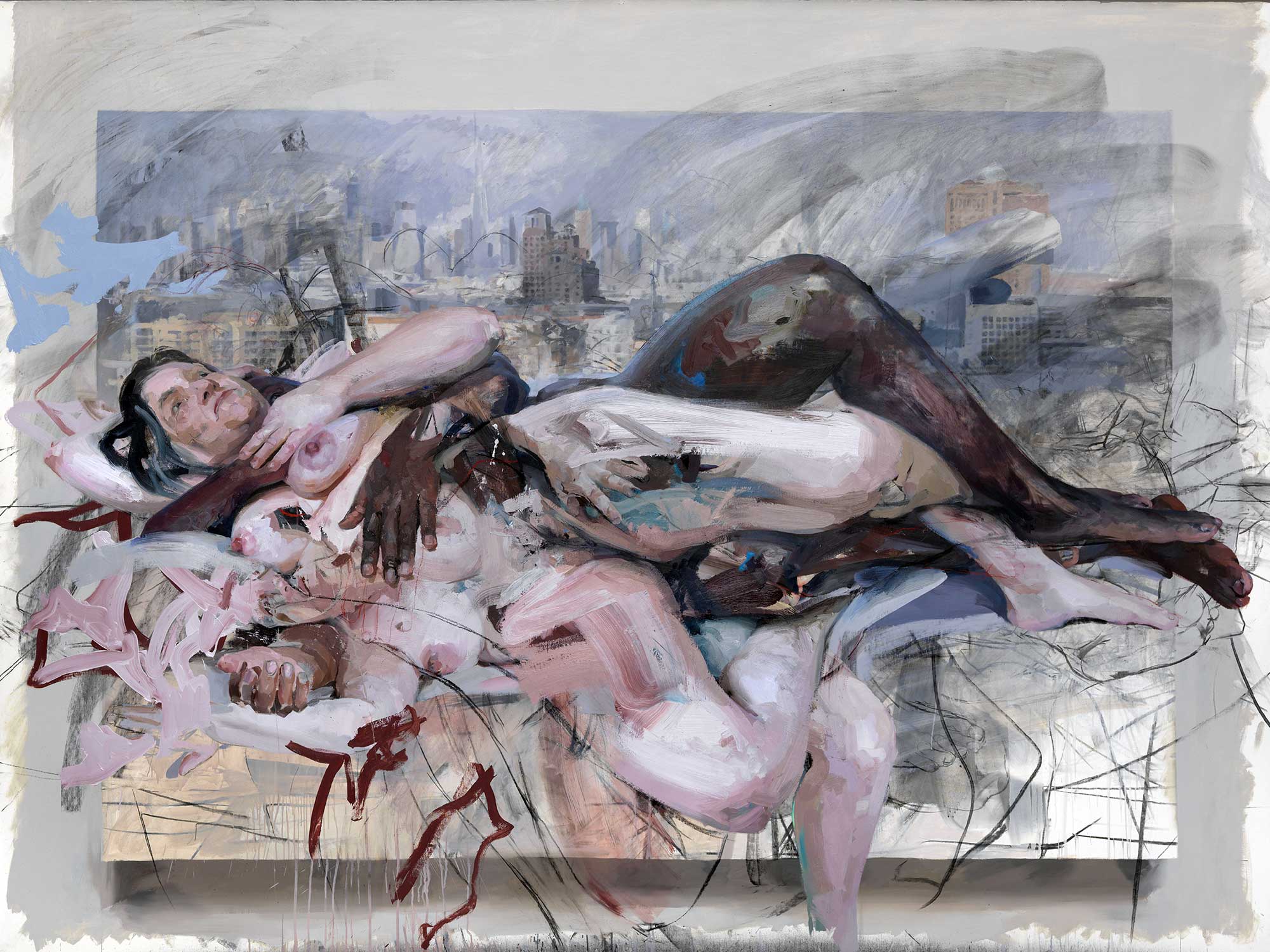
Jenny Saville, Olympia, 2013 – 2014, Charcoal and oil on canvas, 217 x 290 cm, ©Jenny Saville, Courtesy of the artist and Gagosian Gallery
Jenny Saville’s Olympia (2013–2014) reclaims one of the most charged poses in art history by confronting the legacy of Manet’s Olympia with a monumental, unidealized female body rendered in charcoal and oil. The work—measuring roughly 217 × 290 cm—presents a reclining figure whose flesh is layered, smudged, and reworked, emphasizing weight, presence, and the physicality of paint itself. Rather than offering a smooth, consumable nude, Saville builds a body that resists the viewer’s gaze, asserting agency through scale, density, and the refusal of perfection. Her gestural marks and overlapping contours create a sense of motion and multiplicity, as if the figure is simultaneously forming and dissolving, alive in the act of becoming. This approach overturns the traditional reclining nude by foregrounding the realities of flesh—its folds, tensions, and vulnerabilities—while reclaiming the pose as a site of female authorship rather than male fantasy. In Saville’s hands, Olympia becomes a contemporary feminist counter‑monument: a body that dominates the frame, confronts the viewer, and insists on its own complexity.
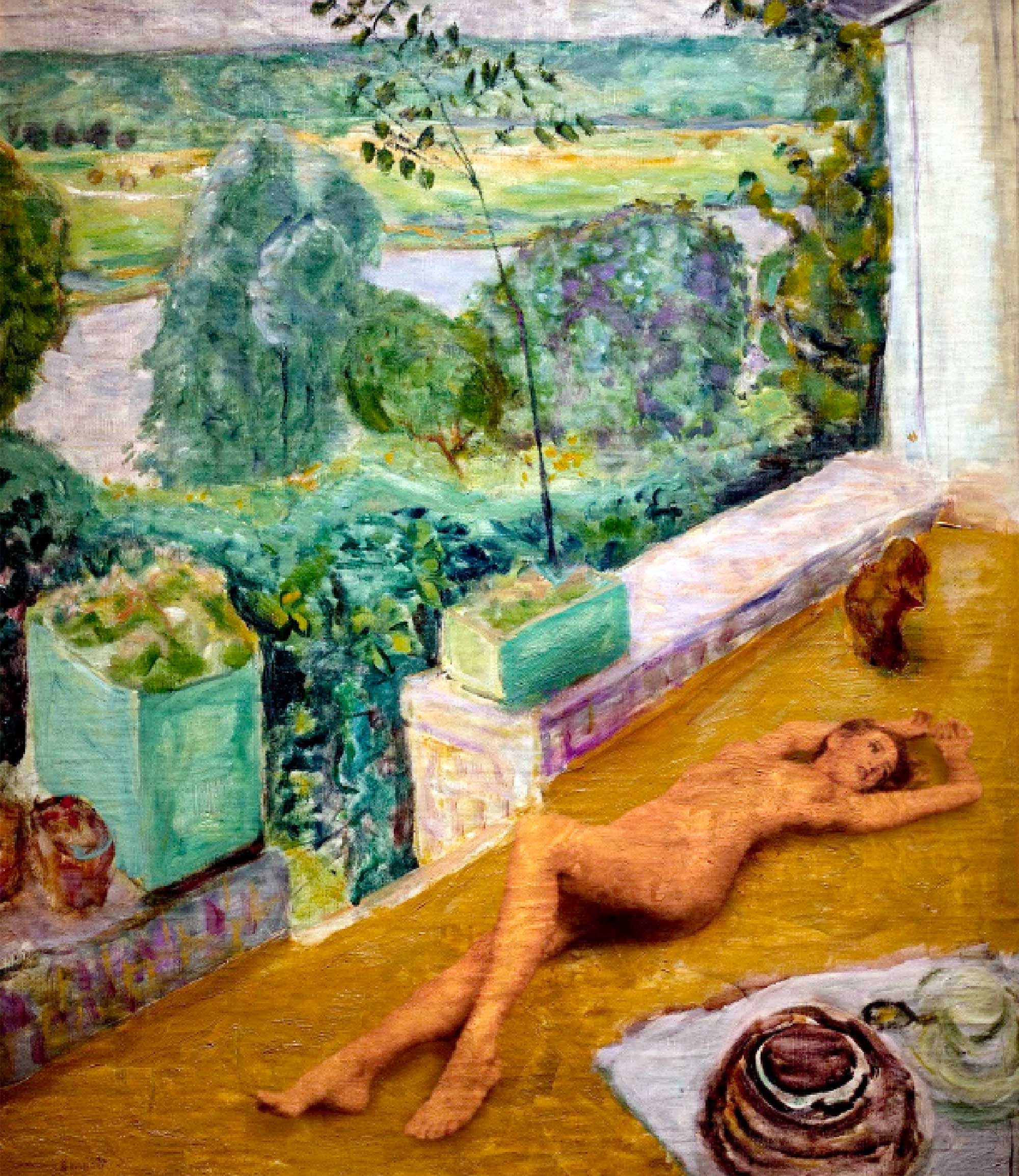
Dahmane, Camille, Pierre Bonnard, 2016, Photomontage original, tiré sur papier baryté, 90 x 78,5 cm. Signé et numéroté par l’artiste. Edition de 7. © Dahmane. Courtesy Galerie Claude Lemand, Paris
Dahmane, Camille, Pierre Bonnard, 2016, photomontage reimagines the reclining nude through a distinctly contemporary lens, merging photographic immediacy with the chromatic sensuality of Bonnard’s late interiors. By layering and digitally suturing multiple exposures, Dahmane creates a figure that seems to hover between presence and dissolution—an echo of Bonnard’s own tendency to let bodies melt into their surroundings as seen in this collection; Nude in the Bath and Small Dog, 1946. The reclining form is both intimate and elusive, its contours softened by the montage process in a way that recalls Bonnard’s shimmering, unstable surfaces. Yet the work is unmistakably modern: the photographic body asserts a physicality and vulnerability that resists the painterly idealization of earlier nudes. In this hybrid image, Dahmane transforms the reclining figure into a site of temporal collision, where Bonnard’s domestic reveries meet the fractured, hyper‑visual language of the digital age.
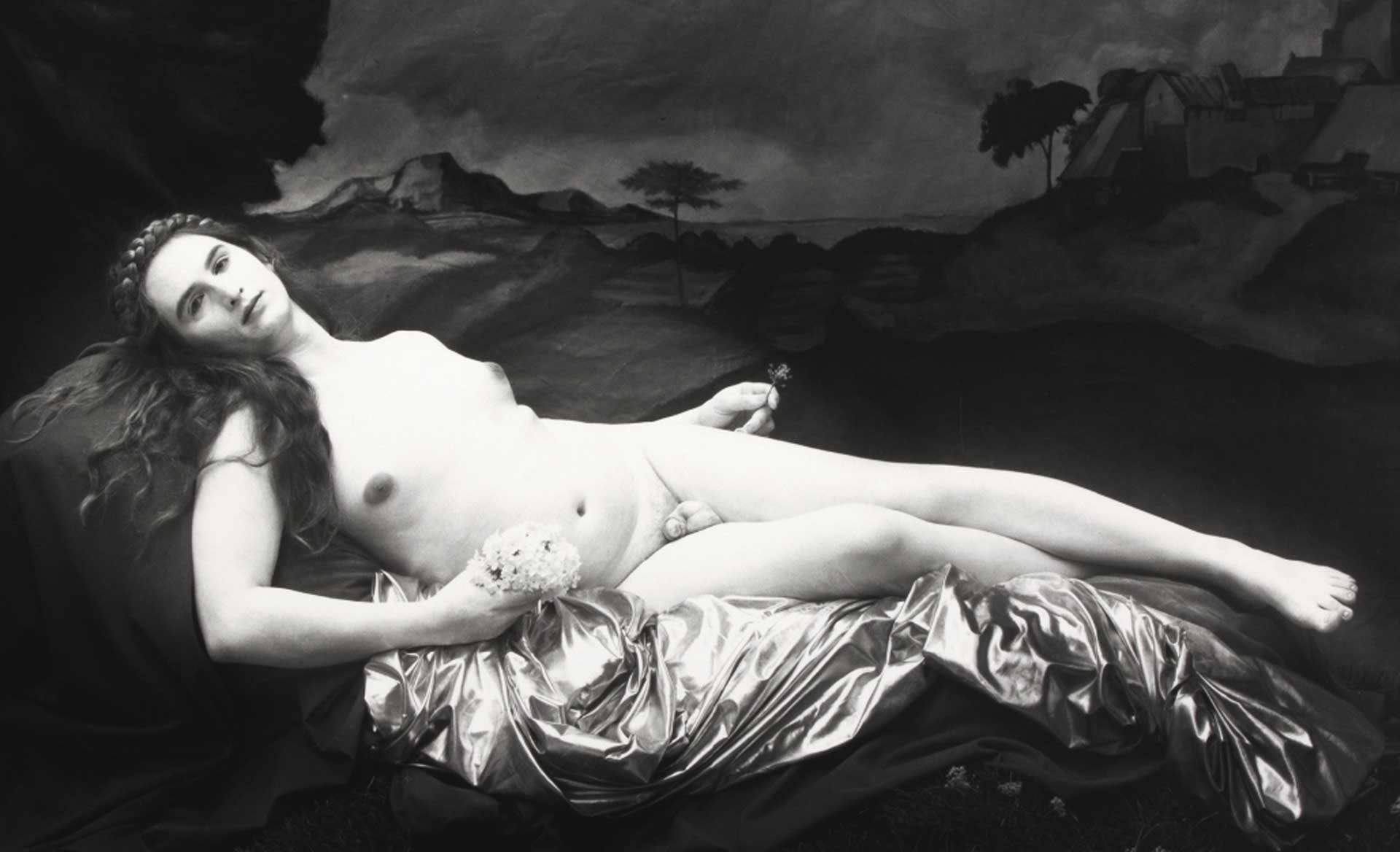
Joel-Peter Witkin, Venus of Five Points, New Mexico, 2019, Gelatin silver print, 16 × 20 in | 40.6 × 50.8 cm, Edition 1/15 Joel-Peter Witkin's Venus of Five Points (2019), more than five centuries after Giorgione’s Sleeping Venus (1510) helped define the Western ideal of the reclining nude, Joel‑Peter Witkin offers a strikingly subversive reinterpretation. By casting a transgender model and reconstructing Giorgione’s pastoral landscape with near‑archaeological precision, he stages a deliberate collision between Renaissance ideals and contemporary understandings of the body. The serene, perfected Venus of the early sixteenth century becomes, in Witkin’s hands, a figure who resists the classical canon rather than embodying it. His version exposes how tightly beauty, gender, and mythology were once policed—and how radically those boundaries have shifted. In an age when artistic norms have expanded and long‑held conventions have loosened, Witkin’s reimagined Venus demonstrates how enduring motifs can be unsettled, recharged, and made newly provocative.
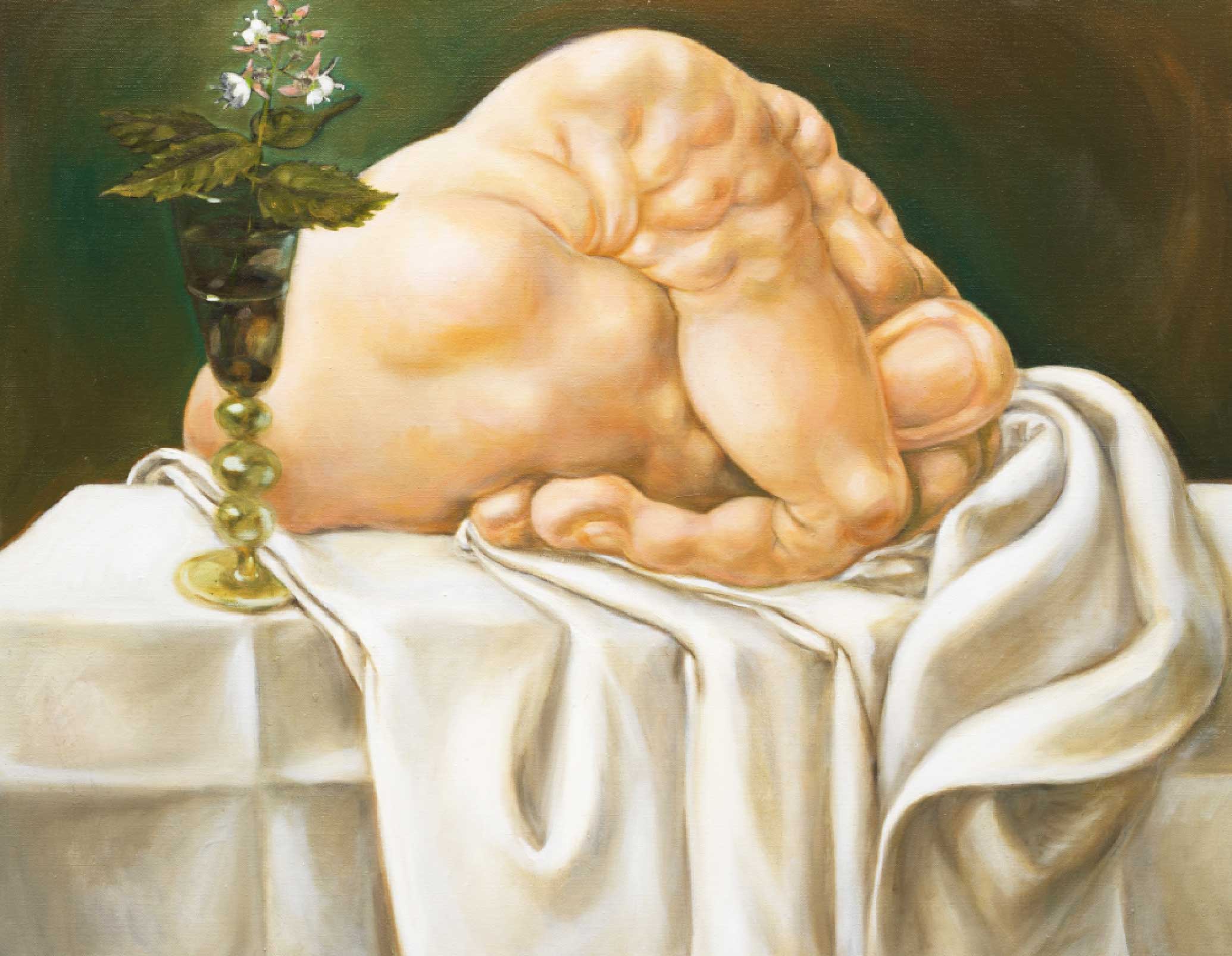
Louise Bonnet, Enchanter’s Nightshade, 2023, Oil on linen, 30 x 40 inches (76.2 x 101.6 cm), Photo: Christopher Burke, Courtesy the artist and Gagosian Gallery, New York Louise Bonnet, Enchanter’s Nightshade, 2023, pushes the reclining nude into the realm of the grotesque sublime, where desire, shame, and bodily distortion coexist in uneasy harmony. Her monumental, swollen forms—at once comic and tragic—refuse the classical ideal and instead expose the body as a site of psychic pressure, vulnerability, and unruly emotion. The figure’s exaggerated limbs and taut, ballooned flesh evoke both Baroque excess and cartoon elasticity, collapsing high and low visual languages into a single, unsettling presence. Bonnet’s palette—lush yet bruised—intensifies the sense of internal turbulence, while the title’s reference to a poisonous woodland plant hints at enchantment, toxicity, and the darker undercurrents of embodiment. In this work, the reclining pose becomes a stage for the grotesque as a mode of truth‑telling, a contemporary counter‑myth that dismantles the fantasy of the serene, available nude and replaces it with a body that feels, suffers, and resists. Conclusion Across five centuries, the reclining nude has proven to be one of art history’s most durable and revealing forms—a stage on which beauty, power, desire, and cultural ideology are continually rehearsed and contested. What began as a Renaissance fiction of divine serenity evolved into a modern arena where artists exposed the mechanics of looking, questioned inherited fantasies, and confronted the unequal structures embedded in the genre itself. For the women’s movement, the reclining nude became both a symbol of the problem and a site of reclamation: a reminder of how often women’s bodies were framed for others, and a catalyst for artists who insisted on authorship, agency, and self‑representation. Contemporary practitioners—across painting, photography, performance, and digital media—no longer accept the pose as a passive tradition. They rework it, resist it, parody it, or inhabit it on their own terms, transforming a once‑static motif into a living conversation about identity, autonomy, and the politics of visibility. The reclining nude endures not because it is timeless, but because it is endlessly reinterpreted. Each generation returns to the figure to test its limits, expose its assumptions, and imagine new possibilities for the body in art. In this ongoing reinvention, the genre becomes less a fixed image than a cultural mirror—reflecting who we are, what we desire, and how we choose to see. Key Texts
  • Gardner’s Art Through the Ages, The definitive survey text book for art history
  • Linda Nochlin, Women, Art, and Power
  • Griselda Pollock, Vision and Difference
  • John Berger, Ways of Seeing
  • Laura Mulvey, “Visual Pleasure and Narrative Cinema”
  • T.J. Clark, The Painting of Modern Life
  • Amelia Jones, Body Art/Performing the Subject
Website & Content Created by Richard Brafford, © 2025, All Rights Reserved, Fair Use Disclaimer for Non-Commercial Use for Educational & Entertainment Purposes OnlyTop